
00 Simple MIDI
Simple MIDI turns the Computer into a simple USB MIDI interface that sends and receives MIDI over the front USB-C connection. It is also used to calibrate the outputs on the Workshop Computer.
Panel
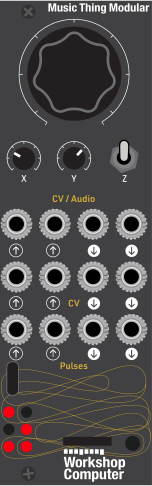 CC 34CC 35CC 36CV 38CV 39CC 40CC 41CH 1 CC 42CH 2 CC 42CH 1 Note CVCH 2 Note CVCH 1 Note OnCH 2 Note On
Controls
CC 34
Main knob position sent to the host as MIDI CC 34
CC 35
X knob position sent to the host as MIDI CC 35
CC 36
Y knob position sent to the host as MIDI CC 36
CC 37: Normal: switch position is sent to the host as MIDI CC 37
Startup Calib: Hold the switch down and press Load to enter output calibration mode
Inputs & Outputs
Inputs
Outputs
Inputs
CV 38
CV input sent to the host as MIDI CC 38
CV 39
CV input sent to the host as MIDI CC 39
CC 40
CV input sent to the host as MIDI CC 40
CC 41
CV input sent to the host as MIDI CC 41
Outputs
CH 1 CC 42
Channel 1 Continuous Controller 42 values output as full-range CV
CH 2 CC 42
Channel 2 Continuous Controller 42 values output as full-range CV
CH 1 Note CV
Channel 1 MIDI notes become calibrated pitch CV
CH 2 Note CV
Channel 2 MIDI notes become calibrated pitch CV
CH 1 Note On
Note on and off events for MIDI notes on Channel 1
CH 2 Note On
Note on and off events for MIDI notes on Channel 2
LEDs
CH 1 CC
Brightness shows Channel 1 CC activity
CH 2 CC
Brightness shows Channel 2 CC activity
CH 1 Pitch
Brightness shows Channel 1 pitch activity
CH 2 Pitch
Brightness shows Channel 2 pitch activity
CH 1 Gate
Indicates gate output activity for Channel 1
CH 2 Gate
Indicates gate output activity for Channel 2
README
Simple MIDI
Simple MIDI turns the Music Thing Modular Workshop Computer into a USB MIDI interface. It sends controls and CV from the Workshop System to a computer, and turns incoming MIDI notes, gates, and continuous-controller messages into CV and gate signals.
It is also the card used to calibrate the Workshop Computer's two precision CV outputs. Other cards, including Turing Machine and Reverb+, can use the saved calibration data so that their pitch outputs play in tune.
Simple MIDI was written by Tom Whitwell in Herne Hill, London, between October 2024 and October 2025.
What it does
Simple MIDI receives two channels of MIDI from a connected computer:
- Note pitch
- Note on/off gates
- Continuous Controller 42
It sends eight controls from the Workshop System back to the computer:
- Main, X, and Y knobs
- The Z switch
- Both Audio/CV inputs
- Both precision CV inputs
The Workshop System appears on the connected computer as Workshop System MIDI or Music Thing Workshop System MIDI.
Watch the 90-second Simple MIDI introduction on Instagram.
Connecting to a computer
- Connect the Workshop Computer's front-panel USB-C port to a computer running a MIDI sequencer or DAW.
- Cycle the Workshop System's power. Power cycling, rather than only pressing Reset, ensures that the Workshop Computer detects the USB host.
- Insert the Simple MIDI card with its gold connector facing down.
- Press the small Reset/Load button beside the Program Card slot.
- The LEDs should blink briefly and then stop.
- Select Workshop System MIDI or Music Thing Workshop System MIDI in your DAW or MIDI software.
If the LEDs continue blinking, the USB connection has not been established:
- Turn the Workshop System off and on again.
- Check that the USB cable supports data. Some USB-C cables provide power only.
- Try another USB port or cable.
The Workshop Computer does not need to connect to a USB-C socket on the host; a USB-A-to-USB-C data cable is also suitable.
MIDI controls
Workshop System to computer
| Workshop Computer control | MIDI message |
|---|---|
| Main knob | CC 34 |
| X knob | CC 35 |
| Y knob | CC 36 |
| Z switch | CC 37 |
| Audio/CV In 1 | CC 38 |
| Audio/CV In 2 | CC 39 |
| CV In 1 | CC 40 |
| CV In 2 | CC 41 |
Computer to Workshop System
| Workshop Computer output | MIDI input |
|---|---|
| Audio/CV Out 1 | Channel 1, CC 42 |
| Audio/CV Out 2 | Channel 2, CC 42 |
| CV Out 1 | Channel 1 note pitch |
| CV Out 2 | Channel 2 note pitch |
| Pulse Out 1 | Channel 1 note on/off |
| Pulse Out 2 | Channel 2 note on/off |
Calibrating the Workshop Computer
For full details on how to calibrate the Workshop Computer and Workshop System oscillators, see the complete Workshop System calibration guide.
Using the calibration data
For more details check the Technical notes