
103 SPECTRAL
SPECTRAL runs a live FFT over Audio In 1 and divides the spectrum into 4 to
128 LOGARITHMICALLY spaced bands. Every band gets a random gain, re-rolled
on a trigger and smoothed over time; bands below a threshold shut entirely.
Bands opening and closing is the sound — a high-resolution filter bank that
keeps morphing but stays musical, because the divisions are logarithmic
rather than linear.
It is a spectral filter, not a granular processor and not a reverb. Feed it
anything sustained — pads, drones, noise, feedback, a whole mix — and it
carves moving holes in the spectrum. Low band counts (4–8) give broad
obvious sweeps, close to a random multi-band gate. High counts (64–128)
give fine shimmering comb-like textures. Slow smoothing lets bands drift
open and shut like weather; fast smoothing makes them snap, which with a
fast re-roll rate becomes a stuttering spectral gate.
TEXTURE randomises the phase of every bin, smearing transients into a
diffuse wash — the part that earns the "clouds" name. FREEZE holds the
current magnitude spectrum while still tracking incoming phase, so a held
sound stays alive instead of becoming a static drone. That makes it an
effect ON a signal rather than a sampler: the input keeps supplying phase
while frozen, so pulling the patch cable thins the sound out rather than
sustaining it, and freezing during a gap holds a correspondingly quiet
spectrum. A short press on the momentary Down position toggles that
freeze; HOLDING Down for two seconds instead selects SEALED freeze, which
holds each bin's phase advance as well as its magnitude — nothing of the
live input reaches the output (leak −69dB rather than −30dB) and the sound
sustains at full level with the input unplugged, as a held chord rather
than a static buzz. Any short press returns to live.
Both outputs carry the same wet signal. Mix the dry signal back externally,
and patch through a stereo effect downstream if width is wanted.
The switch's two stable positions select knob pages. Middle is page one:
Main sets PROBABILITY (how many bands are open), X sets BANDS (4–128), Y
sets SMOOTHING. Up is page two: Main sets TEXTURE, X sets RE-ROLL RATE, Y
sets OUTPUT LEVEL. Down is the spring-loaded momentary position and toggles
FREEZE on each press. Knobs are always live on the page you are looking
at. CV In 1 and 2 offset PROBABILITY and BANDS; Pulse In 1 re-rolls
the bands, Pulse In 2 freezes while held. CV Out 1 follows spectral density, and CV Out 2 reports the
measured DSP load so the headroom can be checked on a voltmeter.
ALT-BOOT: holding the switch DOWN at power-on starts TAPE mode, adding a
tape-style delay after the spectral engine — wow and flutter from two
detuned LFOs moving the read head up to 4ms, damping so repeats darken, and
a saturating feedback path. Page 2 becomes TIME, FEEDBACK and WOW; page 1 is
unchanged. Even LEDs show a normal boot, odd LEDs the alt-boot.
N=1024, hop 256 (75% overlap), sine window, running at 192MHz with all FFT
work on core 1 — the audio ISR only fills a ring. The band ratio the
original stores in a 127-entry table turned out to be exactly
size^(1/(k+1)), verified to 2e-10 against every entry, so it is computed
directly rather than shipped; that also makes it correct at this card's FFT
size rather than Clouds' larger one.
The fixed-point DSP is verified on the host as well as on hardware — FFT
accuracy, rect/polar conversion, overlap-add gain, ring timing, band layout
and the tape delay each have a test in tools/ (see docs/FFT_VALIDATION.md,
which documents the real bugs those tests caught). Flash 1.5%, RAM 70%, and
the DSP runs at about 68% of its per-frame budget at 192MHz — measured on
hardware and reported live on CV Out 2.
Panel
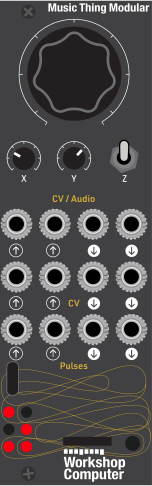 PROBABILITYBANDSSMOOTHINGInProbBandsRe-rollFreezeOutOutDensityDSP LoadRe-rollOpen Gate
Controls
PROBABILITY
How many bands are open. A density control rather than a volume one: most of the level arrives by about halfway, and the top half reads as increasing density and smoothness.
BANDS
4 to 128 logarithmically spaced bands. Low counts give broad obvious sweeps; high counts give fine comb-like textures.
SMOOTHING
How fast band gains morph. Snaps at the bottom of the range, then sweeps from about 50 ms to 2.6 s.
Page 2: Main, X and Y control TEXTURE, RE-ROLL RATE and OUTPUT LEVEL. In the TAPE alt-boot this page becomes TIME, FEEDBACK and WOW instead.
Page 1: Main, X and Y control PROBABILITY, BANDS and SMOOTHING - the performance controls.
Freeze: Briefly press Down to toggle freeze, which holds the magnitude spectrum while still tracking incoming phase. HOLDING Down for two seconds instead selects SEALED freeze, which holds each bin's phase advance as well, so nothing of the live input reaches the output. Any short press returns to live.
Inputs & Outputs
Inputs
Outputs
Inputs
In
The signal to process. Wants something sustained and harmonically rich - pads, drones, noise, cymbals, a whole mix. Percussion smears, since the analysis window is 1024 samples.
Prob
Summed with the Main knob on page one.
Bands
Summed with the X knob on page one.
Re-roll
Rising edge assigns every band a fresh random gain. With RE-ROLL RATE fully anticlockwise this is the only thing that changes them.
Freeze
Holds the magnitude spectrum while high, independently of the switch latch. Always the normal (leaky) freeze, never SEALED.
Outputs
Out
The filtered signal. Mono - both outputs carry the same thing.
Out
Duplicate of Audio Out 1.
Density
Follows how much of the spectrum is currently open.
DSP Load
Diagnostic. Measured core-1 load as a fraction of the per-frame budget; full scale means core 1 is exactly keeping up. Sits around 4V (about 68%) in normal use.
Re-roll
Fires on every re-roll, triggered or spontaneous.
Open Gate
High while more than half the spectrum is open.
LEDs
Density (low)
Density (mid)
Density (high)
Freeze
Steady for normal freeze, slow pulse for SEALED freeze.
Page 1
Lit on page one. At boot, LEDs 0, 2 and 4 light together for about three quarters of a second to show a normal boot.
Page 2
Lit on page two. At boot, LEDs 1, 3 and 5 light together to show the TAPE alt-boot.
README
SPECTRAL
A Spectral filter.
What it does
The card is a real-time spectral filter, not a granular processor and not a reverb.
- Low band counts (4–8) give broad, obvious sweeps, close to a random multi-band gate.
- High band counts (64–128) give fine, comb-like textures.
- Slow smoothing makes bands drift open and shut.
- Fast smoothing makes them snap, which with a fast re-roll rate becomes a stuttering spectral gate.
- TEXTURE randomises bin phases, smearing transients into a diffuse wash.
- FREEZE holds the current magnitude spectrum while still tracking incoming phase, so the held sound stays alive rather than becoming a static drone. See What freeze actually does — it is not a sampler, and it still needs the input.
Both outputs carry the same wet signal. Mix dry externally, and patch through a stereo effect downstream if you want width — the spectral movement itself is what carries the interest.
What to feed it
It needs sustained, harmonically rich material. The card carves moving holes in a spectrum, so it can only work with a spectrum that is actually there. The best sources:
- Pads, drones, held chords — the obvious win. Bands opening and closing over a sustained chord is exactly the effect.
- Noise — white/pink noise becomes pitched, shifting resonances. One of the most dramatic uses: BANDS low, SMOOTHING slow, and it turns noise into a slow chord progression.
- Feedback loops, cymbals, room tone, whole mixes — anything broadband and continuous.
- Distorted guitar, organ, bowed strings — sustained and harmonically dense.
What works poorly:
- Percussion and drums — 21 ms of latency plus a 1024-sample analysis window smears transients. You get a wash, not a beat.
- Sparse plucks, single notes with gaps — during the gaps there is nothing to filter, so the card falls silent and the effect is only heard on the decays.
- Sine waves and thin sounds — a single partial means one band is doing all the work; most of the filter has nothing to act on.
- Anything quiet — the effect scales with what comes in. Bring it to a healthy Eurorack level.
A good first patch: a noise source or a held chord into Audio In 1, BANDS at about 2 o'clock, SMOOTHING slow, PROBABILITY around 12 o'clock. Then sweep PROBABILITY and listen to the holes open and close.
Controls
The switch's two stable positions (Middle and Up) select between two knob pages. Knobs are always live.
Bottom left LED (4) lit = page 1, Bottom right LED (5) lit = page 2.
Switch MIDDLE — page 1
| Control | Parameter |
|---|---|
| Main | PROBABILITY — how many bands are open |
| X | BANDS — 4 to 128, logarithmically spaced |
| Y | SMOOTHING — how fast band gains morph: snap at the bottom, then 0.05 s to about 2.6 s |
Switch UP — page 2
| Control | Parameter |
|---|---|
| Main | TEXTURE — phase randomisation depth |
| X | RE-ROLL RATE — fully anticlockwise = never (Pulse In 1 only), then ~3 s up to continuous |
| Y | OUTPUT LEVEL — holds its current value until you actually move Y, so switching pages never drops the volume |
Switch DOWN — toggle freeze. Momentary position, so it acts as a button:
- Short press — toggle normal freeze (holds magnitudes, tracks live phase).
- Hold 2 seconds — SEALED freeze: holds phase as well, so nothing of the live input reaches the output. It engages at the 2 s mark, while you are still holding, so you get feedback without letting go. LED 3 pulses slowly in sealed mode, steady in normal.
- Any short press while frozen returns to live, whichever mode was active.
(Pulse In 2 freezes while held, and always uses normal freeze.)
| Jack | Function |
|---|---|
| Audio In 1 | signal to process |
| Audio Out 1 / 2 | wet output (mono, duplicated) |
| CV In 1 | added to PROBABILITY |
| CV In 2 | added to BANDS |
| Pulse In 1 | re-roll all band gains |
| Pulse In 2 | freeze while held |
| Pulse Out 1 | fires on every re-roll |
| Pulse Out 2 | high while more than half the spectrum is open |
| CV Out 1 | how much of the spectrum is currently open |
| CV Out 2 | measured DSP load diagnostic — full scale = 100% of the frame budget |
LEDs 0–2 show spectral density, LED 3 freeze (steady = normal, slow pulse = sealed), LEDs 4–5 the current page.
What to expect as you turn Main up
PROBABILITY is a density control, not a volume control, and the two halves of its travel do different things:
| Main | What you hear |
|---|---|
| low | sparse isolated resonant bands — pitched, gated, hollow; the source is barely recognisable |
| ~50% | the source clearly present with moving holes punched through it |
| high | nearly the full spectrum, with only a subtle shimmer of movement |
Most of the level arrives by about halfway (measured: 81% of the total energy by Main=50%). Above that you are opening more bands, but they are the quiet ones — so the top half reads as increasing density and smoothness, not as getting louder. That is how the effect works rather than a fault; if you want the top of the knob to feel more dramatic, turn SMOOTHING down so the band gains spread out again instead of clustering near the middle.
The lowest bins (below about 200 Hz) all share a single band rather than each getting their own at high band counts. Our bins are 46.9 Hz wide where Clouds' are 7.8 Hz, so without that merge a single band down there gates a whole bass partial on and off at the frame rate — audible as low-frequency grit with BANDS and PROBABILITY both high.
Why Main can be silent through part of its travel
PROBABILITY sets a threshold every band gain has to clear. With few bands there are few gains to clear it, so a low setting can shut all of them and the card goes quiet — at 4 bands roughly the bottom half of Main is silent, at 128 bands only the bottom 5%. This is how the effect works rather than a fault (the original has the identical structure), but it does mean BANDS and PROBABILITY interact: turn X up if you want a smooth Main sweep.
Smoothing sweeps the time constant evenly rather than the filter coefficient, so equal movement of the knob multiplies the morph time by a constant factor — the whole range is usable rather than everything happening in the last tenth.
PROBABILITY's threshold is scaled by how spread out the band gains currently are, so equal knob movement opens an equal number of bands whatever SMOOTHING is set to. Without that the control was very uneven at slow smoothing — nearly nothing until noon, then everything at once.
BANDS is floored at 4 for this reason — below that PROBABILITY degenerates into a random on/off gate, and at a single band it was silent through about 95% of its travel.
Reading the DSP load
CV Out 2 reports the measured time to process one FFT frame, live, scaled so full scale (+6V) means core 1 is exactly keeping up. It sits around 4V — about 68% — in normal use. Patch a voltmeter there if you want to confirm the headroom on your own hardware rather than take that figure on trust.
TAPE mode (alt-boot)
Hold the switch DOWN while powering on, and keep holding for the first half second. The card shows which mode it booted into, following NIBBLE-KO's convention:
- Left LEDs 0, 2, 4 (even) — normal boot
- Right LEDs 1, 3, 5 (odd) — TAPE
Tape adds a delay after the spectral engine, so the card still carves its moving holes in the spectrum and the delay carries the result off into the distance. It is deliberately tape-like rather than clean:
- Wow and flutter — the read head wanders up to ±4 ms, driven by two detuned LFOs at incommensurate rates, so repeats bend and drift instead of copying exactly.
- Damping — each pass loses top end, so repeats get darker rather than piling up into a metallic ring.
- Saturation — the feedback path soft-clips, so high feedback thickens instead of blowing up, and the dry/wet sum is soft-limited rather than hard-clipped.
- Loop highpass — the repeats do not accumulate DC or rumble, which is what stops the low end piling up into a thump over successive passes.
Feedback is capped at 0.85 of unity: a long tail that clearly resolves rather than a freeze (the card already has two freeze modes for that).
Page 1 is unchanged. Tape takes over page 2:
| Control | Page 2 in tape mode |
|---|---|
| Main | TIME — 25 ms to 1.35 s |
| X | FEEDBACK |
| Y | WOW — depth of the pitch wobble |
Moving TIME while repeats are sounding gives the pitch swoop of a transport changing speed, because the read position is slewed rather than jumped.
What freeze actually does
Freeze holds the magnitudes of the spectrum. It does not hold the phases — those keep coming from the live input, every frame. That is deliberate: a fully frozen spectrum is a static additive drone, and taking live phase keeps the held sound moving.
Two consequences worth knowing, because they surprise people:
The input is still doing something while frozen. It supplies all the phase information. The frozen spectrum decides what frequencies you hear; the live input decides how they line up in time. Play something different into a frozen spectrum and the character shifts, even though the held frequencies do not.
Pull the input and the level drops. With no signal, every bin's computed phase collapses toward zero, the bins start summing coherently instead of spreading out, and the output falls sharply (measured about 10 dB) into a thin buzz rather than sustaining. Freeze is an effect on a signal, not a sampler that holds after the source stops.
Sealed freeze Holding the switch down for 2 seconds captures each bin's per-frame phase advance as well as its magnitude, then keeps rotating every bin at its own captured frequency instead of reading the input. Measured against normal freeze, the passthrough drops from −30 dB to −69 dB, and with the input unplugged the level holds steady instead of collapsing (rms 372 → 1144). It sustains as a held chord rather than a static buzz, because each partial carries on at the frequency it was actually running at.
Normal freeze remains the more animated of the two — it responds to what you play. Sealed is the one to reach for when you want the held sound to stay put.
In normal freeze, a quiet copy of the live input 'leaks' through — about −41 dB. No bin is ever exactly zero; each one holds the window sidelobes of whatever was captured. Frozen, those residuals still get the live phase, so they reconstruct as a faint but correctly-tuned copy of whatever you play in. Turning TEXTURE up reduces it by scrambling the phase coherence the leak depends on, without touching the held spectrum.
Freezing on a quiet moment holds a quiet spectrum. The captured level tracks the input amplitude linearly, so freezing during a gap, a decay tail, or between notes holds something close to silence. That is faithful — it is holding exactly what was there. It is deliberately not auto-levelled, because normalising every capture to full scale would make quiet freezes roar and flatten the dynamics of the effect. If a freeze comes out silent, re-freeze while the sound is actually playing.
Down is a plain toggle: press to freeze, press again to return to live. Each freeze captures whatever is playing at that moment — the unfrozen path is re-analysing every frame anyway, so there is nothing to arm or reset.
How it works
A 1024-point FFT at 48 kHz, hop 256 (75% overlap), sine window. The audio interrupt only fills a ring buffer; all the FFT work runs on the second core, which is why the card can afford a transform this size at all.
Latency is one frame — 21.3 ms — which is inherent to an STFT of this size rather than a shortcoming. Output is mono.
Full detail, including the fixed-point techniques the RP2040 needs and where this card departs from the original, is in docs/IMPLEMENTATION.md.
Building
Requires the Raspberry Pi Pico SDK.
mkdir build && cd build
cmake -G Ninja ..
ninja
Then drag build/spectral.uf2 onto the Pico in bootloader mode.
The DSP has a host-side test suite in tools/ — run them if you change
anything, they take seconds. See
docs/IMPLEMENTATION.md for what each one covers and
docs/FFT_VALIDATION.md for the bugs they caught.
Credits
- Julius Kammerl — the Spectral Clouds algorithm (kammerl.de/audio/clouds, jkammerl/eurorack).
- Émilie Gillet — Clouds itself (pichenettes/eurorack).
- Chris Johnson — the
ComputerCardlibrary. - Tom Whitwell — the Workshop System.
License
MIT — see LICENSE. Both upstream projects are MIT; this card keeps the same terms.