
106 Uncertainty
A tribute to the Buchla 266 Source of Uncertainty — three noise colours (flat, low-biased, high-biased), a Fluctuating Random Voltage that glides continuously between new targets, and a Quantized Random Voltage that jumps to a new value on each trigger — sharing the card with an antialiased wavefolder (ported from Chris Johnson's Utility Pair) and a Pulse In 1 alternator that duplicates each incoming pulse across Pulse Out 1 and Pulse Out 2 in turn. Z switch Up turns Main/X/Y into bipolar attenuverters for the wavefolder's CV In 1, FRV's output, and QRV's output respectively, with pot-pickup so returning to normal never snaps a value to wherever the knob was left.
Panel
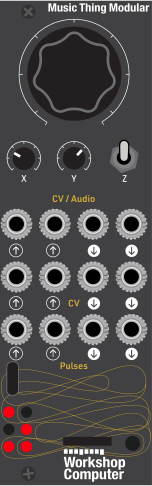 Fold CV In 1 AttenuverterFRV Output AttenuverterQRV Output AttenuverterFold InFold Drive ModFRV Rate ModQRV Trigger / Alternator InFold OutNoise OutFRV OutQRV OutAlternator Out AAlternator Out B
Controls
Fold CV In 1 Attenuverter
Bipolar attenuverter for CV In 1's contribution to the wavefolder's drive. 12 o'clock = CV In 1 has no effect (same as unpatched).
FRV Output Attenuverter
Bipolar attenuverter for FRV's output voltage. 12 o'clock mutes CV Out 1; CCW makes FRV swing negative, CW keeps it swinging positive as before.
QRV Output Attenuverter
Bipolar attenuverter for QRV's output voltage. 12 o'clock mutes CV Out 2; CCW makes QRV swing negative, CW keeps it swinging positive as before.
Attenuverter Mode: Main/X/Y each switch to a bipolar attenuverter for the section they already control (wavefolder CV In 1 / FRV output / QRV output) instead of their normal role. 12 o'clock mutes; CCW inverts and scales towards full negative; CW scales towards the original full-positive value. Each knob's two roles are pot-pickup guarded, so switching in or out of Up never jumps a value — it stays frozen until the knob is moved back to where that role was left.
Cycle Noise Colour: Briefly press and release Down to cycle the noise source between flat, low-biased (pink, -3dB/oct) and high-biased (blue, +3dB/oct). LEDs 0/2/4 hold the current mode.
Inputs & Outputs
Inputs
Outputs
Inputs
Fold In
Wavefolder input
Fold Drive Mod
Bipolar, scaled by Main's attenuverter role (Z up) then added directly onto the Main knob's drive amount, unclamped — enough negative CV (or a CCW attenuverter setting) inverts the signal before folding
FRV Rate Mod
Bipolar modulation of the FRV rate, +-6V, added on top of knob X
QRV Trigger / Alternator In
Rising edge latches a new Quantized Random Voltage value. The same input is also duplicated straight through to Pulse Out 1/2, alternating which one gets each pulse.
Outputs
Fold Out
Wavefolder output
Noise Out
Current noise colour (flat / low-biased / high-biased)
FRV Out
Fluctuating Random Voltage, free-running 0 to +6V before X's attenuverter role (Z up) is applied — CCW of centre there makes it swing negative instead
QRV Out
Quantized Random Voltage, 0 to +6V span set by knob Y's primary role, before Y's attenuverter role (Z up) is applied — CCW of centre there makes it swing negative instead
Alternator Out A
A literal copy of Pulse In 1's timing, routed here on every other incoming pulse (alternates with Pulse Out 2)
Alternator Out B
A literal copy of Pulse In 1's timing, routed here on the pulses Pulse Out 1 doesn't get
LEDs
Noise: Flat
Lit when the noise source is in flat (white) mode
FRV Level
Brightness follows the magnitude of the current FRV output regardless of sign (0V off, brightest at +-6V) — a single LED can't show polarity, so it shows how far from 0V, not which direction
Noise: Low-biased
Lit when the noise source is in low-biased (pink) mode
QRV Level
Brightness follows the magnitude of the current QRV output regardless of sign (0V off, brightest at +-6V) — a single LED can't show polarity, so it shows how far from 0V, not which direction
Noise: High-biased
Lit when the noise source is in high-biased (blue) mode
Alternator Trigger
Lit for the duration of every pulse on Pulse In 1, regardless of which of Pulse Out 1/2 it's currently being routed to
README
Uncertainty for Workshop System Computer
A tribute to the Buchla 266 Source of Uncertainty, sharing the card with a wavefolder (in the spirit of the 259 Complex Oscillator's timbre section) and a pulse alternator (in the spirit of the Model 140 Timing Pulse Generator), for the Music Thing Modular Workshop Computer.
Status: confirmed working on hardware.
What it does
Five things share this one card:
- Noise source — a source of hiss/static in three flavours: flat (even across the spectrum), low-biased (darker, bass-heavy), and high-biased (brighter, treble-heavy). Tap the switch down to cycle between them.
- FRV (Fluctuating Random Voltage) — a voltage that wanders continuously and unpredictably, sliding smoothly from one random value to the next rather than jumping. Speed is adjustable from a slow drift (one change every twenty seconds or so) up to a fast, buzzy wobble.
- QRV (Quantized Random Voltage) — a voltage that jumps to a fresh random value each time it receives a trigger, then holds perfectly still until the next one. The stepped, "sample and hold" counterpart to FRV's continuous drift.
- Wavefolder — takes an incoming audio signal and folds it back on itself once it gets loud enough, the way a real Buchla-style folder does. At low settings it's transparent; turn the drive up and the signal gets progressively more complex, bright, and eventually harsh.
- Pulse alternator — takes a pulse/clock/gate signal and echoes it out, alternating between two separate outputs each time a new pulse arrives. Useful for sharing one clock between two things, each getting half the rate.
Panel layout
                    ┌─────────────────────────┐
                    │   ●  MAIN                │
                    │  (fold drive / CV1 att.) │
              ○ 0   │   ○ X        ○ Y         │  ○ 1
   (noise: flat)    │  (FRV rate/  (QRV range/  │  (FRV level)
              ○ 2   │   FRV att.)   QRV att.)   │
 (noise: low-biased)│   [ (ON)-OFF-ON  Z ]     │  ○ 3
              ○ 4   │  up = attenuverters       │  (QRV level)
(noise: high-biased)│  down-tap = cycle noise   │  ○ 5
                    │                          │  (alternator hit)
                    │ AudioIn1  AudioOut1      │  fold in, fold out
                    │ (unused)  AudioOut2      │  noise out
                    │ CVIn1     CVOut1          │  fold drive mod, FRV out
                    │ CVIn2     CVOut2          │  FRV rate mod, QRV out
                    │ PulseIn1  PulseOut1      │  QRV trigger + alternator in, alternator out A
                    │ (unused)  PulseOut2      │  alternator out B
                    └─────────────────────────┘
Inputs and outputs
| Jack | What it does |
|---|---|
| Audio In 1 | The signal you want folded. |
| Audio Out 1 | The folded signal comes out here. |
| Audio Out 2 | The noise source's output. |
| CV In 1 | Modulates the wavefolder's drive amount, on top of the Main knob. This is bipolar — depending on the polarity of the incoming voltage, it can push the drive up or down (and even flip the signal upside-down, which just sounds like another way of folding it). |
| CV In 2 | Modulates FRV's speed, on top of the X knob. Also bipolar, so it can speed FRV up or slow it down. |
| CV Out 1 | FRV's output voltage. |
| CV Out 2 | QRV's output voltage. |
| Pulse In 1 | Two jobs at once: a pulse here makes QRV jump to a new random value, and that same pulse is echoed straight out through the pulse alternator below. |
| Pulse Out 1 / Pulse Out 2 | The alternator's two outputs. Every pulse that arrives at Pulse In 1 comes out one of these two jacks — alternating which one each time — so a steady stream of pulses in produces two interleaved, half-speed streams out. |
All the audio and CV jacks here work across roughly ±6V.
Controls
Main, X, and Y each do two jobs, depending on the switch:
| Knob | Normal job | Job when the switch is flipped up |
|---|---|---|
| Main | Sets how hard the wavefolder is driven | Attenuverter for CV In 1 |
| X | Sets FRV's speed | Attenuverter for FRV's output |
| Y | Sets QRV's output range | Attenuverter for QRV's output |
What "attenuverter" means here: turn the knob to 12 o'clock and that control has no effect at all — it's silent/off. Turn it left (counter- clockwise) and the signal it's attenuverting comes out flipped upside down, growing stronger the further left you go. Turn it right (clockwise) and it comes out the normal way round, growing stronger the further right you go. It's a way of dialling in "how much, and which direction" with one knob. Because FRV and QRV are normally positive-only voltages, this is also what lets their attenuverters push them negative — turn one CCW of centre and that output starts swinging below 0V instead of only above it.
No jumps when you switch modes. Since each of Main/X/Y is doing two jobs, you'd normally expect a value to jump the moment you flip the switch and the knob's physical position suddenly means something different. That doesn't happen here — each knob remembers where it was left in both of its jobs. Flip to attenuverter mode, dial in an amount, flip back, and the knob's normal job picks up exactly where you left it; it won't start changing again until you turn the knob back to roughly where it was. Same going the other way. So you can freely flip back and forth to tweak an attenuverter setting without ever disturbing whatever the knob was doing a moment ago.
The Z switch:
- Down (tap): a quick press-and-release cycles the noise source through its three colours. It springs back up on its own.
- Middle: normal operation. Main/X/Y do their everyday jobs.
- Up: attenuverter mode. Main/X/Y switch to the jobs described above.
LEDs, top-to-bottom, left-to-right:
- Lit when the noise source is set to flat.
- Brightness follows FRV's current output — off at 0V, brightest the further it swings from there in either direction.
- Lit when the noise source is set to low-biased.
- Brightness follows QRV's current output the same way LED 2 follows FRV's.
- Lit when the noise source is set to high-biased.
- Lights up for the duration of every pulse arriving at Pulse In 1, regardless of which of the two alternator outputs it's currently being sent to.
Build and flash
From a configured Pico SDK environment:
cd releases/106_uncertainty
cmake -S . -B build -G "Unix Makefiles"
cmake --build build
This produces build/uncertainty.uf2 and build/uncertainty.elf. Flash
by holding BOOTSEL while plugging in USB-C, then copying the .uf2 onto
the RP2 drive that appears (or via picotool load, or SWD).
Credits
- Chris Johnson — wrote ComputerCard, the hardware library this whole card is built on (part of the Workshop Computer repo this card lives in), and Utility Pair, whose wavefolder this card's wavefolder is a direct port of, antialiasing technique and all.
- Eric Gao — the pot-pickup ("nothing jumps when you switch modes") logic is ported from his Alloy card, also in this repo.
- Parker et al., DAFx-16 — "Reducing the aliasing of nonlinear waveshaping using continuous-time convolution," the paper behind the antialiasing technique the wavefolder uses.
- Tom Whitwell / Music Thing Modular — the Workshop Computer platform this card runs on.
- Claude Code (Anthropic) — wrote the firmware from the author's brief.
- Don Buchla — the 266 Source of Uncertainty, the 259 Complex Oscillator, and the Model 140 Timing Pulse Generator, whose ideas this card is a tribute to rather than a copy of.
Licence
MIT, matching the ComputerCard framework itself.