
112 Equanimity
Melody notes repeat on their own loops, a little quieter each time, and the overlapping loops make the melody, in the spirit of Eno and Chilvers' Bloom -- over a drone of slowly drifting layers. Everything feeds a 1.1-second and a 9.7-second delay whose repeats drift past each other. One slow tide rises and falls under it all: as it rises, notes come more often and ring brighter, the drone brightens, and the triggers and wander CVs grow restless; as it falls, everything settles. Each set has a random root, scale and tone (harp, marimba, xylophone, glockenspiel, vibraphone or bell, all from one FM pair). Tap the switch down, or send Pulse In 2, for a new set.
Panel
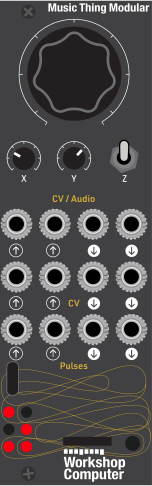 Wet/Dry1.1s Feedback9.7s FeedbackDelay In 1Delay In 21.1s Feedback CV9.7s Feedback CVNew NoteNew SetOut LOut REbbFlowNote TriggerTide Trigger
Controls
Wet/Dry
Equal-power crossfade of the melody against its echoes; the drone stays out of it. Picks up only after passing its last value
1.1s Feedback
Up to about 0.97, plus CV In 1. Picks up only after passing its last value
9.7s Feedback
Up to about 0.97, plus CV In 2. Picks up only after passing its last value
Voices: Main = tone, X = melody volume, Y = drone volume. Wet/dry and feedback hold their values
Play: Main = wet/dry, X / Y = feedback of the 1.1s / 9.7s delay
Play: Same knob jobs as middle (Down is momentary)
New Set: Tap down for a new set, as Pulse In 2 does -- the old notes fade, the delays drain, then a fresh random root, scale and tone
Inputs & Outputs
Inputs
Outputs
Inputs
Delay In 1
Into both delays, not the dry mix
Delay In 2
Into both delays, not the dry mix
1.1s Feedback CV
Added to the 1.1s delay's feedback in every switch position. Positive adds, negative removes
9.7s Feedback CV
Added to the 9.7s delay's feedback in every switch position. Positive adds, negative removes
New Note
Each rising edge births a new note loop straight away. Unplugging never triggers it
New Set
The old notes fade, the drone fades and the delays drain; then a fresh random root, scale and tone begin. Ignored while a change is under way
Outputs
Out L
Melody and drone (centred) plus both delays, from the left read points
Out R
Melody and drone (centred) plus both delays, from the right read points, which wobble on their own
Ebb
Mirror image of CV Out 2 -- the two always add up to about 5V
Flow
Smooth random voltage, 0 to about +5V, lazy at low tide and restless at high tide
Note Trigger
A 10ms trigger on every melody note, repeats included
Tide Trigger
10ms random triggers following the tide -- one every 20s or so at low tide, clusters at high tide
LEDs
Tide meter (top left)
Tide meter (top right)
Tide meter (middle left)
Tide meter (middle right)
Tide meter (bottom left)
The six LEDs fill from the bottom row to the top as the tide rises, flickering softly as each note is born
Tide meter (bottom right)
README
Equanimity
A generative ambient program card for the Music Thing Modular Workshop Computer inspired by Eno and Chilvers' Bloom.
Melody notes repeat on their own loops, a little quieter each time, and the overlapping loops create the melody. Beneath them a slow drone holds the root. Everything goes into two delays, a 1.1-second line and a 9.7-second line, whose repeats drift slowly past each other.
The movement is tied together through its ebb and flow, one slow tide rises and falls. As it rises, notes arrive more often and ring out brighter, the drone opens up and glows, and the triggers and wander CVs get busier. As it falls, everything settles into stasis - this is Equanimity.
Every set has a random root, scale and tone. The melody can play in one of six tones, all from the same two-operator FM pair: harp, marimba, xylophone, glockenspiel, vibraphone and bell.
Quick start
Flash UF2/equanimity.0.3.4.uf2 and press reset. It plays straight away:
a fresh random root, scale and tone on every power-on. Listen to Audio
Out 1 and 2, which are stereo: the echoes drift apart left and right.
Tap the switch down whenever you want a new set, and send triggers to
Pulse In 1 to add notes of your own.
Controls
| Control | Switch middle | Switch up |
|---|---|---|
| Main | Wet/dry | Tone (one of six) |
| X | Feedback of the 1.1s line (+ CV In 1) | Melody volume |
| Y | Feedback of the 9.7s line (+ CV In 2) | Drone volume |
Down on the switch works the knobs as in the middle position.
- Tap down: a new set (the same as Pulse In 2). It acts the moment the switch goes down; nothing needs it held there.
Wet/dry is an equal-power crossfade between the melody and its echoes: fully left is the melody only, fully right is the echoes only. The drone stays out of it, set by its own volume. A little of the drone (its harmonics, not its bass) goes into the delays, for space.
Feedback tops out at about 0.97, never unity. A saturator and lowpass inside each loop keep it from running away. At full feedback a phrase holds for a few minutes, then fades. CV In 1 and 2 add to the feedback in both switch positions.
Pickup. The knobs change jobs between up and middle, and each setting waits for its knob to come back to it before following. Flipping the switch up doesn't change the tone either: the tone only follows Main once Main moves. At power-on, the knobs on the page the switch is in take effect straight away; the other page's settings start at their defaults (wet/dry and both feedbacks in the middle, melody volume about 80%, drone volume about 55%) until their knobs pick them up.
Tones. A tone change applies from each loop's next strike, so it is heard within a few seconds; notes already ringing finish as they are. The tide sets how bright each note is, within its tone.
| Main | Tone | FM ratio | Character | LED |
|---|---|---|---|---|
| fully left | Harp | 1:1 | Quick pluck, brightness gone fast, ~2s ring. Gentle, Eno-ish | top left |
| Marimba | 1:4 | A click of brightness, ~1s ring. Warm, woody, round | top right | |
| Xylophone | 1:3 | Short and sharp, an octave up. Drier, more pointed | middle left | |
| Glockenspiel | 1:2.76 | Bright and ringing, an octave up. Sparkly | middle right | |
| Vibraphone | 1:4 | Soft and steady, long ring, 5Hz tremolo. Late-night | bottom left | |
| fully right | Bell | 1:3.5 | Bright burst, slow fade. The Bloom sound | bottom right |
A new set (Pulse In 2, or tap down): the current loops play at most two more repeats (no more than 9 seconds apart), fading faster, while the drone fades out and the delays' feedback falls to nothing. Once the old notes have rung out, the card waits 10 seconds for the delays to empty: the 9.7s line plays its last echo, then there is true silence. A fresh random root, scale and tone then start, with a first note and the drone swelling in on the new root, and the feedback comes back. The whole change takes about 15 to 35 seconds. New notes (Pulse In 1) and further new-set requests (taps, Pulse In 2) are ignored until it's done, so nothing in the old key sneaks into the new set.
Jacks
| Jack | Job |
|---|---|
| Audio In 1, 2 | Into both delays (not the dry mix): a field recording, another voice |
| CV In 1 | Added to the 1.1s feedback. Positive adds, negative removes |
| CV In 2 | Added to the 9.7s feedback |
| Pulse In 1 | A new note, straight away |
| Pulse In 2 | A new set (see above) |
| Audio Out 1, 2 | Melody and drone (centred) plus both delays (each side reads its own wobbling tap) |
| CV Out 1 | Ebb: the mirror image of CV Out 2. The two always add up to about 5V |
| CV Out 2 | Flow: a smooth random voltage, 0 to about +5V, faster at high tide |
| Pulse Out 1 | A trigger on every melody note, repeats included: a loose, breathing clock |
| Pulse Out 2 | Tide triggers: one every 20s or so at low tide, clusters at high tide |
The triggers are 10ms long. Patched to two VCAs, CV Outs 1 and 2 crossfade or pan between two sources. Unpatched inputs contribute nothing. Pulse In edges count after 20ms, and only if the cable is still in, so pulling a cable out never triggers anything.
LEDs. With the switch in the middle, the six LEDs are a tide meter, filling from the bottom row to the top, with a soft flicker each time a note is born. With the switch up, one LED shows the tone.
How it works
- Melody. Eight two-operator FM voices. The modulator wobbles the carrier's phase; the ratio between them decides which partials sound (whole numbers for harmonic tones, 2.76 and 3.5 for metallic ones). The brightness (modulation index) dies away faster than the volume, and a gentle lowpass follows. A note born at high tide is bright and clear; one born at low tide is soft, almost a sine.
- Note loops. Each note gets a pitch from the scale, spanning two octaves from the root in octave 4. It also gets a loop period of 5 to 25 seconds (wide apart, so the melody has space and the delays fill the gaps) and 4 to 10 repeats, each quieter than the last. New notes arrive about every 12s at low tide and every 2.5s at high tide. With all eight loops busy, the quietest one is retired.
- Scales. Major, Minor, Major Pentatonic, Minor Pentatonic, Dorian and Lydian, on any of the twelve roots.
- Drone. Built the way Eno describes his own: not one tone but "several unstable elements that change in both timbre and volume", each on its own long cycle. Four layers on the set's root: the root in octave 2 (65–123Hz), the 5th, the octave and the 5th above that, each a 1:1 FM pair a few cents off the others, so they beat gently. Each layer has a volume cycle and a brightness cycle of its own, between 30 and 71 seconds long. All eight lengths are unrelated ("incommensurable", like the tape loops of Music for Airports), so the layers drift in and out of prominence and never line up the same way twice. The root never sinks below about half, so the key always holds; the upper 5th comes and goes. A resonant lowpass over the whole drone drifts on a ninth cycle (83s) and opens with the tide, as does each layer's brightest point. The colour keeps shifting (root-heavy, open fifth, bright octave) but the drone never changes note within a set. Like Bloom's drone, it changes pitch only with a new set: it fades out with the old set (2s) and swells in on the new root (6s).
- The tide. Three slow sines (47s, 113s, 271s) at random phases, summed. It's squared before it sets birth rates and trigger density, so the still passages last longer and the busy ones feel earned.
- Delays. The short line stores 16-bit samples at 24kHz (53KB). The long line stores 8-bit mu-law samples at 8kHz (78KB), so it is dark and a little grainy, which suits distant repeats. Each read point drifts slowly, like tape. Feedback is taken from the left read point of each line (averaging both wobbling points would comb-filter the echoes more on every repeat), and a ~2Hz DC blocker on the delay input keeps any offset from building up in the loops.
Every tuning value is a named constant in src/Config.h,
so you can adjust it by ear. That covers the six tones, tide periods, birth
rates, the drone's layers, cycles, filter and send, the feedback ceiling,
wobble depths, the changeover timings and the output level.
The RP2040 runs at 192MHz (an officially supported setting, at 1.15V). At the usual 144MHz there wouldn't be enough margin for eight FM voices, the drone and two delays. At 192MHz the worst case measures 79% of the time available per sample.
Building
You need the Pico SDK (2.1.1) and the ARM GNU toolchain.
export PICO_SDK_PATH=/path/to/pico-sdk
cmake -S . -B build -DCMAKE_BUILD_TYPE=Release
cmake --build build
That gives build/Equanimity.uf2.
Tests and renders
The whole instrument also builds on a computer, driven by a pretend panel.
make -C test          # host tests
make -C test render   # WAVs in test/out/, to hear before flashing
The renders are: each tone in turn, ten minutes of the tide at work, a full-feedback pad, a change of set, and the drone on its own.
Timing check
ProcessSample() must finish in ~20µs, every sample. tools/bench/cycles.py
runs the compiled firmware on an emulated Cortex-M0+ and reports the
cycle count per sample across a scripted performance.
python3 -m venv venv && venv/bin/pip install unicorn capstone
cmake -S . -B build-bench -DCMAKE_BUILD_TYPE=Release -DEQUANIMITY_BENCH=ON
cmake --build build-bench
venv/bin/python tools/bench/cycles.py build-bench/Equanimity.elf
Status
0.3.4, released. Every version has been played on hardware, as well as tested on a computer and measured on the emulator.
Along the way: everything moved inside the Computer in 0.2 (the first version played its drone on the Workshop System's analog oscillator), with the six tones, random root and scale, triggers and ebb/flow CVs. 0.3 rebuilt the drone as Eno-style drifting layers and made a tap down start a new set. Since then the tuning has been by ear: the drone up an octave, and loop repeats 5 to 25 seconds apart, so the melody has space and the delays fill the gaps.
Credits and licence
By Matt Allison. MIT licence (see LICENSE).
The firmware was written with Claude (Anthropic), working from Matt's spec and changes, and from the structure, pickup, random and smooth-random code of his Impermanence card.
ComputerCard
v0.4.0 by Chris Johnson (MIT, lib/ComputerCard.LICENSE).