
113 Constancy
Constancy holds a single morning in memory: 17 April 2024 at Calamansac on the Helford River, the last day of the Music Thing Modular residency there, from first light to two hours after sunrise. Time (Main) moves through it; nothing else does. The real tide sets every envelope (plucky at low water, long washed swells at high tide), the sun sets the delay time and brightness and calls in the lead once it clears the horizon, and the wind moves a CV output, and a clocked, scale-aware Turing machine (after Tom Whitwell's) plays 1V/octave notes in the card's key for the rest of the system. The voice is a Vangelis-style supersaw through a fixed-point port of the feedback loop from Infinite Digits' Icarus, over Equanimity's note loops and a pure-fifth drone. Sun (X) flies the loop close enough to burn; Water (Y) drowns or thins it.
Panel
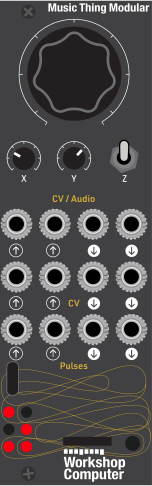 TimeSunWaterLoop In 1Loop In 2Time CVWater CVTuring ClockLead PhraseOut LOut RTideTuring PitchLead TriggerTuring Trigger
Controls
Time
First light (04:17) to two hours after sunrise (08:21). The morning moves only when this (or CV In 1) does. Picks up only after passing its last value
Sun
The loop's feedback and drive: gentle at left, long tails at the centre, burning to the right. Picks up only after passing its last value
Water
Open in the centre; left drowns (lowpass), right thins (low-cut). Plus CV In 2. Crossing the centre never clicks. Picks up only after passing its last value
Levels: Main = Turing machine, X = melody level, Y = drone level. Time, Sun and Water hold their values
Play: Main = Time, X = Sun, Y = Water
Play: Same knob jobs as middle (Down is momentary)
New Key: Tap down for a new key -- every melodic note stops, the drone glides to the new root, then the new key begins
Inputs & Outputs
Inputs
Outputs
Inputs
Loop In 1
Into the Icarus feedback loop only, not the dry mix
Loop In 2
Into the Icarus feedback loop only, not the dry mix
Time CV
Added to Time, so an LFO or random source drifts the morning. +5V moves it about the whole window
Water CV
Added to Water. Negative drowns (lowpass), positive thins (low-cut)
Turing Clock
Each pulse steps the Turing machine once. Unpatched, it holds its note
Lead Phrase
The lead plays a phrase now, even before sunrise. Ignored while a phrase is playing or a new key is arriving. Unplugging never triggers it
Outputs
Out L
Voices, the Icarus loop and the drone, through Water
Out R
Voices, the Icarus loop and the drone, through Water
Tide
Smooth random voltage, 0 to about +5V, centred on the tide's height; wanders wider and choppier as the wind rises
Turing Pitch
1V per octave (calibrated with the Simple MIDI card), the Turing machine's notes in the card's key, two octaves up from the root (-1V to +2V)
Lead Trigger
A 10ms trigger on every lead note
Turing Trigger
A 10ms trigger with each Turing step whose bit is 1, as on the original Turing Machine
LEDs
Sun meter (top left)
Sun meter (top right)
Sun meter (middle left)
Sun meter (middle right)
Sun meter (bottom left)
The six LEDs fill from the bottom row to the top as the sun climbs; all glow together as it crosses the horizon
Sun meter (bottom right)
README
Constancy
A generative program card for the Music Thing Modular Workshop Computer that plays one Cornish morning, forever.
The morning is 17 April 2024 at Calamansac, on Port Navas Creek off the Helford River. It was the last day of Tom Whitwell's five-day Music Thing Modular residency there, part of the Workshop System's origin story. The card holds that one dawn in memory: the tide, the sun, the wind and the cloud, from first light to two hours after sunrise. Nothing moves unless you move through the morning with the Time knob.
The voice is a Vangelis-style CS-80 supersaw through a fixed-point port of the feedback loop from Infinite Digits' Icarus for norns. The notes and keys come from Equanimity. Low tide gives short, plucky strikes; high tide stretches everything into long, washed swells. The lead only appears once the sun clears the horizon.
It sits in the series beside Uncertainty, Scintillator, Impermanence and Equanimity.
Quick start
Flash UF2/constancy.0.3.2.uf2 and press reset. It starts playing at
once, in a random key. Listen to Audio Out 1 and 2 (stereo).
Turn Main slowly from left to right: night, then the first grey light, then the sun coming up, then the morning. The lead starts to sing a little after halfway. Turn X (Sun) right of centre to make the loop burn, and Y (Water) left to drown it or right to thin it. Tap the switch down for a new key.
To play the rest of the Workshop System along with it, patch a clock into Pulse In 1, CV Out 2 to an oscillator's pitch and Pulse Out 2 to an envelope: a Turing machine plays in the card's key. For its notes to land in that key, first tune the oscillator to C2 (65.41Hz, with A at 440Hz) with nothing patched into its pitch input, then leave its tuning alone. 0V is C, and the card works out every key from there.
The morning
| BST | The sun | Table position (Main) |
|---|---|---|
| 04:17 | 18° below: astronomical dawn, the window opens | fully left |
| 05:05 | 12° below: nautical dawn | about 20% |
| 05:48 | 6° below: civil dawn | about 37% |
| 06:22 | sunrise | about 51% |
| 06:57 | low water | about 65% |
| 08:21 | 18° above: the window closes | fully right |
The sun climbs evenly from 18° below the horizon to 18° above. This was a neap morning (first quarter moon was on 15 April). The tide was falling through most of the window, reached low water about half an hour after sunrise, and was just turning to flood when the window closed. So the dark is the high-tide end, with long swells. Sunrise is plucky. The feedback settles as the tide turns at 06:57. At the end, the swells start to come back. It was a grey morning: the cloud cleared briefly around sunrise and closed in again (the card keeps the cloud data, though since 0.3 nothing uses it). The wind rose from about 18 to 23 km/h.
Each stream is scaled to its full range across the window. Four hours is only a third of a tide, so without scaling the card would sound timid. Between its 128 points the card blends smoothly, so nothing steps.
Controls
| Control | Switch middle: Play | Switch up: Levels |
|---|---|---|
| Main | Time. First light to two hours after sunrise (+ CV In 1) | Turing machine. Pendulum and locked, random, locked |
| X | Sun. Feedback and drive: fly close and it burns | Melody level |
| Y | Water. Centre open; left drowns (lowpass), right thins (low-cut) (+ CV In 2) | Drone level |
| Switch down | Tap: a new key | The same |
Time is manual. The morning moves only when Main or CV In 1 moves it. Parked, the card holds that moment, and the loops and lead keep playing in it.
Sun runs the loop's feedback from 0.4 through 0.8 at the centre up to 1.5, Icarus's top. Its drive into the soft clipper rises with it, from 1.0 through Icarus's 1.25 at the centre to 2.0. At the centre the loop's gain is just under one: long tails that still fade. Right of centre it passes one. The clipper and the ladder filter then hold the loop at a burning, saturated sustain instead of letting it run away. Past that point the wet level is trimmed gently, so the burn grows without jumping out.
Water is a 12dB-per-octave lowpass to the left of centre (16kHz down to 120Hz) and a 12dB-per-octave low-cut to the right (15Hz up to 2.5kHz). Both are open across a small dead zone in the middle. Everything (voices, loop and drone) goes through it on the way out. Each filter fades in over the first eighth of its side, and one only hands over to the other once it has faded right out, so sweeping through the centre never clicks. CV In 2 adds to the knob: an LFO there makes the tide wash in and out.
Turing machine (Main on the Levels page): how much its eight-step loop changes, and which way it plays. At the centre every step is random. Turning either way, steps change less and less often (the loop slips now and then), until near the end of travel it's locked. Fully clockwise, the locked loop plays forwards, round and round. Fully anticlockwise, it plays as a pendulum: forwards to the eighth step, then back (1-8-1). See the Jacks and How it works.
The delay mix (the voices as played, against the Icarus loop) is fixed
at about two-thirds wet: kDelayMix in src/Config.h.
Pickup. The knobs change jobs between the two pages. Each setting keeps its value, and waits for its knob to come back through it before following, so nothing jumps. At power-on the page the switch is on takes its knobs as they are. The other page starts at its defaults until picked up: Time, Sun and Water in the middle; the Turing machine fully clockwise (locked); melody at 80% of full volume, drone at 40% (levels are knob position squared, so their knobs sit at about 89% and 63%).
A new key (tap down): every melodic note stops. The loops end with no further repeats, and the notes still sounding (the lead's too) fade as they would rather than being cut. A new random root and scale are picked at once, and the drone glides over four seconds to the new root, whichever octave of it is nearer. Meanwhile the loop's feedback dips so the old key drains out, even if Sun has it burning. No new melodic note starts until the drone has arrived and the old notes have died away (and at least three seconds have passed). Then the new key's loops begin, the first almost at once, and the feedback comes back.
Jacks
| Jack | Job |
|---|---|
| Audio In 1, 2 | Into the Icarus loop only: a field recording, another voice |
| CV In 1 | Added to Time: an LFO or a slow random drifts the morning. +5V moves it about the whole window |
| CV In 2 | Added to Water: negative drowns, positive thins |
| Pulse In 1 | Clock for the Turing machine: each pulse is one step |
| Pulse In 2 | A lead phrase now, whatever the sun is doing |
| Audio Out 1, 2 | Stereo mix of the voices, the loop and the drone |
| CV Out 1 | Tide. A smooth random voltage, 0 to about +5V, centred on the tide's height; still air wanders slowly, wind makes it wider and choppier |
| CV Out 2 | Turing pitch. 1V per octave, in the card's key, two octaves up from the root (-1V to +2V), with 0V as C: tune the oscillator to C2 at 0V. Calibrated: run the Simple MIDI card's calibration first for it to track |
| Pulse Out 1 | A 10ms trigger on every lead note |
| Pulse Out 2 | Turing trigger. 10ms, with each step whose bit is 1, like the original Turing Machine's pulse output |
Unpatched inputs contribute nothing. Pulse In edges count after 20ms, and only if the cable is still in, so pulling a cable out never triggers anything.
LEDs. On the Play page the six LEDs show the sun's height, filling from the bottom row to the top. They all glow together as the sun crosses the horizon, and flicker at a new key. On the Levels page the top row is the Turing machine: dark at the centre (random), the left LED brightening towards a locked pendulum, the right towards locked forwards. The middle row is the melody level, the bottom row the drone's.
How it works
- The voice. Each melodic voice is a stack of PolyBLEP sawtooth waves
a few cents apart, the supersaw: five for the lead, three for each loop.
Every saw keeps Icarus's random pitch wander, a sine of up to ±10 cents
whose speed jumps to a new random value every second. Saws alternate
left and right, so each voice is wide. The envelope is Icarus's cubed
ADSR: attacks start gently and arrive fast; releases drop quickly and
then trail off. After the voices comes the CS-80's lowpass. It is
muffled before dawn (1.5kHz) and opens with the sun (10kHz by morning).
The lead's own copy swells by up to 1.3 octaves after each attack,
standing in for the CS-80's aftertouch. A makeup gain follows the
morning so the melody sounds about as loud throughout: without it, the
dark plucks around civil dawn measured 16dB quieter than the bright,
long-sustaining morning (
kMelodyMakeupDbX10insrc/Config.h). - The loops (voices 2 to 4). Equanimity's note loops. Each owns one note of the scale and repeats it every 5 to 15 seconds, quieter each time, for 4 to 9 repeats; then it rests, and a new loop begins. Each loop owns its voice, so a repeat only restarts its own note, swelling up from wherever its release had got to. A new loop waits for silence: no stealing, no clipped tails. Each strike takes its envelope from the tide at that moment.
- The lead (voice 1). Phrases of three to six notes, mostly moving by step through the scale, ending on a long held note, then silence. Some notes glide in from the last (portamento). Vibrato eases in after 350ms of holding. Now and then the last note sinks 1.5 to 3 semitones as it fades, like easing off the CS-80's ribbon. There are no phrases before sunrise. Just after sunrise one comes about every 22 seconds, and by the top of the window about every 5. Scrub back below the horizon and it stops.
- The drone. Root and fifth, two octaves below the melody (65–123Hz). Two drifting saws on the root, left and right, and one on the fifth in the centre. The fifth is tuned pure: exactly 3:2, not the equal-tempered fifth a keyboard plays, which beats slowly against the root. Pure, it locks, and the drone stays still. It has its own gentle lowpass and a 47-second breath. It goes around the loop; only a little goes through.
- The Turing machine. After Tom Whitwell's Music Thing Modular Turing Machine (and his Workshop Computer card of it), written afresh here. Eight bits in a loop, one step per clock on Pulse In 1. The eight bits read from the playhead onwards make a number, 0 to 255, which picks a note of the card's current key from the root in octave 3 up two octaves: out of CV Out 2 at 1V per octave (MIDI note 60 is 0V). Pulse Out 2 fires when the bit under the playhead is 1, so the rhythm locks and changes with the notes. As the playhead lands, that bit may flip: half the time at Main's centre (every step random), never in the last 160 counts of either end (locked). A new key re-pitches the same pattern from the next step; the machine keeps running through a reseed, since it's for the rest of the system rather than the card's own voices. With no clock it holds its note. Each power-on starts it with a different pattern.
- Keys. Equanimity's six scales: Major, Minor, Major and Minor Pentatonic, Dorian and Lydian. All have a perfect fifth, so the drone always belongs. Notes a semitone above a drone note (only Minor has one, its flat 6th) come up a third as often, never on a high-tide swell, and never end a lead phrase.
- The Icarus loop. A port of the feedback loop in Icarus's
Engine_Icarus.sc. It runs: read the delay line, then three allpasses for diffusion (Constancy's stand-in for the Blade Runner hall), then LeakDC, then add the new sound, drive and soft-clip, then a four-pole ladder lowpass, then the dropouts. That output is fed back throughOnePole(0.4)andOnePole(-0.08)and a 36° stereo rotation every lap. The delay time follows the sun: 60ms before dawn, 250ms at sunrise, 500ms by morning. It is lagged by 0.2s as Icarus lags it, so moving Time bends the pitch of what's in the loop. The ladder opens with the sun too (1kHz to 9kHz). - Destruction. Icarus's random dropouts: below a quarter-second delay the loop ducks to half for 0.2s at random moments. They come up to three times a second at the shortest delay: the fragile time before dawn.
- The sunrise swoop. As the sun crosses the horizon, the delay stretches by 150ms and comes back, once. It's like holding Icarus's time key: the whole loop bends down in pitch and back up. It re-arms only after Time has gone well back into the dark.
- The tide. Its height sets every envelope. Pluck: 23ms attack, 450ms release. Swell: 2.4s attack, 5s release. How fast it's running nudges the loop's feedback up by as much as 0.08; at the turn of the tide, nothing.
Every tuning value is a named constant in src/Config.h,
so it can be adjusted by ear.
Fitting on the chip
The RP2040 runs at 192MHz (an officially supported setting, at 1.15V), as Equanimity does. The worst case measured on the emulator is 80% of the time available per sample, with every voice sounding, Sun burning, Water closing and audio coming in. RAM use is 46%.
Two choices got it there, both measured:
- The loop runs at half rate, 24kHz. The left side runs on even samples and the right on odd ones, so every sample does half the loop's work, and the delay line needs half the memory (65KB for 0.67s of stereo). The cost is the loop's top octave above ~11kHz, a little grit that the ladder mostly hides. The whole loop at 48kHz measured too heavy to leave room for the voices.
- Water runs only the filter that's closing. The ladder's input clamp stands in for a tanh, because the soft clipper just before it already does the overdrive. The gain ramps step every other sample.
The card uses no floating point at all. The lookup tables are generated
on a computer (tools/tables/make_tables.py), and core 1 works in
integer Log2/Exp2.
Building
You need the Pico SDK (2.1.1) and the ARM GNU toolchain.
export PICO_SDK_PATH=/path/to/pico-sdk
cmake -S . -B build -DCMAKE_BUILD_TYPE=Release
cmake --build build
That gives build/Constancy.uf2.
Tests and renders
The whole instrument also builds on a computer, driven by a pretend panel.
make -C test          # host tests
make -C test render   # WAVs in test/out/, to hear before flashing
The renders are:
morning: the whole window in 90 seconds.sun: X from left to right.water: Y through both sides.loops: the pad at dawn, at low water with a new key, and at the end of the window.sunrise: three minutes across the horizon.levels: the Levels page (melody and drone levels).
Timing check
ProcessSample() must finish in ~20µs, every sample. tools/bench/cycles.py
(from Equanimity) runs the compiled firmware on an emulated Cortex-M0+ and
reports the cycle count per sample across a scripted performance.
python3 -m venv venv && venv/bin/pip install unicorn capstone
cmake -S . -B build-bench -DCMAKE_BUILD_TYPE=Release -DCONSTANCY_BENCH=ON
cmake --build build-bench
venv/bin/python tools/bench/cycles.py build-bench/Constancy.elf
The data
tools/data/build_data.py computes the sun and smooths the tide, wind and
cloud into src/DayData.h. The Open-Meteo responses it used are saved in
tools/data/raw/, so it rebuilds offline. Run it with --fetch to
download them again.
Status
0.3.2, released. Built from the design brief (constancy-brief.md) in ten
milestones, tested on a computer and measured on the emulator at every
step, and since 0.1 played on hardware and tuned by ear.
Along the way: the drone went down an octave and came back up (octave 1 was too low), and a clocked four-note bass line was tried and taken out again, so the drone holds root and fifth. CV In 2 moved from Sun to Water, and Water no longer clicks crossing its centre. A new key now stops every melodic note until the drone has glided to the new root. In 0.3 a scale-aware Turing machine took over CV Out 2 and Pulse Out 2 (they were a light wander and a sun-up gate) and Main on the Levels page (it was the delay mix, now fixed). Since then: the melody's loudness evened out across the morning, and the power-on levels set to melody 80%, drone 40%.
Credits and licence
By Matt Allison. MIT licence (see LICENSE).
The firmware was written with Claude (Anthropic), working from Matt's design brief. It reuses the structure, two-core handoff, pickup, random, smooth-random and Pulse In code of his Equanimity and Impermanence cards, and Equanimity's cycle-counting bench.
The feedback loop, oscillator drift and envelope are ported from
Icarus by Zack Scholl (schollz), MIT
licence, copyright 2021 Zack (lib/Icarus.LICENSE).
Weather and tide data by Open-Meteo.com (CC BY
4.0), from the Deutscher Wetterdienst (DWD) and other national weather
services. The tide comes from the
Open-Meteo Marine API
(sea_level_height_msl) at its nearest sea point, about 15km south of
Calamansac; wind and cloud come from the historical weather archive. Sun
positions use NOAA's solar equations.
The Turing machine follows the idea of Tom Whitwell's Music Thing Modular Turing Machine and his Workshop Computer card of it; the code is Constancy's own.
ComputerCard
v0.4.0 by Chris Johnson (MIT, lib/ComputerCard.LICENSE).