
122 You spin me round
A hardware-tested mono-to-stereo Leslie-style rotary speaker for the Workshop Computer. Main sets speed, X opens up movement and stereo spread, and Y adds cabinet drive. Switch between slow and fast, or hold Down to brake and release to resume. Outside is the default; hold Down at boot and use Main to select an exaggerated Inside perspective. Release candidate based on the tested alpha3 DSP.
Panel
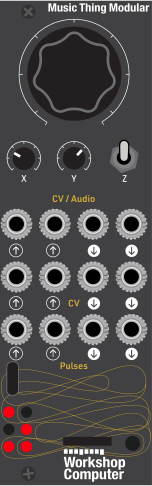 SpeedIntensityDriveMono SourceUnusedSpeed CVIntensity CVFast GateBrake GateLeft OutRight OutUnusedUnusedUnusedUnused
Controls
Speed
Sets rate within the slow/fast range; selects Outside/Inside while the boot selector is held.
Intensity
Rotary movement and stereo spread with a responsive low-end curve; fully left is stationary.
Drive
Cabinet input drive into soft saturation.
Fast: Fast rotation range unless Pulse In 1 is patched.
Slow: Slow rotation range unless Pulse In 1 is patched.
Hold Brake: Hold to brake and release to resume; hold at boot to select Outside/Inside with Main.
Inputs & Outputs
Inputs
Outputs
Inputs
Mono Source
Mono source feeding the bass drum and treble horn.
Unused
Not used by this card.
Speed CV
Bipolar modulation added to Main, clamped to its range.
Intensity CV
Bipolar modulation added to X before its curved movement response.
Fast Gate
When patched, high selects fast and low selects slow, overriding switch Up/Middle.
Brake Gate
High holds brake; low releases unless switch Down remains held.
Outputs
Left Out
Processed stereo left output.
Right Out
Processed stereo right output.
Unused
Set to nominal zero.
Unused
Set to nominal zero.
Unused
Held low.
Unused
Held low.
LEDs
Horn Motion
Brightness follows actual horn phase and inertia.
Drum Motion
Brightness follows actual drum phase and inertia.
Fast Range
On when fast is selected, including the gate override.
Brake
On while switch Down or the brake gate is held.
Inside
On for Inside, off for default Outside.
Timing Warning
Latched when this callback takes at least 18 microseconds; not a complete-ISR measurement.
README
You spin me round for Workshop Computer
Version 0.1.0-rc1. Hardware-tested release candidate.
You spin me round is a mono-to-stereo Leslie-style rotary speaker effect by Adrian Vos. Separate bass-drum and treble-horn motion creates a slow roll or a fast shimmer, with Doppler pitch movement, changing loudness and tone, cabinet drive, and different acceleration and braking times for each rotor.
Choose the familiar Outside perspective or an exaggerated Inside the cabinet perspective with opposing stereo motion and deeper Doppler movement. The controls stay immediate: three knobs, slow/fast, and a hold-to-brake gesture.
Card 122 is a nod to the Leslie 122 speaker.
The release folder is 122_You_Spin_Me_Round. This is a creative rotary
model, rather than a component-by-component recreation of that specific cabinet.
Install
Flash You_Spin_Me_Round_0.1.0-rc1.uf2 to a Workshop Computer program card using BOOTSEL, then reset with the switch in Middle. Patch a mono source into Audio In 1 and listen to Audio Outs 1/2 as left/right. Start with Main and X at noon and Y low.
RC1 uses the exact firmware bytes of the alpha3 build that passed the author's hardware tests and listening checks. This folder contains the release candidate, source, documentation and previews for the Workshop Computer catalogue.
Controls
| Control | Function |
|---|---|
| Main | Rotation speed within the selected slow or fast range |
| X | Rotary movement and stereo spread; a curved response brings movement into the lower knob range |
| Y | Cabinet drive into soft saturation |
| Z Up | Fast range, unless Pulse In 1 is patched |
| Z Middle | Slow range, unless Pulse In 1 is patched |
| Z Down | Hold to brake; release to resume |
X fully left removes movement and gives matching digital left/right outputs; the stationary cabinet signal path remains, so this is not a dry bypass. Y increases compression and grit rather than simply multiplying output volume.
The horn accelerates and slows faster than the drum. When braking, audio continues through the stationary cabinet. Releasing Down returns the switch to Middle and therefore the slow range, unless Pulse In 1 selects fast. Either a held Down switch or a high brake gate keeps the brake active.
Approximate steady rotation ranges:
| Range | Treble horn | Bass drum |
|---|---|---|
| Slow | 0.4–1.4 revolutions/second | 0.3–1.1 revolutions/second |
| Fast | 4.5–8.5 revolutions/second | 3.8–7.2 revolutions/second |
Listening perspective
Normal startup always selects Outside. To choose a perspective:
- Hold Z Down while starting or resetting the Computer, and keep holding.
- Turn Main left for Outside or right for Inside. The left or right LED column shows the choice; a small centre deadband prevents flicker.
- Release Z to confirm. Main returns to its speed function and audio fades in.
The choice lasts until reset and is not saved to flash. There is no web editor. Inside has wider opposing ear viewpoints, a deeper Doppler sweep, different horn tone/path and stronger short cabinet reflections. It is a creative close-up perspective, not a physically exact inside-cabinet simulation.
Inputs
| Input | Function |
|---|---|
| Audio In 1 | Mono source |
| Audio In 2 | Unused |
| CV In 1 | Bipolar speed modulation added to Main |
| CV In 2 | Bipolar intensity modulation added to X |
| Pulse In 1 | When patched, high selects fast and low selects slow, overriding Z Up/Middle |
| Pulse In 2 | High holds brake; low releases it unless Z Down is still held |
Both pulse inputs use held gate levels, not trigger toggles or tap tempo. Levels must last at least 2 ms to be reliably sampled. CV values are doubled in ADC units and clamped to the knob range: approximately ±3 V reaches the endpoints from a centred knob, subject to the Computer's input scaling. Removing a patched speed gate restores switch control. Audio and CV jack detection use the ComputerCard normalisation probe.
Outputs
| Output | Function |
|---|---|
| Audio Out 1 | Processed left output |
| Audio Out 2 | Processed right output |
| CV Out 1 / CV Out 2 | Unused; nominal zero |
| Pulse Out 1 / Pulse Out 2 | Unused; low |
LEDs
| LED | Meaning |
|---|---|
| LED0, top left | Horn rotation, following actual phase and inertia |
| LED1, top right | Drum rotation, following actual phase and inertia |
| LED2, middle left | Fast range selected, including gate override |
| LED3, middle right | Brake commanded by either held source |
| LED4, bottom left | Inside perspective; off for Outside |
| LED5, bottom right | Latched callback timing warning; reset to clear |
Motion LEDs slow and freeze at their rotor's final phase when braking. LED5 lights if this card's callback takes at least 18 microseconds. It measures the callback rather than the full ComputerCard interrupt; it is not a complete-ISR timing certification.
Test
The author reports all alpha3 hardware tests pass and the sound works nicely. RC1 is byte-identical to that tested firmware. The repeatable test protocol is in docs/HARDWARE_CHECK.md, and the validation record is in docs/BUILD_STATUS.md. A measured complete-ISR maximum has not been recorded.
The Outside, Inside and dry source previews are synthetic host renders through the same DSP, not recordings from the hardware. Slow starts at 0 s, fast is selected at 4 s, and brake at 12 s. All use the same source and gain.
Build
Set PICO_SDK_PATH to an installed Raspberry Pi Pico SDK checkout, then run with
CMake and the ARM embedded toolchain installed:
cmake -S . -B build -DCMAKE_BUILD_TYPE=Release
cmake --build build -j2
This produces build/you_spin_me_round.uf2. Vendored ComputerCard 0.4.0
handles hardware at a 48 kHz audio rate. The CPU runs at 144 MHz, the program
runs from RAM, oscillator startup multiplier is 64, and USB/UART stdio are off.
Audio is processed per sample; motor targets and UI update at 1 kHz and geometry
targets every 32 samples. USB has no MIDI or editor function.
Run sh tests/run.sh for host sanitizer tests, and
python3 tools/render_previews.py to regenerate previews. These need a host
Clang C++ compiler; preview generation also needs Python 3. The original
phase-accumulator lookup-table approach follows ComputerCard's sine_wave_lookup
example. docs/PROCESSING.md records the processing choice.
Credits
- You spin me round code, documentation and synthetic preview audio by Adrian Vos (soveda), 2026.
- ComputerCard 0.4.0 by Chris Johnson, MIT. Its unmodified header and license are
preserved in
vendor/ComputerCard/. - Music Thing Modular Workshop Computer by Tom Whitwell / Music Thing Modular.
- Pico SDK and its import helper by Raspberry Pi; applicable notices are preserved
in
vendor/PicoSDK/LICENSE.TXT. - Rotary-speaker inspiration: Leslie speakers. The name and card number identify the inspiration, without claiming affiliation or endorsement.
License
Original code and documentation are released under the MIT License. Dependencies retain their own licenses and notices. See THIRD_PARTY_NOTICES.md for source references and credits.
Firmware distribution notices
See THIRD_PARTY_NOTICES.md for dependency
copyright and license texts. Keep the accompanying NOTICE.txt with
each UF2 when redistributing it.