
174 Skipping Stones
Skipping Stones is a controlled-random patch conductor inspired by the ideas of Mutable Instruments Marbles: related random gates and voltages, deja-vu loop memory, bias/spread shaping, clocked uncertainty, and musical repetition. It is adapted for the Workshop Computer and Workshop System rather than being a literal panel clone. CV Out 1 is a calibrated quantized pitch stream for a SineSquare oscillator, CV Out 2 is a related smoothed modulation voltage, Pulse Out 1 and 2 drive slopes, filters, or accents. Embedded TR-606 closed and open hi-hat samples on the audio outputs provide a rhythm bed before any analogue patching is done. Their attack shaping and short retrigger crossfade prevent abrupt sample-playback clicks during dense patterns.
Panel
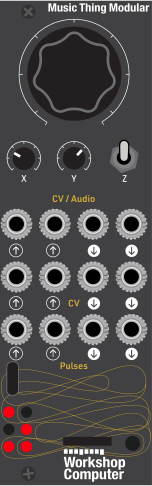 Density / RateDeja VuSpread / JitterBias InDensity CVSpread CVClockResetClosed HatOpen HatPitch CVMotion CVMain GateAccent Gate
Controls
Density / Rate
Sets internal clock speed and trigger activity; CV In 1 adds to it
Deja Vu
Moves from constantly rewritten randomness to repeating loop memory
Spread / Jitter
Widens the voltage range and timing jitter; CV In 2 adds to it
Coupled: More regular relationship between the two pulse streams
Sparse: More gaps and independent pulse decisions
Write: Momentary write mode; newly generated steps replace the loop aggressively
Inputs & Outputs
Inputs
Outputs
Inputs
Bias In
Optional bipolar bias control for the random voltage distribution
Density CV
Adds to the Main density/activity control, useful with Four Voltages
Spread CV
Adds to the Y spread/jitter control
Clock
External clock; when active it replaces the internal clock
Reset
Rising edge resets playback to the first captured loop step
Outputs
Closed Hat
Embedded TR-606 closed-hat sample with softened attack and retrigger crossfade
Open Hat
Embedded TR-606 open-hat sample with softened attack and retrigger crossfade
Pitch CV
Calibrated quantized pitch stream for an analogue oscillator
Motion CV
Smoothed related modulation stream for filter, slope, or VCA control
Main Gate
Primary probabilistic trigger stream
Accent Gate
Related accent/fill trigger stream
LEDs
Main Gate / Density
Flashes on Pulse Out 1, otherwise follows density
Accent Gate / Deja Vu
Flashes on Pulse Out 2, otherwise follows loop lock amount
Spread
Follows the effective spread/jitter control
Pitch CV
Follows the quantized pitch output range
Motion CV
Follows the smoothed modulation output
Clock Source
Bright when an external clock is active, dim on internal clock
README
Skipping Stones
Skipping Stones is a controlled-random patch conductor for the Music Thing Workshop Computer. It is inspired by the ideas in Mutable Instruments Marbles: related random gates and voltages, deja-vu loop memory, bias/spread shaping, clocked uncertainty, and repeatable musical chance.
It is designed for the Workshop System as a complete performance setup. Patch CV Out 1 to a SineSquare oscillator pitch input, Pulse Out 1 to a Slope trigger, CV Out 2 to a filter, slope time, or VCA/ring-mod control, and Pulse Out 2 to a second Slope or accent destination. The audio outputs provide closed and open hi-hats so the card still makes a useful rhythm bed before any analogue patching.
Controls
| Control | Function |
|---|---|
| Main | Internal rate and trigger density |
| X | Deja Vu: from new randomness to locked loop memory |
| Y | Spread and timing jitter |
| Switch Up | Coupled mode: more regular relationship between the two pulse streams |
| Switch Middle | Sparse mode: more gaps and independent pulse decisions |
| Switch Down | Write mode: aggressively replaces steps in the loop while held |
| CV In 1 | Adds to density/rate, good with Four Voltages |
| CV In 2 | Adds to spread/jitter |
| Audio In 1 | Bias input for tilting the random voltage distribution |
| Pulse In 1 | External clock |
| Pulse In 2 | Reset to the start of the captured loop |
Outputs
| Output | Function |
|---|---|
| CV Out 1 | Calibrated quantized pitch CV |
| CV Out 2 | Smoothed related modulation CV |
| Pulse Out 1 | Main gate stream |
| Pulse Out 2 | Accent/fill gate stream |
| Audio Out 1 | Embedded TR-606 closed-hat sample, triggered by the main gate stream |
| Audio Out 2 | Embedded TR-606 open-hat sample, triggered by the accent/fill gate stream |
Notes
The firmware runs the RP2040 at 192 MHz and is copied to RAM by the linker to avoid flash-cache timing jitter in the audio interrupt. The samples are stored as 16-bit 44.1 kHz PCM and play at their native speed through a fixed-point 48 kHz playback step.
The audio voices play embedded TR-606 PCM: the closed-hat sample on Audio Out 1 and the open-hat sample on Audio Out 2. Both use a 10.7 ms attack ramp, and retriggering crossfades the prior voice for 2.7 ms to avoid a discontinuity.
This is not a direct source port of Marbles. It uses the same broad instrument ideas, adapted to the Workshop Computer's two CV outputs, two pulse outputs, audio outputs, and three-knob/switch panel.
Attribution And Licence
Skipping Stones program code is released under the MIT License in LICENSE.
It uses ComputerCard version 0.3.0 by Chris Johnson, distributed with the
Music Thing Modular Workshop Computer repository. Its interface header remains
attributed in ComputerCard.h.
The design is inspired by Mutable Instruments Marbles by Emilie Gillet. No Mutable Instruments source code is included; the random, loop-memory, and distribution logic was independently written for this card.
Firmware distribution notices
See THIRD_PARTY_NOTICES.md for dependency
copyright and license texts. Keep the accompanying NOTICE.txt with
each UF2 when redistributing it.