
197 Cosmik M1N1
A monophonic Workshop Computer synth voice with two band-limited wavetable oscillators, external OSC3 pitch CV and audio return, a four-pole resonant low/high-pass filter, noise, ADS contours, internal LFO, MIDI CC1 modulation, glide, and eight factory plus eight named user presets.
Panel
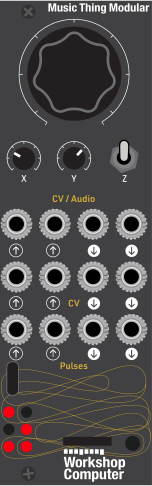 CutoffResonanceFilter ContourPitch CVOSC3 ReturnFilter CVMod SourceGate 1Gate 2Filtered VoicePre-filter MixOSC3 PitchLoudness EnvelopeGate 1 Mirror
Controls
Cutoff
Filter cutoff.
Resonance
Filter emphasis/resonance.
Filter Contour
Amount of filter ADS contour.
Oscillator Setup: Edit the selected OSC1, OSC2, or external OSC3 page.
Filter Voice: Cutoff, resonance/emphasis, and filter contour.
Modulation / Noise / Presets: Short hold edits modulation, a longer hold edits noise, and long holds enter preset selection.
Inputs & Outputs
Inputs
Outputs
Inputs
Pitch CV
Calibrated 1V/oct pitch CV when no USB MIDI note is active.
OSC3 Return
External oscillator audio return for the pre-filter mixer.
Filter CV
Positive filter-cutoff modulation.
Mod Source
External OSC3 or other modulation source selectable in the Web UI.
Gate 1
Gates the amplifier and filter ADS contours; mirrored at Pulse Out 1.
Gate 2
Additional gate input for the amplifier and filter ADS contours.
Outputs
Filtered Voice
Main four-pole filtered mono voice output.
Pre-filter Mix
Mixer output before the resonant filter.
OSC3 Pitch
Calibrated external OSC3 1V/oct pitch CV, with C3 at 0V and shared glide.
Loudness Envelope
Amplifier ADS envelope CV.
Gate 1 Mirror
Mirrors Pulse In 1.
README
Cosmik M1N1
Cosmik M1N1 is a Minimoog-influenced monophonic voice for the Music Thing Modular Workshop Computer. It combines two internal band-limited oscillators, an external OSC3 pitch/CV loop, a four-pole resonant filter, noise, ADS contours, a free-running LFO, USB MIDI, and Web MIDI preset management.
Release 1.0.0
Flash uf2/COSMIK_M1N1_1.0.0.uf2. The release UF2 is built from the accepted
musical-glide firmware and is accompanied by SHA256SUMS.txt.
Voice
- OSC1 and OSC2 offer triangle, sharktooth, saw, square, wide rectangle, and narrow rectangle waveforms. Nine pitch-selected harmonic bands reduce aliasing while preserving distinct waveform character.
- Each internal oscillator has a
32'--2'pipe-length range, a seven semitone fine range around noon, its own level, and waveform selection. - External OSC3 uses
CV Out 1for calibrated pitch,Audio In 2as its mixer return, andCV In 2as an external modulation source. C3 is 0 V, matching the Workshop System and Keystep convention. Audio Out 1is the filtered voice.Audio Out 2is the pre-filter mixer.- White and pink noise have independent level and colour selection.
Front Panel
- Middle: Main is cutoff, X is resonance/emphasis, and Y is filter contour.
- Up: edits the selected OSC1, OSC2, or external OSC3 page. A short Down press cycles the selected oscillator page. Main controls pitch/offset, X controls level, and Y selects waveform for internal oscillators or range for external OSC3.
- Down, short hold: Main is external OSC3 offset, X is MOD DEPTH, and Y is pitch/filter modulation balance. MIDI CC1 adds temporary depth here without changing the stored setting.
- Down, held longer than half a second: Main controls noise level, X selects white or pink noise across a small noon dead zone, and Y is MOD MIX.
- Preset selection: hold Down at startup, or hold it for five seconds during operation. LED 4 warns after four seconds. Factory voices and only populated user slots are available; LED 5 identifies the user bank.
- Soft pickup prevents knob jumps whenever the switch position or oscillator page changes.
Filter, Contours, And Modulation
Audio Out 1 uses a four-pole resonant ladder filter with accepted low-pass
and high-pass modes. The Web UI supplies cutoff mode, emphasis, filter contour,
independent amplifier and filter ADS controls, independent decay-release
switches, and None/1/3/2/3/Full keyboard tracking.
MOD SRC A selects External OSC3 / CV In2 or Filter Contour. MOD SRC B selects Noise, external modulation on CV In2, or the internal LFO. MOD MIX crossfades those sources; MOD DEPTH and pitch/filter balance set their amount and destination. The internal LFO is free-running, triangle or square, and covers 0.05--14 Hz. Oscillator and filter modulation can be independently enabled.
Glide is preset-backed and acts on the underlying MIDI or 1 V/oct pitch before
modulation. CV Out 1 follows the same glide, keeping a patched external OSC3
in step with OSC1 and OSC2.
Inputs And MIDI
Audio In 1: calibrated 1 V/oct pitch CV for OSC1 and OSC2.Audio In 2: external OSC3 audio return.CV In 1: positive filter-cutoff modulation.CV In 2: external OSC3 or other external modulation source.Pulse In 1andPulse In 2: gate the amplifier and filter contours.Pulse Out 1: mirrorsPulse In 1;Pulse Out 2is held low.- USB MIDI: mono, last-note-wins note on/off, pitch bend at +/-2 semitones,
and CC1 modulation depth. An active MIDI note takes pitch priority over
Audio In 1; gate sources remain ORed, so a pulse gate can hold a contour after MIDI note-off.
Web MIDI
Serve web/ locally in Chrome or Edge, connect the card with the Web MIDI
button, then use the complete voice editor, eight factory voices, and eight
named card-backed user slots. The UI can save, recall, duplicate, and delete
user voices, provides a developer MIDI monitor, and polls live card changes
back into the interface. Earlier user slots migrate safely with Glide at zero.
Release Verification
Release 1.0.0 passed the following Workshop System and Keystep tests:
- OSC1, OSC2, and external OSC3 range/pitch tracking, including glide.
- Harmonic-band transitions and distinct waveform character.
- Low/high-pass filter mode, contour, keyboard tracking, resonance, and ADS.
- White/pink noise, modulation-source routing, internal LFO, and MIDI CC1.
- USB MIDI, calibrated pitch CV, pulse gates, MIDI/CV priority, and pulse mirror output.
- Factory/user preset selection, Web MIDI sync, save/recall/delete, and persistence across power cycles.
Build
Set PICO_SDK_PATH to a Raspberry Pi Pico SDK checkout, then run:
cmake -S . -B build -DPICO_NO_PICOTOOL=1
cmake --build build -j2
Provenance
The initial platform, USB MIDI host support, and lookup-table framework derive
from Workshop_Computer/releases/101_Gnarly_C1ZZL3 at commit
bf4ecbbed2f2075a6d008f2cba18f70502593b86. The inherited code and licence
notices remain under the MIT License.
Cosmik M1N1 uses the ComputerCard framework by Chris Johnson. The bundled
computercard.h is the canonical ComputerCard 0.4.0 release under the MIT
License.
The USB MIDI host driver files retain the MIT copyright notices from rppicomidi (2023). Raspberry Pi Pico SDK and TinyUSB are external build dependencies and are not vendored in this release directory.
Firmware distribution notices
See THIRD_PARTY_NOTICES.md for dependency
copyright and license texts. Keep the accompanying NOTICE.txt with
each UF2 when redistributing it.