
20 Reverb+
Reverb+ combines a CV-controllable Hall Reverb algorithm with a flexible range of other utilities: MIDI to gate/CV, Bernoulli gate, Turing Machine, sample & hold, and two internal clock sources, all with associated clock dividers. These utilities are configured through a browser-based editor.
Panel
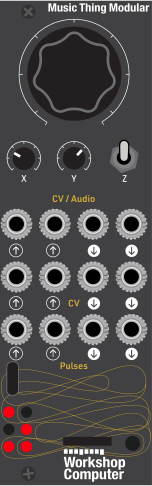 Reverb wet/dryReverb decayReverb toneReverb In+Reverb In-CV In 1CV In 2Pulse In 1Pulse In 2Reverb Out LeftReverb Out RightCV Out 1CV Out 2Pulse Out 1Pulse Out 2
Controls
Reverb wet/dry
Can be re-assigned in the web editor
Reverb decay
Can be re-assigned in the web editor
Reverb tone
Can be re-assigned in the web editor
Noise gate off: The input signal passes directly into the reverberator
Noise gate on: A noise gate is applied to the combined reverb input, useful for noisy input signals with long periods of silence.
Reverb Freeze: The reverb is frozen: the input to the reverb is muted and the reverb decay is extended to infinity.
Inputs & Outputs
Inputs
Outputs
Inputs
Reverb In+
Summed with inverted IN- to form mono reverb input
Reverb In-
Fixed reverb input contribution, summed into mono reverb input
CV In 1
Default: adds to reverb decay
CV In 2
Default: adds to reverb wet/dry
Pulse In 1
Default: freeze reverb
Pulse In 2
Default: clock Turing machine
Outputs
Reverb Out Left
Stereo reverb output (left)
Reverb Out Right
Stereo reverb output (right)
CV Out 1
Default: stepped random noise at 60BPM
CV Out 2
Default: the analogue output of an 8-step Turing Machine, with 10% chance of flipping each bit
Pulse Out 1
Default: outputs a short (~2ms) trigger pulse at a fixed 120bpm
Pulse Out 2
Default: output of a Bernoulli gate, that toggles between high and low with a 10% probability at each trigger pulse
LEDs
Wet Level High
Upper segment of wet-output VU meter
Input Clip
Indicates clipping on reverb input path
Wet Level Mid
Middle segment of wet-output VU meter
Pulse Out 1 State
Mirrors Pulse Out 1 gate/trigger activity
Wet Level Low
Lower segment of wet-output VU meter
Pulse Out 2 State
Mirrors Pulse Out 2 gate/trigger activity
README
The top row of jacks, the Z switch, and the LEDs have fixed functions, while the knobs and the CV and pulse inputs and outputs are configurable with the web configuration editor.
Web Configuration Editor
Connect the Workshop Computer to a desktop or laptop via USB and open the Reverb+ configuration editor in a WebMIDI-compatible browser (such as Google Chrome).
The editor presents a series of editable sentences describing the module's behaviour. Clicking highlighted words changes the configuration immediately. Settings are previewed immediately but are only written to the card after clicking "Save to flash card". The configurable parameters are:
- Wet/Dry
- Decay
- Tone
- Freeze
- Pulse Out 1
- Pulse Out 2
- CV Out 1
- CV Out 2
Additional parameters appear automatically when clocks, the Turing Machine, or the Bernoulli Gate require configuration.
Restore Defaults
Hold the Z switch down while powering on or rebooting the card to restore the factory configuration.
Reverb+ Patch Tips
- The most straightforward role of Reverb+ is at both the start and end of the signal chain. CV and gate generation from Reverb+ modulates analogue filters and oscillators, which feed into the reverb. The stereo reverb outputs are connected to Mix channels 1 and 2, panned hard left and right.
- Reverb+ benefits from a bit of effort with gain staging. The top right LED is an input clipping indicator. The left column of LEDs is a wet reverb output VU meter, with the top LED solidly on meaning output clipping.
- Reverb+ is designed to be fed back into itself, with tones ranging from a tonally coloured 'halo' around the input signal, through sustained metallic timbres to outright distortion, depending on the amplitude of feedback. Try feedback through both the normal and inverting inputs, which may give different tones, or add filters, ring mod, or other effects into the feedback path.
- Modulating the Reverb Decay parameter causes a pitch shift, which can be exploited for unusual effects or even to create melodic patterns.
- CV and gate outputs can be fed back into CV and gate inputs, allowing a Sample & Hold triggered by the output of a Bernoulli Gate, clocks with randomly varying frequency, self-modulated reverb parameters, and other feedback patches.
- When the noise Sample & Hold is run continuously, the resulting white noise output reaches well into the audible range, making it useful as an audio source for percussion or for subsequent shaping with filters.
- Up to four independent pulse outputs at different frequencies can be generated - useful for exploring polyrhythms and phasing.
Configuration Notes
- The configuration interface and MIDI input connect through USB. The Reverb+ card acts as a USB MIDI device (which is connected to USB MIDI host, such as a laptop). On Workshop System Computers made in 2025 onwards (PCB revision >= 1.1), it can also act as a USB MIDI host (connected to a USB MIDI device, such as an Android phone or MIDI controller/keyboard).
- On Android, you may need to go to
Settings→Default USB Configurationand select MIDI. Connect the Android device when the Workshop System is powered off, then turn on the Workshop System power.
- On Android, you may need to go to
- MIDI note pitches use CV output calibration set by the 00 Simple MIDI card.
- Pulse outputs have gate and trigger mode: the trigger mode generates a ~2ms pulse at a rising edge of the chosen gate source, useful for triggering the Slopes module on the Workshop System.
- The clock dividers for each output are independent (not synchronised)
- The Bernoulli Gate is based loosely on Mutable Instruments Branches, and the Turing Machine on the Music Thing Modular module, with similar inputs, outputs and parameters.