
26 Clockwork
6-channel polyrhythmic clock, gate generator, LFO, and envelope card inspired by Pamela's Workout. Each output channel operates independently with its own clock division or multiplication (/2048 to x128), Euclidean sequencer (0–16 steps), 14 analog or 6 digital output shapes (envelopes, LFOs, S&H, math logic), trigger probability, and quantizer scales. Syncs to external pulse or USB MIDI clock, and includes a browser-based Web MIDI manager with live oscilloscope views and preset loading.
Panel
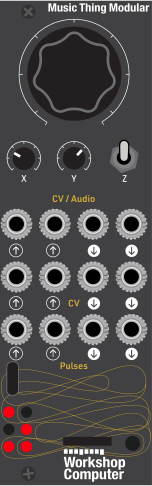 Speed Modifier / Master BPMEuclidean Steps / SwingFills / Phase Offset / HumanizeChannel 1 CV Input / Audio 1Channel 2 CV Input / Audio 2Channel 3 CV Input / CV 1Channel 4 CV Input / CV 2External Clock Sync / Pulse 1Reset / Run Gate / Pulse 2Output 1Output 2Output 3Output 4Output 5Output 6
Controls
Speed Modifier / Master BPM
Clock division (/2048 to /2), straight x1 at noon, multiplication (x2 to x128), cross-channel triggers, or MIDI mode. On Global Page: Master BPM (20–300 BPM)
Euclidean Steps / Swing
Euclidean pattern step count (0 to 16; 0 = straight clock). On Global Page: Master Swing (50%–75%)
Fills / Phase Offset / Humanize
Active Euclidean fill count when steps > 0; LFO phase offset (0–255) when steps = 0. On Global Page: Humanize / Randomization
Shape: Main = Waveform Shape (Global: PPQN); X = Level / Phase Delay (Global: Seed); Y = Wave Parameter (Global: Pulse 2 mode). A quick flick UP (<400ms) toggles Play/Pause.
Rhythm: Main = Speed Modifier (Global: Master BPM 20–300); X = Euclidean Steps (Global: Swing); Y = Fills / Phase Offset (Global: Humanize / Randomization).
Advanced / Page: Tap to cycle active channel page (1–6 & Global). Hold DOWN to edit Advanced Settings (Main = Loop Length 1–64; X = Probability 0–100%; Y = Step Offset or Scale. Global: Preset Slot Load/Save/Reset).
Inputs & Outputs
Inputs
Outputs
Inputs
Channel 1 CV Input / Audio 1
CV input for Channel 1: modulates wave parameter, S&H sample input, CV delay input, Math carrier, or external clock trigger depending on selected shape
Channel 2 CV Input / Audio 2
CV input for Channel 2: modulates wave parameter, S&H sample input, CV delay input, Math carrier, or external clock trigger depending on selected shape
Channel 3 CV Input / CV 1
CV input for Channel 3: modulates wave parameter, S&H sample input, CV delay input, Math carrier, or external clock trigger depending on selected shape
Channel 4 CV Input / CV 2
CV input for Channel 4: modulates wave parameter, S&H sample input, CV delay input, Math carrier, or external clock trigger depending on selected shape
External Clock Sync / Pulse 1
External clock pulse sync input
Reset / Run Gate / Pulse 2
Clock reset trigger input or run gate
Outputs
Output 1
Channel 1 bipolar/unipolar CV/LFO/gate output
Output 2
Channel 2 bipolar/unipolar CV/LFO/gate output
Output 3
Channel 3 bipolar/unipolar CV/LFO/gate output
Output 4
Channel 4 bipolar/unipolar CV/LFO/gate output
Output 5
Channel 5 digital gate output (Gate, Ratchet, Trigger, Burst, Random, Utility)
Output 6
Channel 6 digital gate output (Gate, Ratchet, Trigger, Burst, Random, Utility)
LEDs
Channel 1 / Matrix Bit 0
Lights when Channel 1 is active page; indicates top-left bit of waveform 3x2 matrix
Channel 2 / Matrix Bit 1
Lights when Channel 2 is active page; indicates top-right bit of waveform 3x2 matrix
Channel 3 / Matrix Bit 2
Lights when Channel 3 is active page; indicates mid-left bit of waveform 3x2 matrix
Channel 4 / Matrix Bit 3
Lights when Channel 4 is active page; indicates mid-right bit of waveform 3x2 matrix
Channel 5 / Matrix Bit 4
Lights when Channel 5 is active page; indicates bot-left bit of waveform 3x2 matrix
Channel 6 / Matrix Bit 5
Lights when Channel 6 is active page; indicates bot-right bit of waveform 3x2 matrix
README
Clockwork
A 6-channel polyrhythmic timing and modulation card for the Workshop Computer, inspired by ALM Pamela’s Workout.
Clockwork turns the Workshop Computer into a central clock generator, gate sequencer, LFO source, and USB MIDI interface. Each of its 6 independent outputs generates clock divisions and multiplications, Euclidean rhythms, custom LFO shapes, or decay envelopes.
- 6 Output Channels: Configure each channel independently for gates, ratchets, envelopes, LFOs, random voltages, or CV delay lines.
- Euclidean Engine: Built-in Euclidean pattern generators (0 to 16 steps) with fills and step rotation offsets.
- Clock Sync: Automatically syncs to incoming USB MIDI clock or external pulse clock, or runs on its internal clock engine.
- USB Device & Host Modes: Connect to a computer for Web MIDI Manager telemetry and DAW clock sync, or plug a USB MIDI controller directly into the card in host mode to drive channels with MIDI note, velocity, and pitch.
- Web MIDI Manager: Interactive browser-based editor (
web/index.html) with real-time oscilloscope telemetry, Euclidean orbits, and preset backup.
Videos & Media
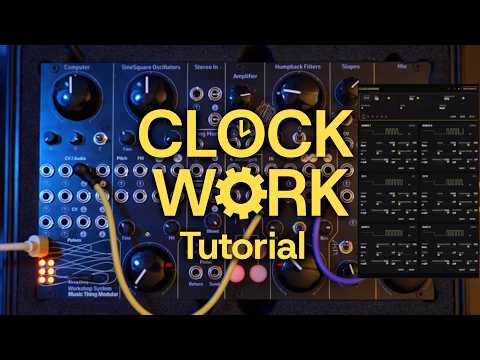
- Tutorial Walkthrough: Clockwork Tutorial Video
- Performance Demo: Clockwork Demo Video
Patch Ideas
- Synthesized Kick Drums: Set an analog output channel to
EnvelopeorLog Envshape with a short decay time. Patch the output directly into an oscillator's pitch or filter FM input to synthesize punchy kick drums. - Euclidean Snare & Percussion Patterns: Set a digital gate output to a Euclidean rhythm (e.g., 12 or 16 steps with 5 fills) and ratchet subdivisions. Use the gate to trigger a noise generator or slope generator for shifting percussion.
- Quantized Sample & Hold Melodic Lines: Set an analog output channel to
S&Hshape, set its speed modifier to a cross-channel trigger (so it clocks in sync with another channel), and enable a quantizer scale (e.g. Minor Pentatonic or Harmonic Minor). Set pattern loop length to 8 or 16 steps for repeating, in-key melodic sequences and arpeggios. - Cross-Modulated Waveforms & Math Logic: Set an analog channel to
Mathshape and select another channel's LFO or trigger as the modulator. Use Knob Y in Shape mode to combine the signals using Multiplication (*), Minimum (min), Maximum (max), or Logic operators (AND, OR, XOR) to generate complex, evolving modulation waves.
Operating Modes & Switch Controls
Clockwork uses Switch Z (Up, Middle, and spring-loaded momentary Down) to navigate pages and adjust settings:
| Switch Position | Mode Name | Description |
|---|---|---|
| Middle | Rhythm | Main = Speed Modifier (/2048 to /2, x1 at noon, x2 to x128, Cross-Triggers, MIDI Mode); X = Euclidean Steps (0 to 16); Y = Fills (when steps > 0) or LFO Phase Offset (when steps = 0). |
| Up | Shape | Main = Waveform Shape; X = Output Level / Phase Delay (bipolar -100% to +100%); Y = Wave Parameter (pulse width, decay, or math operator).Short flick UP (<400ms) toggles Play/Pause. |
| Down (Held) | Advanced | Main = Pattern Loop Length (1 to 64 steps, 0 = infinite); X = Trigger Probability (0% to 100%); Y = Step Rotation Offset (when steps > 0) or Quantizer Scale (when steps = 0). |
| Down (Tap) | Page Cycle | Tap briefly to step forward through channels 1–6 and the Global Page (indicated by lit LEDs). Hold slightly and release to cycle backward. |
Global Page Settings (All 6 LEDs Pulsing)
Cycle past Channel 6 to reach the Global Page:
- Switch Middle: Main = Master BPM; X = Swing; Y = Humanize / Randomization (subtle timing jitter at lower settings; skips beats or randomizes voltages at higher settings).
- Switch Up: Main = External Clock PPQN; X = Random Seed (swaps random sequence patterns); Y = Pulse 2 Input Mode (selects Gate or Run gate).
- Switch Down (Held): Preset Menu: Main = Select preset slot (1–6) or Reset; X = Turn left to Load, right to Save, or Reset.
Special Speed Modifier Settings (Right Side of Speed Knob)
Rotating the Main Speed knob past x128 in Middle mode accesses special clocking modes:
- Cross-Channel Triggers: Clocks the active channel loop from another channel's gate transitions (e.g. Channel 2 clocks Channel 1). Ideal for synced Sample & Hold or cross-clocked LFOs.
- MIDI Mode: Clocks the channel from USB MIDI input (Channels 1–6). Automatically maps MIDI notes, velocity, or pitch to output shapes.
Quantizer Scales (Switch DOWN Held, Steps = 0)
Turn Knob Y while holding Switch DOWN (when Euclidean steps = 0) to snap smooth random walks or LFOs to musical scales for playing melodies and arpeggios:
OFF (Raw CV), CHRO (Chromatic), MAJ (Major), MPEN (Major Pentatonic), MIN (Natural Minor), MINP (Minor Pentatonic), DOR (Dorian), MIXO (Mixolydian), LYD (Lydian), PHRY (Phrygian), HMIN (Harmonic Minor).
Panel Jack Reference
Inputs (Jacks 1–4 correlate to Channels 1–4)
Patching a cable into jacks 1–4 overrides default channel behavior depending on active shape:
- Audio In 1 (Channel 1 CV Input / Audio 1): Modulates Channel 1 wave parameter, S&H sample input, CV delay input, Math carrier, or external clock trigger.
- Audio In 2 (Channel 2 CV Input / Audio 2): Modulates Channel 2 wave parameter, S&H sample input, CV delay input, Math carrier, or external clock trigger.
- CV In 1 (Channel 3 CV Input / CV 1): Modulates Channel 3 wave parameter, S&H sample input, CV delay input, Math carrier, or external clock trigger.
- CV In 2 (Channel 4 CV Input / CV 2): Modulates Channel 4 wave parameter, S&H sample input, CV delay input, Math carrier, or external clock trigger.
- Pulse In 1 (External Clock Sync / Pulse 1): External clock pulse sync input.
- Pulse In 2 (Reset / Run Gate / Pulse 2): Clock reset trigger input or run gate.
Outputs
- Audio Out 1 (Output 1): Channel 1 bipolar/unipolar CV, LFO, envelope, or gate output (SPI DAC).
- Audio Out 2 (Output 2): Channel 2 bipolar/unipolar CV, LFO, envelope, or gate output (SPI DAC).
- CV Out 1 (Output 3): Channel 3 bipolar/unipolar CV, LFO, envelope, or gate output (PWM).
- CV Out 2 (Output 4): Channel 4 bipolar/unipolar CV, LFO, envelope, or gate output (PWM).
- Pulse Out 1 (Output 5): Channel 5 digital gate output (Gate, Ratchet, Trigger, Burst, Random, Utility).
- Pulse Out 2 (Output 6): Channel 6 digital gate output (Gate, Ratchet, Trigger, Burst, Random, Utility).
Output Waveforms & Parameter Reference
Active shapes are displayed on the 6 panel LEDs as a 3x2 matrix (● = ON, ○ = OFF):
Row 1: [LED 0] [LED 1]
Row 2: [LED 2] [LED 3]
Row 3: [LED 4] [LED 5]
1. Analog Outputs (Channels 1–4 / Jacks 1–4)
Bipolar (-6V to +6V) or unipolar (0V to +6V).
| Index | Shape Name | LED Matrix (3x2) | Knob Y Parameter |
|---|---|---|---|
| 0 | Gate | ○○ / ○○ / ○○ | Duty cycle / pulse width |
| 1 | Ratchet | ●○ / ○○ / ○○ | Subdivisions (2, 3, 4, 6, 8, 12, or 16 pulses) |
| 2 | Sine | ○● / ○○ / ○○ | Phase offset (0° to 360°) |
| 3 | Triangle | ●● / ○○ / ○○ | Skew (falling saw ↔ tri ↔ rising saw) |
| 4 | Saw ↑ | ○○ / ●○ / ○○ | Curve skew (log ↔ linear ↔ exp) |
| 5 | Saw ↓ | ●○ / ●○ / ○○ | Curve skew (log ↔ linear ↔ exp) |
| 6 | Trapezoid | ○● / ●○ / ○○ | Peak flat sustain duration |
| 7 | Hump | ●● / ●○ / ○○ | Peak center skew |
| 8 | Envelope | ○○ / ○● / ○○ | Linear decay duration |
| 9 | Log Env | ●○ / ○● / ○○ | Exponential decay duration |
| 10 | S&H | ○● / ○● / ○○ | Random Sample & Hold (1V/Oct pitch in MIDI mode) |
| 11 | Smooth | ●● / ○● / ○○ | Smoothing/slew rate (MIDI velocity in MIDI mode) |
| 12 | Delay | ○○ / ●● / ○○ | CV delay feedback level |
| 13 | Math | ●○ / ●● / ○○ | Math logic operator (Mix, Sub, Min, Max, Mult, AND, OR, XOR) |
2. Digital Gate Outputs (Channels 5–6 / Jacks 5–6)
Unipolar (0V to +6V).
| Index | Shape Name | LED Matrix (3x2) | Knob Y Parameter |
|---|---|---|---|
| 0 | Gate | ○○ / ○○ / ○○ | Pulse width / duty cycle |
| 1 | Ratchet | ●○ / ○○ / ○○ | Double trigger spacing |
| 2 | Trigger | ○● / ○○ / ○○ | Phase delay (10ms fixed pulse width) |
| 3 | Burst | ●● / ○○ / ○○ | Pulse count (1 to 8 triggers) |
| 4 | Random | ○○ / ●○ / ○○ | Max random gate width scale |
| 5 | Utility | ●○ / ●○ / ○○ | Utility mode (1 PPQN, 4 PPQN, 24 PPQN, Run Gate) |
Web MIDI Manager
Open web/index.html in Chrome or Edge, or visit the online Clockwork Web Manager.
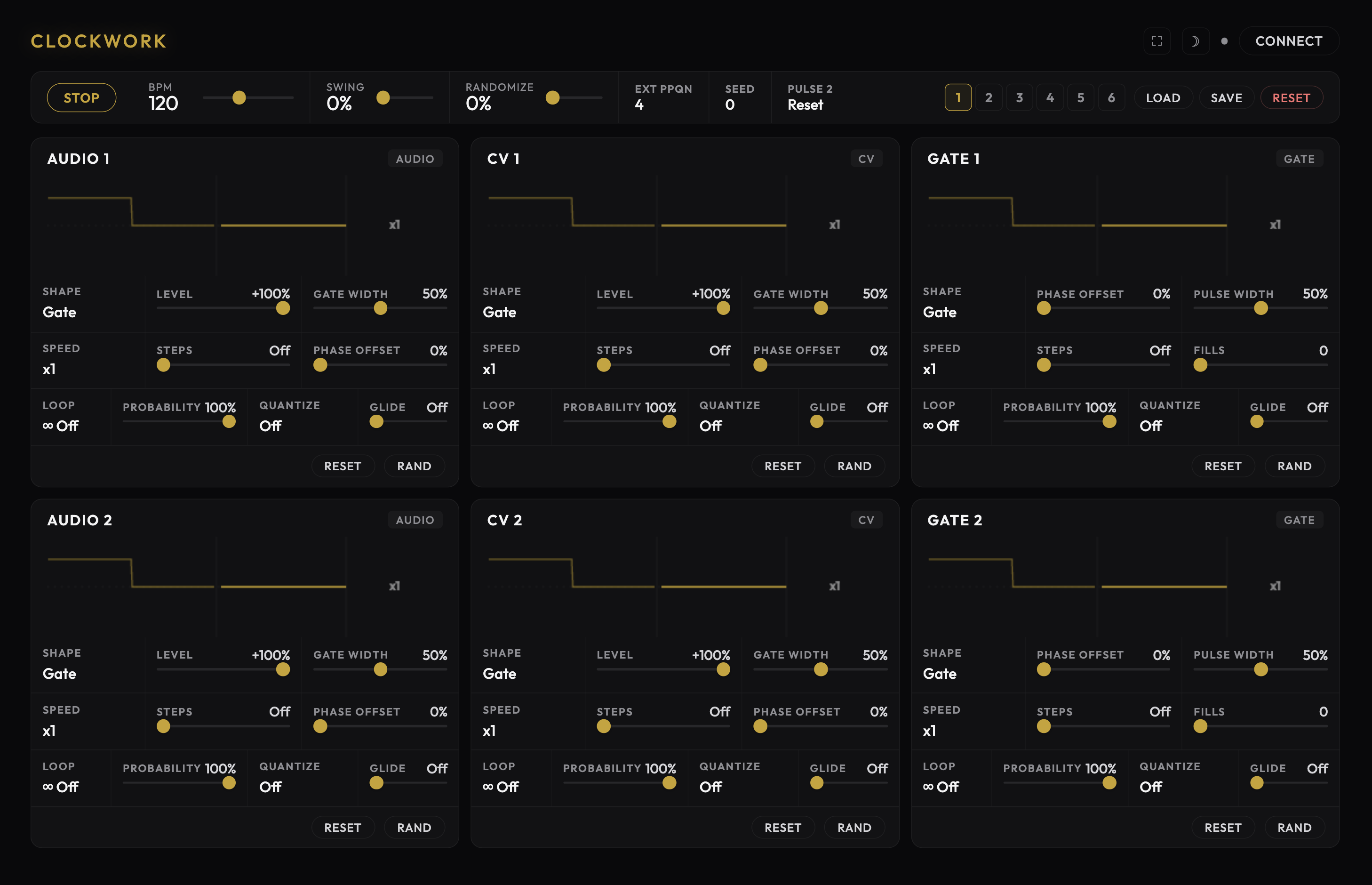
- Live Oscilloscope: Monitor output voltages across all 6 channels in real time.
- Euclidean Orbits: Concentric rings showing step counts, active fills, phase offsets, and rotations.
- Instant Hardware Sync: Turning hardware knobs updates the web browser live, and tweaking web UI controls updates the card immediately.
- Preset Manager: Save, load, name, and back up 6 preset slots to disk or internal flash memory.
- Routing & Scale Controls: Configure cross-channel triggers, math operators, and quantizer scales visually.
Building from Source (Developer Info)
mkdir build
cd build
cmake ..
make
Flash the generated clockwork.uf2 by holding BOOTSEL while connecting the card via USB-C.
Created for the Music Thing Modular Workshop System by Vincent Maurer with assistance from Google Gemini. Special thanks to Tom Whitwell and Chris Johnson.