
333 Spatial Disorientation
A headphone spatializer for two independent mono sources. Choose Twin Orbits, Spatial Mixer or Disorientation at startup. Disorientation offers Fig8, Pendulum and Wander, selected and saved through the editor or cycled live with an 8mu D tap. Separate mode settings, named preset files and source-aware Mixer pickup make it playable from panel, CV or 8mu. Beta package of the user-tested alpha14 firmware. Horizontal positioning only; elevation will be iterated on at a later date.
Panel
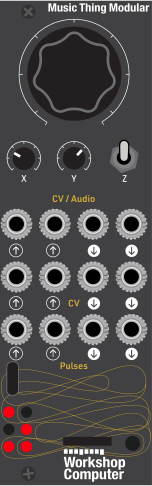 Position / ShapeSpeed / DistanceDistance / Level / ExcursionSource ASource BPosition / Shape CVDistance / Excursion CVMovement ClockPhase ResetLeft EarRight Ear
Controls
Position / Shape
Orbits offset; Mixer selected-source position; Fig8/Wander depth or Pendulum arc centre. Selects the startup mode while Down is held.
Speed / Distance
Signed movement speed with centre stop in Orbits/Disorientation; selected-source distance in Mixer.
Distance / Level / Excursion
Orbits distance; Mixer selected-source level; Disorientation excursion.
Linked / Source A: Linked movement in Orbits/Disorientation; selects A in Mixer.
Opposing / Retain Source: Opposing movement in Orbits/Disorientation; retains the selected Mixer source.
Reset / Source B / Hold Freeze: Orbits resets once per press; Mixer selects B; Disorientation freezes phase while held. Hold at startup and choose a mode with Main, then release.
Inputs & Outputs
Inputs
Outputs
Inputs
Source A
First independent mono source; unplugged input is silent.
Source B
Second independent mono source; unplugged input is silent.
Position / Shape CV
Adds position in Orbits/Mixer; depth or arc-centre modulation in Disorientation.
Distance / Excursion CV
Adds distance in Orbits/Mixer; overall movement excursion in Disorientation.
Movement Clock
Clocks phase cycles in Orbits/Disorientation; unused in Mixer. Default four pulses per cycle.
Phase Reset
Rising edge resets phase in Orbits/Disorientation, including while frozen; unused in Mixer.
Outputs
Left Ear
Binaural left mix; connect through a headphone monitoring path.
Right Ear
Binaural right mix; connect through a headphone monitoring path.
LEDs
A Left
Source A left/right direction pair; Mixer selected pair blinks while panel pickup is pending.
A Right
Source A right-side brightness; equal pair brightness can mean front or back.
B Left
Source B left/right direction pair.
B Right
Source B right-side brightness; Mixer selected pair blinks while panel pickup is pending.
Linked / Editing A
Linked motion in Orbits/Disorientation; editing A in Mixer. During boot selection, left column selects Mixer.
Timing Warning
Latches for callback at least 18 us, block at least 1200 us or an audio queue fault. Hardware reset clears it. During boot selection, right column selects Disorientation.
README
Spatial Disorientation — card 333
Beta · 0.1.0-alpha14 · Adrian Vos (soveda)
Two independent mono sources become a binaural stereo mix: orbit around the listener, place each source separately, or choose Fig8, Pendulum and Wander movement. Musical inspiration: Neuzeit Instruments Quasar. This is an independent implementation, with no Quasar code, graphics or data.
Use headphones through a suitable monitoring path. This version renders horizontal direction and distance; elevation is a future refinement. 333 is a mnemonic for three spatial axes, not a claim that height is implemented.
Original code/documentation © 2026 Adrian Vos (soveda), MIT. Dependencies and measurement data retain their own terms; see attribution. Keep uf2/NOTICE.txt with redistributed firmware. This follows the notice packaging of Adrian Vos's card 122 and the component-notice standard of card 369; it does not adopt card 369's application freeware license.
Load and start
Flash the tested alpha14 UF2 using the Workshop Computer BOOTSEL procedure. The binary is unchanged from the user-tested development build; checksum. Patch mono Audio 1, optionally a different source to Audio 2. Audio Out 1/2 are the left/right binaural mix. Unplugged inputs are silent. CV outputs are nominal zero and pulse outputs low.
Normal boot always selects Twin Orbits. To select another function, hold Down during reset/startup, choose with Main, then release:
| Main third | Function | Startup LEDs |
|---|---|---|
| Lower | Twin Orbits | All off |
| Middle | Spatial Mixer | Left column |
| Upper | Disorientation | Right column |
Audio is muted during selection. Mode remains fixed until reset and is not saved.
Twin Orbits
Start Main/X at noon, Y low; turn X slightly right to begin a slow orbit.
| Control | Behaviour |
|---|---|
| Main | Position offset; noon puts A front after phase reset |
| X | Signed speed; centre stops, extremes approach 1.5 turns/sec |
| Y | Distance: quieter, darker, later, with greater reflected/direct balance |
| Up / middle | Linked / opposing traversal |
| Down | Phase reset once per press; retains the prior relationship while held |
| CV1 / CV2 | Add position / distance |
| Pulse1 / Pulse2 | Movement clock / rising-edge phase reset |
X has a centre deadband of approximately ±3% of total travel (6% total width). Clock lock requires two valid edges; intervals 25 ms–60 s. Clocked speed is capped at 2 cycles/sec. Unpatching restores manual speed; timeout is the greater of 3 seconds or three clock intervals. Use pulse widths at least 1 ms. Default clock division is four pulses per turn. CV inputs are nominal, not calibrated.
Spatial Mixer
Up selects A; Down selects B; middle retains the last selection. Main sets that source's position (noon front, ends back), X distance and Y panel level. Both sources retain their placements. CV1/CV2 modulate both positions/distances without changing the saved base; pulse inputs are unused.
Knobs require near/crossing pickup after source selection or placement restoration (about 1.6% tolerance). The selected top/middle LED pair blinks until all three controls are picked up. Defaults: A front, B back, both near at full panel level. Editor A/B trims multiply the individual panel levels. The editor can Read/Apply/ Save both placements, with separate Mixer settings. Separation/clock fields are unused in Mixer.
Disorientation
Choose Fig8, Pendulum or Wander in the editor; Apply auditions and Save retains the choice. Fig8 is the default. Begin with a slow X speed and listen without the display for the first placement comparison.
| Movement | Main / CV1 | Y / CV2 |
|---|---|---|
| Fig8 | Front/back depth of crossing loops | Overall excursion |
| Pendulum | Arc centre: minimum front, noon right, maximum nearly back | Swing width up to ±90° |
| Wander | Front/back reach of smooth random positions | Overall excursion |
X controls signed phase speed, centre stops, maximum 1.5 cycles/sec. Up/middle links/opposes the two source phases. Down held freezes phase; release resumes. CV and shape controls can still reshape a frozen position. Pulse1 clocks phase; Pulse2 resets even while frozen. Editor separation offsets source path phase.
Fig8 crosses in front and reaches behind at greater depth/excursion. Pendulum reverses along the same arc at fixed 25% distance. Wander smoothly joins deterministic random positions, with four transitions per phase cycle; reversing X retraces the route. Reset restarts its sequence. Y minimum collapses Fig8/Wander to a front point and Pendulum to its selected centre; it does not mute audio.
Web editor and presets
Open web/index.html in desktop Chrome/Edge. Use a USB-C data cable, close Serial Monitor/other apps, enable MIDI with SysEx permission and select Spatial Disorientation for both ports. iOS is unsupported. If local file MIDI access is blocked, serve the self-contained page from localhost:
python3 -m http.server 8793 --bind 127.0.0.1 --directory web
Visit http://127.0.0.1:8793. The page has no external scripts/services.
- Read: retrieve applied base settings and current Mixer placements.
- Apply: audition staged edits. Ordinary slider edits are not sent automatically.
- Save to card: persist applied settings/placements/default movement; briefly fades audio during the flash write. Apply dirty edits first.
- Reset to init: apply defaults for the active mode; Save separately to retain.
- Export: download displayed settings, including unapplied edits.
- Import: stage a named JSON preset; choose the matching startup mode, then Apply/Save.
Each mode has its own six base settings: phase/angular separation, room, A/B trims, strength and clock division. Mixer adds six placement values; Disorientation adds movement. Defaults: 180° separation, about 29% room, 50% trims, full strength, four clock pulses/cycle, Fig8. Panel controls, CV, phase, motion and live 8mu overrides are excluded from saved configuration.
This editor/firmware uses SysEx and JSON v3, flash v4. Old v1/v2 presets import; old Disorientation presets choose Fig8. Flash v1/v2/v3 migrates in RAM without a boot write, preserving prior banks/placements. Only explicit Save writes flash. Older firmware cannot read v4; export presets before saving if you may downgrade. A corrupt/absent record restores defaults; power-loss recovery is not guaranteed. Protocol details.
Direct 8mu control
Connect 8mu before reset. Rev 1.1 chooses host/device USB role at boot; earlier hardware retains device/editor mode. Change cables and reset when switching roles. Editor and 8mu are used in separate sessions. The inherited identify handshake temporarily loads the 8mu default assignments/bank 1; controller bank selection returns after power-cycling the 8mu. Host adaptation.
| Fader | Orbits / Disorientation | Mixer |
|---|---|---|
| 1 | Signed speed | Selected-source distance |
| 2 | Distance / excursion | Selected-source panel level |
| 3 | Angular / path-phase separation | Selected-source position |
| 4 | Room | Room |
| 5 / 6 | A / B trims | A / B trims |
| 7 | Spatial strength | Spatial strength |
| 8 | Motion amount | Unused |
Faders require independent near/crossing pickup. In Mixer, source selection rearms faders 1–3 against stored placements. Waiting LEDs blink; picked LEDs show level. Mixer LED8 identifies A steady/B blinking; Mixer ignores motion.
| Button | Orbits | Disorientation | Mixer |
|---|---|---|---|
| A | Reset/recentre | Reset/recentre | Select A |
| B | Toggle motion | Toggle motion | Select B |
| C held | Stop orbit speed temporarily | Freeze phase | Unused |
| D | Hold for timing | Tap cycles movement; hold for timing | Hold for timing |
Motion initially off. Orbits motion replaces Main's position; Disorientation motion replaces Main's depth/arc centre. Roll offsets the captured pose; gyro yaw is integrated as a rate. Disorientation Main values clamp at limits. Fader8 scales tilt/rate; zero removes tilt influence and stops rate integration, retaining its held base. A recaptures physical Main/current pose. CV remains additive.
In Disorientation, D release before 500 ms cycles Fig8→Pendulum→Wander; a longer hold shows timing and never cycles on release. LEDs1/2/3 identify the choice for one second. Live choice reverts to the saved movement on disconnect/new session. C and panel Down combine: release both to resume. LED8 steady bright indicates motion, bright blinking indicates Disorientation freeze; timing/selection notices take priority. Turning motion off/disconnecting holds owned Main/X/Y until panel pickup. Mixer handback preserves placements with pickup; Orbits returns to panel. Shared editor trims return to saved values on disconnect. No 8mu gesture saves flash.
LEDs, timing and verification
Top LED pair shows A's left/right direction, middle pair B's. Equal brightness can mean front or back. Bottom left indicates linked motion or Mixer editing A. Bottom right latches for callback ≥18 µs, block ≥1,200 µs or queue fault; hardware reset clears it. Crossing a warning threshold does not stop audio. An actual missed playback block outputs 64 frames of silence (1.33 ms); late audio is discarded. 8mu D diagnostics show 150 µs block-time bands; flashing all LEDs indicates a warning.
The user reports alpha14 tests pass, with peak callback 13 µs and peak block 997 µs, below warning thresholds. Run duration and measurement USB role were not supplied; callback timing excludes surrounding framework ISR work. Build and twelve sanitizer host suites plus editor lifecycle/preset tests pass. Generic short HRTFs may give front/back confusion; headphones and listener differences matter. Hardware protocols and results.
Build: set PICO_SDK_PATH to Pico SDK 2.3.0, then cmake -S . -B build and
cmake --build build -j2. ComputerCard 0.4.0 is vendored unmodified; 192 MHz / 1.15 V,
48 kHz, 32 taps, RAM execution, 64-frame block processing with two-block transport
latency (2.67 ms). Build provenance.
Attribution and licenses
Original DSP, controls, editor and documentation: Adrian Vos (soveda), MIT. Hardware/build/editor conventions: Chris Johnson's ComputerCard 0.4.0 and web_interface; host integration: Chris Johnson's WaveSeq/EightMU and rppicomidi, MIT notices preserved. Block scheduling adapts Adrian Vos/contributors' Workshop_BlockAudioCard; mathematical sine values reuse You spin me round. Pico SDK is BSD-3-Clause with component notices; TinyUSB is MIT. Newlib/GCC runtime notices and the GCC runtime exception accompany the firmware.
Measured HRTF data: Bill Gardner and Keith Martin, MIT Media Laboratory (1994), HRTF Measurements of a KEMAR Dummy-Head Microphone, Technical Report #280. Original source; retained terms and derivation. The measurements retain their attribution terms and are not relicensed under MIT. Horizontal 32-tap minimum-phase filters use separate analytical ear delays and a synthetic room model. Full source mapping, revisions and notices: THIRD_PARTY_NOTICES.md.