
404 BlackBox
It is not necessary to enter the black box to understand the nature of the function it performs. (Stafford Beer) Each time Z is pressed, the card builds a new system: voices, voltages, rhythms and the connections between them. Its workings stay sealed. What remains open are its inputs, its outputs and its behaviour. Vary an input, observe what changes, and repeat until the behaviour makes sense. Each system is unique and impermanent; press Z again and there is a new one to understand.
Panel
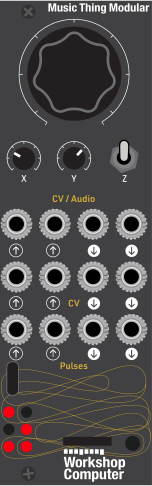 Variable 1Variable 2Variable 3Audio InAudio InCV InCV InPulse InPulse InVoice / Effect 1Voice / Effect 2CV Generator 1CV Generator 2Rhythm 1Rhythm 2
Controls
Variable 1
Moves internal settings on two of the six outputs, sometimes plus tempo. No effect at 12 o'clock, so start there and sweep both ways.
Variable 2
Moves internal settings on two other outputs, sometimes plus tempo. Neutral at 12 o'clock.
Variable 3
Moves internal settings on the remaining two outputs, sometimes plus tempo. Neutral at 12 o'clock. Between them the three knobs always reach every output.
Play (reserved): Same as middle. Reserved for saving patches in a future version.
Play: Normal running.
Mutate: Hold for about 0.6 s to mutate the current system. It keeps its character, with 2–3 things changed (a resting point, an internal connection, the scale, the tempo, a sequence or waveform).
New Patch: Briefly press and release to discard the current system and build a new one. About half a second of measuring, then it fades in. The old patch is gone for good.
Inputs & Outputs
Inputs
Outputs
Inputs
Audio In
Always acts on sound. Depending on the patch it is processed by an effect, excites a plucked string, ring-modulates or gates a voice, drives an envelope follower, or secretly modulates a parameter by its loudness. Unplugged, the patch uses internal sources instead.
Audio In
As Audio In 1, with its own independent role.
CV In
Bends one or two internal settings, like a voltage-controlled knob. Can reach voices, CV and rhythm generators, or tempo. Does nothing when unplugged.
CV In
As CV In 1, with its own destinations.
Pulse In
Each rising edge does one job, chosen per patch. It may replace the internal clock (most often on this jack), or reset, trigger, reroll or sample-and-hold part of the patch. Does nothing when unplugged.
Pulse In
As Pulse In 1. Occasionally the clock input, more often a reset, trigger, reroll or sample-and-hold.
Outputs
Voice / Effect 1
One of a synth voice, FM, plucked string, filtered noise, bytebeat, wavefolder, granular, tape delay or ring modulator. Drone or rhythmic. Level is set automatically when the patch is built.
Voice / Effect 2
A second, independent choice from the same set. Sometimes it processes Voice 1.
CV Generator 1
One of a step sequencer or Turing machine (quantised to the patch's scale, calibrated 1V/oct), LFO, smooth random, Lorenz chaos, envelope, or envelope follower. Often plays the same melody as one of the voices.
CV Generator 2
A second, independent CV generator from the same set.
Rhythm 1
One of a clock divider, Euclidean pattern, probability gate, burst generator, comparator, or additive grouping (such as 3+3+2). Often secretly triggers a voice or sequence too.
Rhythm 2
A second rhythm generator, steered toward a different clock from Rhythm 1 so the two pull against each other.
LEDs
Audio 1 level
Brightness follows the level of Audio Out 1.
Audio 2 level
Brightness follows the level of Audio Out 2.
CV 1 voltage
Off at about -5 V, half at 0 V, full at about +5 V.
CV 2 voltage
As LED 2, for CV Out 2.
Rhythm 1
Flashes on each pulse from Pulse Out 1.
Rhythm 2
Flashes on each pulse from Pulse Out 2.
README
BlackBox
It is not necessary to enter the black box to understand the nature of the function it performs. (Stafford Beer)
A sealed system of audio, voltages and pulses, freshly generated by each press of Z. Vary its inputs and observe its outputs to learn what it does.
Whatever the system, some things never change:
- Audio jacks are always sound.
- CV jacks are always voltages.
- Pulse jacks are always rhythms or events.
- Every knob always does something.
- Every patch plays on its own, so you don't need to plug anything into the inputs.
How to use it
- Set up the starter patch below.
- Leave the inputs empty and set the knobs to 12 o'clock.
- Tap Z. After about half a second a new patch fades in.
- Listen, watch the LEDs, and turn one knob at a time.
- Like it? Hold Z for about half a second to change it a little. Tap Z again to throw it away and get a new one.
Nothing is saved. Every patch is a one-off.
Starter patch
Use the patch below to get an approximate sense of what the current generation is doing.
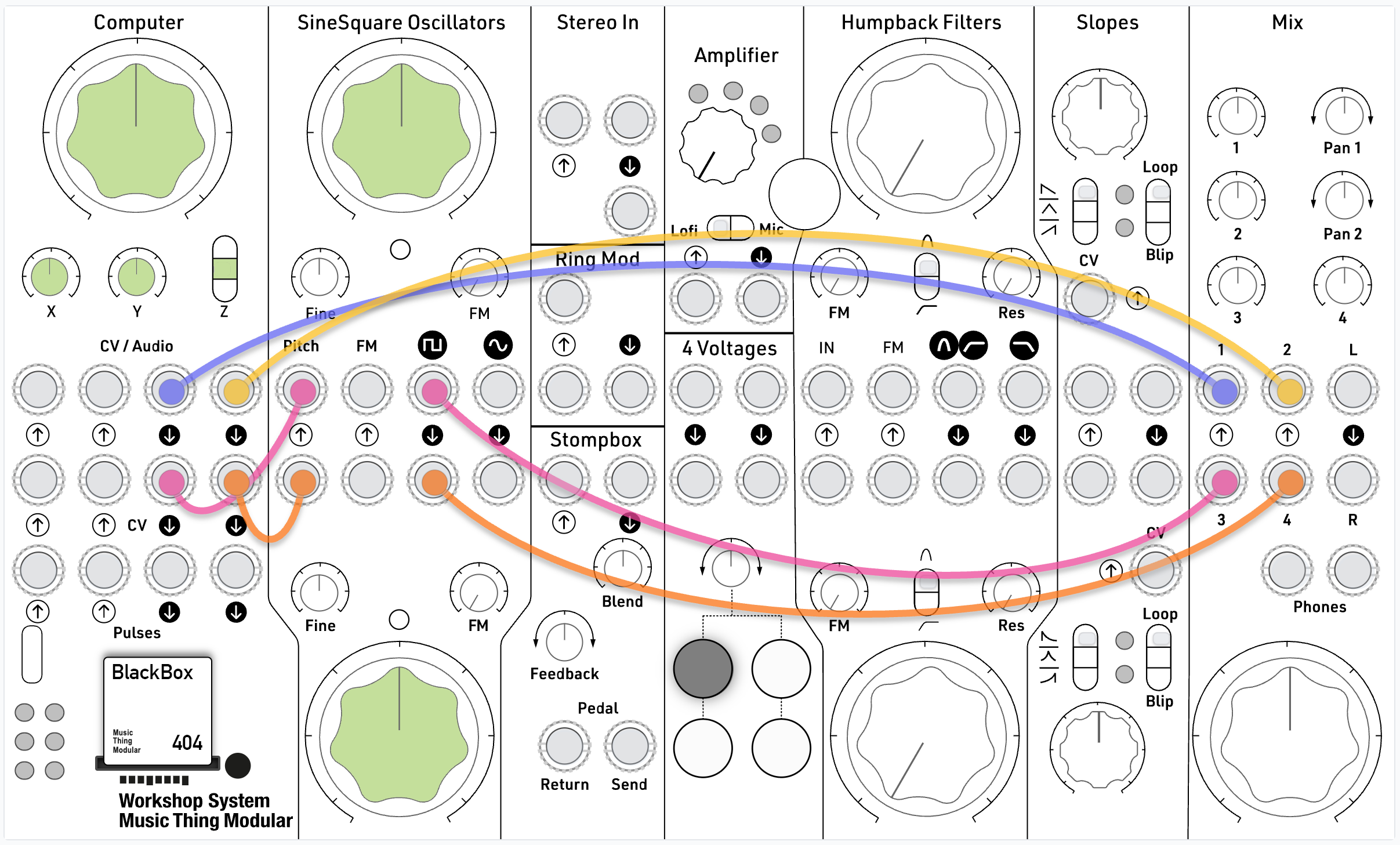
Leave all six inputs empty to begin with. Set both oscillators' pitch knobs mid-range, because the CV can swing a long way up or down.
To test the pulse outputs, unplug the oscillators from mixer channels 3 and 4, and patch the pulse outputs in instead. The pulses come through as clicks, so you can hear the two rhythms against each other. Start with those faders low, because pulses are much louder than audio. You can also just watch the bottom row of LEDs, which flash on each pulse.
Observing a system
- LEDs: top row is audio level, middle row is CV voltage, bottom row flashes on pulses.
- Audio outs: is it a drone or a rhythm? Does it follow one of the pulse LEDs?
- CV outs (on the oscillators): a melody means a sequence. A siren or vibrato means an LFO. Wandering means random or chaos. A swoop up and back down on each hit means an envelope.
- Knobs: turn one at a time from 12 o'clock, both ways. Each one changes two of the outputs, and sometimes the tempo.
- Inputs: try patching the card into itself first, such as Pulse Out 1 into Pulse In 1 or CV Out 1 into CV In 1. You already know what that signal is, so it's easier to hear what the input does.
What might be on each jack
Audio Out 1 and 2: synth voice, FM, plucked string, noise, bytebeat, wavefolder, grains, tape delay or ring mod.
CV Out 1 and 2: sequencer, Turing machine, LFO, smooth random, chaos, envelope or envelope follower. Melodies are 1V/oct.
Pulse Out 1 and 2: clock divider, Euclidean rhythm, random gate, bursts, comparator or irregular groups (such as 3+3+2).
Main, X and Y (Variables 1–3): each moves internal settings on two outputs (pitch, filter, speed, density, pattern and so on), sometimes plus tempo. Between them they reach all six outputs.
Audio In 1 and 2: processed by an effect, excite a plucked string, ring-mod or gate a voice, or move a setting by loudness.
CV In 1 and 2: bend one or two internal settings, like a knob you control with voltage.
Pulse In 1 and 2: clock, reset, trigger, reroll (shake something up) or sample-and-hold. On a grain or delay voice, trigger freezes the sound.
Z switch: tap for a new patch, hold to mutate. Up is unused.