
49 Tape Bias
Tape Bias is a first-pass mono record/replay processor inspired by 1960s reel-to-reel machines. It models record drive, virtual AC-bias calibration, tape formulation, transport speed, replay head loss, magnetic memory, and hiss without generating an ultrasonic bias carrier at the 48 kHz audio rate.

Panel
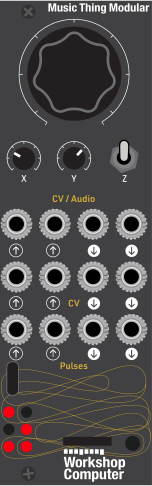 Record LevelBiasTape TypeAudio InBias CVTape CVEraseReplay OutReplay OutBias OffsetTape Flux
Controls
Record Level
Sets record drive into the magnetic transfer curve
Bias
Moves from under-biased through nominal to over-biased response
Tape Type
Moves from lower-output ferric toward higher-output tape response
3.75 ips: Slow transport with reduced replay bandwidth and stronger head loss
7.5 ips: Standard transport setting
15 ips: Fast transport with wider replay bandwidth and reduced head loss
Inputs & Outputs
Inputs
Outputs
Inputs
Audio In
Mono source recorded into the virtual tape path
Bias CV
Strong bipolar modulation of bias calibration around the X control
Tape CV
Modulates tape formulation around the Y control
Erase
Clears tape state and creates a brief replay dropout on a rising edge
Outputs
Replay Out
Virtual tape replay output
Replay Out
Duplicate virtual tape replay output
Bias Offset
Full-scale effective bias calibration relative to nominal bias
Tape Flux
Slow magnetic-memory state of the virtual tape
LEDs
Record Level
Follows the Main record-level control.
Effective Bias
Follows the X Bias control after Bias CV modulation.
Magnetic Flux
Shows the magnitude of magnetic memory and flashes fully during an erase pulse.
Over-Bias Treble
Full brightness at under-bias or nominal bias; dims as over-bias reduces replay treble.
Effective Tape Type
Follows the Y Tape Type control after Tape CV modulation.
Transport Speed
Indicates switch position: brightest at 3.75 ips, medium at 7.5 ips, and dimmest at 15 ips.
README
Tape Bias
Tape Bias is an experimental 1960s-inspired reel-to-reel record/replay processor. It models the practical consequences of AC bias calibration: record drive, under-bias roughness, over-bias treble loss, magnetic saturation, tape formulation, transport speed, replay EQ, and residual hiss.
It is deliberately separate from Tapegrade. Tapegrade is a cassette warble and damage effect; Tape Bias is a steadier record/replay machine model.
Controls
| Control | Function |
|---|---|
| Main | Record level and magnetic drive |
| X | Bias calibration, from under-biased through nominal to over-biased |
| Y | Tape formulation, from low-output ferric to higher-output tape |
| Switch Up | 3.75 ips: reduced bandwidth and stronger head loss |
| Switch Middle | 7.5 ips: standard transport setting |
| Switch Down | 15 ips: wider bandwidth and less head loss |
| CV In 1 | Bias modulation |
| CV In 2 | Tape-formulation modulation |
| Pulse In 1 | Erase tape state, reset magnetic memory, and create a brief replay dropout |
Audio In 1 is a mono input. Audio Out 1 and Audio Out 2 carry the replay signal. CV Out 1 reports the effective bias offset and CV Out 2 reports slow magnetic flux.
Bias Behaviour
At nominal bias, the model gives the most even replay response. Turning X below centre produces a brighter but rougher record characteristic with more nonlinear artefacts. Turning it above centre progressively softens the replay high end.
The firmware does not generate a literal 100 kHz bias oscillator: at the Workshop Computer's 48 kHz audio rate that would require substantial oversampling. Instead, it uses an averaged magnetic transfer curve whose saturation, high-frequency loss, and hiss vary with the virtual bias calibration.
Status
Version 0.1.1 is the current stable fallback build, hardware-tested by one person with sine, square, bass-loop, bias-CV, tape-type, and erase-input checks. It remains Beta rather than a calibrated emulation of a particular recorder or tape formulation.
Firmware distribution notices
See THIRD_PARTY_NOTICES.md for dependency
copyright and license texts. Keep the accompanying NOTICE.txt with
each UF2 when redistributing it.