
538 Bootleg Radio
A lo-fi bootleg tribute to Music Thing Modular's Radio Music - not a
replacement, but a cheaper, grubbier cousin. Named for the 538 AM pirate
broadcasters off the Dutch coast (and the Botlek, the grimy Rotterdam
docklands where sub- and pirate culture ran thick), it deliberately keeps the
hiss and the seams. Load a USB stick with WAV files, plug it into the
Computer's front USB-C jack, and tune through them like radio stations. For a
ready-made start, the
Radio Music Suggested Audio
page is a great set of loops and samples to load onto the stick and try the
card. The Main knob and CV in 1 pick the station, the X knob and CV in 2 set the
tape speed, the Y knob and Audio in 1 set the loop start, and Audio in 2 sets
the loop length. Each station loops over its window; the switch retriggers,
selects banks, or (held) changes the tune mode.
Files are grouped into banks: the root directory is bank 0, and each
subdirectory that holds WAV files is another bank (up to 32). Hold the switch
up and turn Main to change bank; a new bank starts at its first station. The
root is always bank 0 even if it holds no WAVs, in which case the card starts
silent until you pick a folder. Banks and the stations within them are
natural-sorted (case-insensitive, digits compared as numbers), so the order
matches Finder; a bank holds up to 64 stations.
Files must be uncompressed 16-bit PCM, mono or stereo, at any sample rate up
to 192kHz; they are resampled to 48kHz on the fly. This is a hacker's sampler
rather than a pristine one: the DAC is 12-bit and the resampling is simple
linear interpolation, which is part of the character.
Tuning can be a "synchronised jump" - the new file picks up at the same
proportional position where the old one stopped - so a slow sweep through the
stick keeps its place instead of restarting everything at the beginning. This
is the default "Sync" mode; holding switch-down toggles to "Loop" mode, where a
new station starts at its loop start point. A deliberate retrigger, or reaching
the loop end, restarts from the live loop start point.
Needs a Rev 1.1 or later Computer (the revision with USB host support), and
nothing else may be in the front USB socket, because the Computer has to act
as a USB host.
Panel
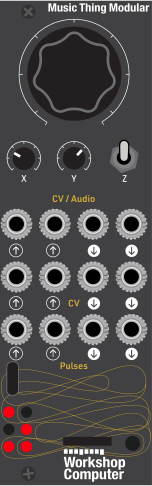 Station / BankTape SpeedLoop StartLoop Start CVLoop Length CVStation CVSpeed CVClockRetriggerAudio Out 1Audio Out 2Random CVTriangle LFOLoop GateWrap Tick
Controls
Station / Bank
Chooses the station within the current bank; CV in 1 adds to it, so patching a CV lets you tune by voltage as well as by hand. While the switch is held up, the same knob selects the bank instead.
Tape Speed
Playback rate from -2 to +2 octaves, exponential around a centre of normal speed. Slower also plays lower, like slowing a tape. CV in 2 adds to it.
Loop Start
Where the loop begins, as a fraction of the file. The loop plays from here for the loop length, then wraps back. Audio in 1 adds to it.
Select Bank: While held, the Main knob and CV in 1 select the bank (root = bank 0, then each subfolder with WAV files). A new bank starts at its first station; releasing the switch returns Main to selecting stations.
Play: Playback runs normally. A station loops over its window forever; the card never advances on its own.
Retrigger / Mode: Momentary. A short tap restarts the current station from the loop start, so the switch acts as a trigger input for the loop. Holding it for about a second toggles the tune mode between Loop and Sync; the whole panel blinks 2 times for Loop and 3 times for Sync.
Inputs & Outputs
Inputs
Outputs
Inputs
Loop Start CV
Loop start point, added to the Y knob: about -6V is the start of the file, +6V the end. The audio inputs are DC-coupled, so they read a steady voltage just like a CV input.
Loop Length CV
Loop length, as a fraction of the file: about -6V is a very short loop, 0V is half the file, +6V the whole file. Unpatched, the loop runs to the end of the file.
Station CV
Selects the station, added to the Main knob. The whole CV range sweeps evenly across every station in the current bank; while the switch is held up it selects the bank instead. When the jack is unpatched the knob works alone.
Speed CV
Tape speed, added to the X knob: about -6V is the slowest (-2 octaves), 0V is normal speed, +6V the fastest (+2 octaves). The CV inputs are bipolar, so a unipolar source sweeps only half the range.
Clock
External clock for the two CV outputs (the triangle LFO and the random CV). Unpatched, they run from an internal 120 BPM clock; patch a clock here to drive them from it. The tempo glides to the new rate and falls back to 120 BPM if the clock stops.
Retrigger
A rising edge retriggers the current station from the loop start, just like a short switch-down tap.
Outputs
Audio Out 1
Left channel (mono files appear on both outputs).
Audio Out 2
Right channel (mono files appear on both outputs).
Random CV
A random stepped voltage (bipolar), with a new value on every clock pulse (2Hz at the internal 120 BPM). Patch it into any input to step a parameter - for example CV in 2 to step the tape speed, or Audio in 1 to jump the loop start.
Triangle LFO
A bipolar triangle, one cycle per 40 clock pulses (20 seconds at 120 BPM, stretching or shrinking with an external clock), so the card doubles as a slow LFO for the rest of the rack. Patch it into CV in 1 to sweep through the stations, or CV in 2 to sweep the tape speed.
Loop Gate
By default, high while the loop is playing and low during the wrap/seek gap, so other modules can follow the loop window. settings.txt can set it to a loop-wrap tick, the active clock pulse, or off.
Wrap Tick
By default, a short pulse each time the loop wraps around to the start. settings.txt can set it to the loop gate, the active clock pulse, or off.
LEDs
Left Level
Brightness follows the left output level.
Right Level
Brightness follows the right output level.
Playing / Mode
Off when idle. Steady while a station is playing in Sync mode, and slowly blinking while playing in Loop mode, so it shows both the play state and the current tune mode.
Station Change / No Files
Blinks for about half a second when the station changes. Lights steadily (with LED 4) if a mounted stick has no WAV files in the selected bank, or if none of the files found could be played. Dark in the "quiet" LED mode (settings.txt).
USB Mounted
Lit while a USB stick is detected.
Underrun / Mount Fault
Flashes if the stick cannot feed the buffer fast enough. Lights steadily (with LED 4) if the filesystem on a detected stick could not be mounted. Dark in the "quiet" LED mode (settings.txt).
README
Bootleg Radio (538)
A lo-fi bootleg tribute to Music Thing Modular's Radio Music — not a replacement, a cheaper, grubbier cousin. Load a USB stick with WAV files, plug it into the Workshop Computer's front USB-C jack, and tune through them like radio stations. The name comes from 538, the AM frequency the pirate station Radio Veronica used off the Dutch coast; Bootleg also nods to the Botlek, the Rotterdam docklands where sub- and pirate culture ran thick.
The DAC is 12-bit and files are resampled with simple linear interpolation, so expect character rather than fidelity — which is rather the point.
Quick start
- Format a USB stick as FAT32 or exFAT. The usual macOS/Windows defaults are fine — see Supported USB sticks.
- Copy uncompressed 16-bit PCM WAV files (mono or stereo, any sample rate up
to 192 kHz) into the root directory, and/or into subfolders. Each
subfolder that contains WAV files becomes a bank.
- The official Music Thing Radio Music Suggested Audio page is a great set of loops and samples to load onto the stick first — it is the recommended starting content for trying the card.
- With the Computer powered off, plug the stick into the front USB-C jack. This needs a Rev 1.1 or later board (the Computer acts as USB host), and nothing else may share that socket.
- Insert the card and power up. While a stick is present but not yet readable, all six LEDs blink together; once the filesystem is readable they stop and LED 4 lights. (Reading the stick can take a moment after it enumerates.)
- Turn Main (and/or patch CV in 1) to pick a station. Hold the switch up to change bank, or flick it down to retrigger the loop.
The root directory is always bank 0, even if it holds no WAV files. If it is empty the card starts silent — hold the switch up and turn Main to reach your folders.
Controls
| Control | Function |
|---|---|
| Main knob | Station selection in the current bank; bank selection while the switch is Up |
| CV in 1 | Station/bank selection, added to Main (patch for remote tuning) |
| X knob | Tape speed: −2 to +2 octaves, exponential, centre = normal speed |
| CV in 2 | Tape speed, added to X |
| Y knob | Loop start point, as a fraction of the file |
| Audio in 1 | Loop start point, added to Y (DC-coupled, so it works like a CV) |
| Audio in 2 | Loop length, as a fraction of the file (unpatched = whole file) |
| Pulse in 1 | External clock for the CV outs (unpatched = internal 120 BPM) |
| Pulse in 2 | External retrigger, like a short switch-down tap |
| Pulse out 1 | Loop gate: high while looping, low during the wrap gap (settable) |
| Pulse out 2 | Loop wrap tick: a short pulse each wrap (settable) |
| CV out 1 | Clocked random stepped CV (new value each clock pulse) |
| CV out 2 | Clocked bipolar triangle LFO (one cycle per 40 clock pulses = 20 s at 120 BPM) |
| Switch down | Short tap = retrigger to loop start; hold ~1 s = toggle Loop/Sync mode |
| Switch up | Hold = select bank with Main/CV1 (new bank starts at its first station) |
| Switch middle | Normal playback |
Tape speed links pitch and time: slowing the card plays lower too. There is no separate time-stretch or "90s mode".
Inputs and outputs
- CV in 1 — station/bank selection, added to Main. This is how you tune by voltage.
- CV in 2 — tape speed, added to X.
- Audio in 1 — loop start point, added to Y. It is DC-coupled, so a steady voltage works just like a CV.
- Audio in 2 — loop length, as a fraction of the file. Unpatched, the loop runs to the end of the file.
- Pulse in 1 — clock for the two CV outputs. Unpatched, they use the internal 120 BPM clock.
- Pulse in 2 — external retrigger, the same as a short switch-down tap.
- Audio out 1 / 2 — left and right. Mono files appear on both.
- Pulse out 1 — loop gate: high while the loop plays, low during the wrap gap.
- Pulse out 2 — loop wrap tick: a short pulse each time the loop wraps.
- CV out 1 — clocked random stepped CV.
- CV out 2 — clocked bipolar triangle LFO.
The CV inputs are bipolar: a unipolar 0–10 V source reaches only the upper half of the range. The audio inputs used for loop start behave the same way.
Banks
Files are organised into banks: the root directory is bank 0, and each subdirectory that contains WAV files is another bank (up to 32).
- To change bank, hold the switch up and turn Main (or patch CV in 1). The new bank starts at its first station, and nothing changes until the knob moves. Release the switch to go back to selecting stations.
- The card powers up on the
banksetting fromsettings.txt(default 0 = the root), and starts on that bank's first station. The Main knob does not override the start bank until you actually turn it. - The root is always bank 0, even if it holds no WAV files.
- Banks and the stations inside them are natural-sorted: case-insensitive,
with runs of digits compared as numbers, so
station2comes beforestation10— the same order you see in Finder. Root stays first. - A bank holds up to 64 stations; any beyond that are ignored.
Looping
A station loops over its window: it plays from the loop start (Y / Audio in 1) for the loop length (Audio in 2), then wraps back to the start. Unpatched, the length is the whole file, so the loop runs from the start point to the end and back.
The card never advances on its own. You move it with Main/CV in 1 (station), switch up (bank), or switch down (retrigger).
Loop seam. Wrapping re-reads the file from the USB stick, so there is a very short gap at the moment of wrap. A click-free crossfade is a future improvement. There is also no reverse playback or crossfade between stations yet.
Tune modes (Loop vs Sync)
Both modes loop the station. The mode only decides where a new station starts when you tune (Main/CV1) or change bank (switch up):
- Loop — the new station starts at its loop start.
- Sync — the new station starts at the same proportional position as the old file (synchronised station jumping), clamped into its window. Sweeping the station knob or CV glides through the stick's material in place. This is the default.
To toggle, hold switch-down for about a second. The whole panel blinks 2 times for Loop and 3 times for Sync. A short tap still retriggers.
The built-in LFO and random CV
The two CV outputs are a clocked modulation pair, so you can self-patch the card with no external LFO. They share a clock: the internal 120 BPM by default, or an external clock patched into Pulse in 1 (the tempo glides to the new rate, and falls back to 120 BPM if the clock stops). They run whether or not a file is playing.
- CV out 2 is a bipolar triangle, one cycle every 40 clock pulses (20 seconds at 120 BPM).
- CV out 1 is a random stepped voltage, a new value on every clock pulse (2 Hz at 120 BPM).
Patch them back into any input to bring the card to life — see Patch ideas.
Settings (settings.txt)
The card has no screen or editor (the USB socket is the host port for the stick),
so a few "set and forget" behaviours live in an optional settings.txt file
in the root of the stick. A ready-to-copy example is included as
settings.example.txt. It is read once each time the
stick is mounted (only after the filesystem mounts and the root directory can be
listed); all lines are optional:
# settings.txt - all lines optional
mode = sync        # power-on tune mode: loop | sync
bank = 0           # bank to start on (0-31)
clockBpm = 120     # internal clock tempo (30-240)
triPulses = 40     # clock pulses per triangle cycle (1-256)
pulse1 = gate      # Pulse out 1: gate | tick | clock | off
pulse2 = tick      # Pulse out 2: gate | tick | clock | off
led = verbose      # LED mode: verbose | quiet
Rules and defaults:
key = valuelines;#and;start comments. Unknown keys and blank lines are ignored.- A missing file, or an out-of-range/unknown value, keeps the default — so with no file the card behaves exactly as described here.
- Pulse-out modes:
gate= high while looping;tick= a short pulse each wrap;clock= the active clock pulse;off= always low. - LED modes:
verboseshows level, playing, station-change and fault;quietshows only level, playing and mounted (LEDs 3 and 5 stay dark).
LEDs
| LED | Meaning |
|---|---|
| 0 | Left output level |
| 1 | Right output level |
| 2 | Off when idle; steady while playing in Sync mode; blinking while playing in Loop mode |
| 3 | Blinks ~0.5 s when the station changes; steady with LED 4 = no WAV files (or none playable). Dark in quiet LED mode |
| 4 | USB stick detected |
| 5 | Underrun (the stick can't keep up); steady with LED 4 = filesystem would not mount. Dark in quiet LED mode |
Reading the LEDs when something is wrong
There is no console on a USB-host card, so the LEDs carry the diagnosis:
- LED 4 + 3 — mounted, but no
.wavfiles were found in the selected bank. (If you started on an empty bank 0, hold the switch up and turn Main to reach a folder.) - LED 4 + 3 + 5 — WAV files found, but none could be decoded (they must be uncompressed 16-bit PCM, mono or stereo).
- LED 4 + 5 — the stick was detected but its filesystem would not mount.
- LED 4 + 2 — playing normally.
Supported USB sticks
The card reads an unusually wide range of sticks:
| Supported | |
|---|---|
| Filesystem | FAT32, exFAT |
| Partition scheme | Master Boot Record (MBR), GUID Partition Map (GPT), or whole-disk "superfloppy" (no partition table) |
| Sector size | 512, 1024, 2048 or 4096 bytes |
Notes:
- macOS Disk Utility defaults to a GUID Partition Map, which is fine.
- For a GPT stick, the data volume must be the Microsoft Basic Data partition type — that is what macOS and Windows use for FAT/exFAT volumes, so a normally formatted stick already qualifies.
Patch ideas
- Slow station sweep (self-patched). Patch CV out 2 (triangle) into CV in 1. The card sweeps through the stations in the current bank, one pass every 40 clock pulses (20 s at 120 BPM). Turn Main to choose the centre of the sweep.
- Clock-synced random scanning. Patch CV out 1 (random stepped) into CV in 1, and clock the card via Pulse in 1. A new station is picked on every clock pulse — a random radio scanner locked to your patch.
- Tape wobble / loop jumps. Patch CV out 1 into CV in 2 for stepped speed changes, or into Audio in 1 to jump the loop start point around on every clock. Slow CV out 2 into CV in 2 gives a smooth speed sweep.
- Rhythmic wraps. Patch Pulse out 2 (wrap tick) into a percussion trigger, or back into Pulse in 1 to clock the CV outs from the loop itself. Patch Pulse out 1 (loop gate) into a VCA to mute the seam gap.
Links
- Radio Music Suggested Audio — the recommended set of loops and samples to load onto the stick.
- Music Thing Radio Music page
Credits
- Radio Music is a Music Thing Modular module by Tom Whitwell. Thank you, Tom, for Radio Music and for the suggested audio sets. This card is an unofficial, lo-fi bootleg tribute to the idea, not a replacement for it.
- This card is adapted from Chris Johnson's
usb_msc_hostComputerCard example, added to the Workshop_Computer repository in PR #437.ComputerCard.his © Chris Johnson, MIT licensed. fatfs/is FatFs by ChaN; seefatfs/LICENSE.txt.
Building from source
This card needs TinyUSB 0.21 or later (older versions read sticks too slowly for audio). From this folder:
make
The built firmware is copied to UF2/bootleg_radio.uf2. Flash with the usual
Workshop Computer workflow (debug probe/OpenOCD or UF2 drag-and-drop). If you
build outside the repo dev container, point CMake at a newer TinyUSB with
-DPICO_TINYUSB_PATH=/path/to/tinyusb.
Files of interest
main.cpp— core 1 runs the 48 kHz audio and knob/CV/switch handling; core 0 runs USB, FatFs and WAV parsing, and fills the ring buffer.diskio.c,fatfs/— FatFs glue for a TinyUSB host mass-storage device (built withFF_LBA64 = 1and a 4kFF_MAX_SSso GPT and 4096-byte-sector sticks mount).tusb_config.h— host-only TinyUSB config (mass storage, single device).ComputerCard.h— vendor copy of Chris Johnson's header-only card library.