
561 Alien Sitar
A sitar-inspired plucked instrument with evolving jawari buzz, secondary swells and twelve sympathetic strings. Main controls Jawari, X controls Swell and Y controls String. Tap Down or trigger PulseIn1 to pluck. Hold Down and deliberately move a knob to edit its assigned secondary setting; the webpage can reassign each knob. Switch Up uses incoming audio to excite the melody string and sympathetic halo, with an adjustable dry/wet mix. Start with Jawari and Swell near 65%, String near 80%, and AudioOut1 connected to a mixer. Unpatched pitch is D3. The sympathetic bank defaults to a D-tonic Yaman adaptation with D4 as Sa; its notes can be edited individually. Halo output level defaults to 50%, independently of Sympathy. Melody and sympathetic durations each cover 25–400%. The USB webpage provides tuning presets, held-control assignments, user pitch CV corrections, and explicit Save/Restore on the program card. CVOut1 follows played pitch with bend and octave edits; PulseOut2 responds to a rising halo. This card has been developed using AI (GPT-6.1 Sol)
Panel
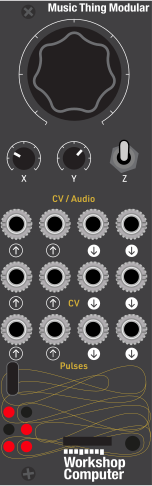 JawariSwellStringJawari CVSwell CVPitchMeendPluckDampFull InstrumentSympathetic HaloPlayed PitchHalo LevelPluck EventHalo Bloom
Controls
Jawari
Bridge contact and buzz; AudioIn1 adds modulation in Middle and Down.
Swell
Note decay and secondary amplitude rise; AudioIn2 adds modulation in Middle and Down.
String
Playing-string propagation and tone/brightness.
External Excitation: AudioIn1 excites the melody string; AudioIn2 excites the sympathetic bank.
Plucked Instrument: AudioIn1 and AudioIn2 provide Jawari and Swell modulation CV.
Pluck and Held Edits: Plucks once on entry; holding does not repeat. Deliberately moving a knob edits its webpage-selected secondary assignment. Defaults: Main=Sympathy, X=Octave, Y=Pick release. Normal timbre settings stay frozen; edited knobs need pickup after release.
Manual Pluck: Briefly press Down to pluck once on entry; release does not create another pluck.
Inputs & Outputs
Inputs
Outputs
Inputs
Jawari CV
Adds to the Main knob. Nominal +/-5 V adds +/-one full control range; the sum is clamped and smoothed. Unpatched or 0 V adds zero, with settling and a ramp when a cable is connected.
Swell CV
Adds to the X knob. Nominal +/-5 V adds +/-one full control range; the sum is clamped and smoothed. Unpatched or 0 V adds zero, with settling and a ramp when a cable is connected.
Pitch
Continuous 1 V/oct melody pitch. At the default octave offset of -1, patched 0 V plays C3 and +1 V plays C4; unpatched pitch is D3. Octave edits transpose both patched and unpatched operation. At octave offset 0, patched 0 V plays C4. Pitch changes do not pluck or retune the fixed sympathetic bank. Optional user input correction applies after factory calibration; both are retained.
Meend
Melody pitch bend. Nominal +/-5 V gives +/-2 semitones, added to Pitch and the octave offset. Unpatched input adds no bend.
Pluck
Rising edge plucks once; internal plucking also works in Up mode.
Damp
Rising edge smoothly damps the instrument without abruptly clearing its buffers.
Outputs
Full Instrument
Complete mono sitar signal, including the sympathetic halo; main listening output.
Sympathetic Halo
Sympathetic bank alone. Sympathy and the independent Halo output level control its audible amount. Halo output level defaults to 50%; stored custom values restore as saved.
Played Pitch
Nominal melody pitch, 1 V/oct with 0 V=C4, including model slew, meend and octave offset. Default unpatched D3 gives -0.833 V; patched 0 V at octave -1 gives -1 V out. Approximate range -2.71 to +2.93 V. Model state, not an audio pitch tracker; accuracy depends on input and CV-output calibration.
Halo Level
Sympathetic halo amplitude follower, nominal 0-5 V.
Pluck Event
A 5 ms pulse when a manual or external pluck is accepted. Audio follows after buffering and filter delay.
Halo Bloom
A 5 ms pulse on a sustained rise in the audible halo, including external excitation. Not a delayed pluck or a pulse per note; overlapping swells can merge. Hysteresis and a 200 ms holdoff reject chatter. Damping and queue faults inhibit detection.
LEDs
Pluck
Top left; lights during the accepted pluck-event pulse.
External Mode
Top right; lit when switch Z is Up.
Melody Level
Middle left; brightness follows melody amplitude.
Halo Level
Middle right; brightness follows audible halo amplitude.
Timing Fault
Bottom left; latches on a queue or audio-handler timing fault and should stay off during playing.
Calibration Missing
Bottom right; lit when input or CV-output calibration is unavailable and nominal scaling is used.
README
First sound
Connect AudioOut1 to your mixer, set Z to Middle, Main/Jawari and X/Swell near 65%, and Y/String near 80%. Tap Down to pluck. Unpatched pitch starts at D3. Halo output level defaults to 50%; Sympathy defaults to full.
Knobs and held controls
Main shapes jawari bridge buzz, X shapes decay and secondary swell, and Y shapes playing-string tone. Hold Down and deliberately turn a knob to edit its secondary assignment. Defaults are Sympathy, Octave and Pick release. Choose alternatives from the webpage’s named dropdowns. Release Down before applying webpage edits; after a held edit, move the physical knob through its previous normal position to regain control. Holding Down alone changes no secondary setting and never repeats plucks.
Sympathetic tuning and duration
The twelve taraf strings ring from related frequencies in the melody or external excitation. Their tuning stays fixed during melody pitch changes and bends. The Yaman preset is an equal-tempered twelve-string adaptation with D4 as Sa, an octave above the default D3 melody; duplicate notes are intentional. Choose individual note names or apply a preset. Presets apply all twelve notes immediately; individual selections need Apply. Retuning briefly fades and restarts the halo. Melody and sympathetic duration controls range from 25% to 400%.
USB editing and saving
Open the webpage in desktop Chrome or Edge, connect the normally powered Computer with a USB-C data cable, and choose MTM Sitar USB editor. Sound, held assignments, tuning and user CV1 input / pitch-output corrections can be edited. Apply changes the running instrument. Save to card retains applied settings across reset. Restore saved reloads them; Revert defaults changes the running settings until saved. Existing saved levels are preserved when firmware defaults change. Factory EEPROM calibration is unchanged.
Patching
CVIn1 is 1 V/oct; at default octave -1, 0 V=C3 and +1 V=C4. CVIn2 bends by ±2 semitones at ±5 V. PulseIn1 plucks; PulseIn2 smoothly damps. In Middle, AudioIn1/2 add Jawari/Swell CV; in Up they excite the melody/halo. The webpage sets Up-mode dry/wet mix. AudioOut2 is halo only. CVOut1 follows nominal played pitch at 0 V=C4, CVOut2 follows halo amplitude, PulseOut1 marks plucks, and PulseOut2 marks sustained halo rises.