
580 Vortex Runner
Vortex Runner is a Yamaha CS-80-inspired Workshop Computer synth voice. The current firmware keeps a monophonic note path but renders two related output voices: Audio Out 1 is Voice A and Audio Out 2 is Voice B, detunable relative to Voice A. Pitch, gate, envelopes, portamento, CV policy, MIDI handling, LFO timing, and preset state are shared; only oscillator/filter colour is A/B-specific, including source/output levels, pulse/PWM, and filter settings. It includes expressive envelopes, 12 dB/octave high-pass and low-pass filters with bounded resonance, ring modulation, MIDI/Web MIDI control, a hardware preset browser, and 8mu controller support. The current 8mu build prevents its layer-selection buttons from entering the synth MIDI note path.
Panel
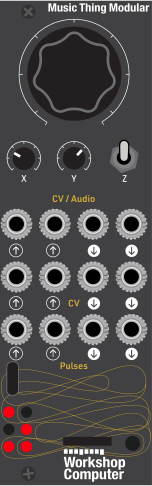 Base PitchPulse WidthPWM AmountPitch CVAudio / Mod InFilter CVExpression CVGateTrigger / HoldVoice AVoice BOffOffOffOff
Controls
Base Pitch
Shared base pitch offset for both output voices.
Pulse Width
Pulse width for the selected output voice.
PWM Amount
Pulse-width modulation amount for the selected output voice. The independent source mixer is Web-editor controlled.
Filter page: Low-pass cutoff, high-pass cutoff, and resonance for the selected output voice, with soft pickup.
Oscillator page: Shared base pitch plus pulse width and PWM amount for the selected output voice, with soft pickup.
Performance page: Hold page for Voice B detune, ring modulation, and LFO-to-pitch depth, with soft pickup.
Inputs & Outputs
Inputs
Outputs
Inputs
Pitch CV
Web-selectable 1V/oct pitch input: 0 V to +5 V with C4 at +3 V, or -3 V to +3 V with C4 at 0 V.
Audio / Mod In
Reserved for future audio-rate modulation or external processing experiments.
Filter CV
Wide high-pass and low-pass filter modulation.
Expression CV
Expression input for brightness and resonance modulation.
Gate
Gate input for the amp and filter envelopes. When patched, it takes priority over USB MIDI gate.
Trigger / Hold
Reserved for retrigger, sustain, or alternate performance gestures.
Outputs
Voice A
First audio voice output.
Voice B
Second audio voice output, detunable relative to Voice A.
Off
Reserved for later modulation output once the split-output voice is stable.
Off
Reserved for later modulation output once the split-output voice is stable.
Off
Reserved for later clock, gate, or envelope-state output.
Off
Reserved for later clock, gate, or envelope-state output.
LEDs
Voice A
Bright when Voice A is selected for hardware-panel editing.
Voice B
Bright when Voice B is selected for hardware-panel editing.
X Value
Stored X parameter value for the active switch page.
X Pickup
Soft-pickup state for the X knob; dim until picked up, bright when active.
Y Value
Stored Y parameter value for the active switch page.
Y Pickup
Soft-pickup state for the Y knob; dim until picked up, bright when active.
README
Vortex Runner
Vortex Runner is a Workshop Computer card for a CS-80-inspired split-output synthesiser voice.
The current stable target is still deliberately modest: keep one playable monophonic note path, but render it as two related output voices so Audio Out 2 can be detuned against Audio Out 1.
This card is not affiliated with Yamaha and is not intended to be a circuit emulation of the Yamaha CS-80. The goal is a playable Workshop Computer instrument inspired by the broad musical gestures of that synthesiser: two oscillator lanes, animated pulse/saw tone, high-pass into low-pass filtering, performance modulation, ring modulation, and expressive envelopes.
Current Status
This folder contains the split-output firmware baseline and its Web MIDI editor.
- Firmware:
uf2/Vortex_Runner_8mu_button_note_fix_20261007.uf2is the current 8mu button-note fix build. It has compiled successfully and requires hardware verification. It adds 12 dB/octave high-pass and low-pass paths, bounded resonance, the factory-plus-saved hardware preset browser, and 8mu controller support with panel LED feedback. Filter Envelope layer fader 5 controls HP cutoff; fader 6 controls resonance. - Web editor: Vortex Runner SysEx v10 patch apply/readback interface with named persistent card slots
- Rollbacks: locally retained rollback UF2s are ignored by git
- Release status: 8mu button-note fix build (2026-10-07); hardware verification pending
- Release guide and first patch: RELEASE_SUMMARY.md or RELEASE_SUMMARY.txt
Release firmware should go in uf2/ when a build is ready to publish. Local
hardware-test UF2s should go in test-uf2/, which is ignored by git.
Design Target
- RP2040 clock: 192 MHz
- Firmware should use
pico_set_binary_type(... copy_to_ram) - Audio rendering should stay on core 0
- USB MIDI, Web MIDI SysEx, and editor communication run on core 1
- The audio loop should avoid division, float-heavy code, blocking calls, flash writes, and MIDI parsing
- Complete Web MIDI patches cross from core 1 to core 0 through a bounded, lockless SPSC queue; core 0 publishes readback snapshots through a second queue
- The playable note path remains monophonic while Audio Out 1 and Audio Out 2 render separate A/B voices for detune and shaping experiments
Current Voice Shape
- monophonic note/gate path with two split audio outputs
Audio Out 1: Voice AAudio Out 2: Voice B, detunable relative to Voice A- one shared pitch, gate, amp/filter envelope, portamento, pitch-CV policy, CV routing, MIDI state, LFO timing, and preset state for both outputs
- A/B differences are limited to oscillator/filter colour: source levels, output level, detune, pulse width, PWM amount, HP cutoff, LP cutoff, and resonance
- web-first portamento for smooth CV/pitch glides
- independent saw, square/pulse, sine, and noise mixer levels
- independent pulse width, PWM amount, LFO-to-pitch, and LFO-to-PWM controls
- oscillator spread or detune
- 12 dB/octave high-pass then 12 dB/octave low-pass filter character
- amp envelope
- filter envelope
- LFO for vibrato, tremolo, or filter movement
- ring modulation as a performance colour
- gate and MIDI note triggering
- Web MIDI editor for patch editing, readback, and saving
Filter Architecture
Each output has its own 12 dB/octave high-pass path feeding a 12 dB/octave low-pass path. HP cutoff, LP cutoff, resonance, and filter state are independent for Voice A and Voice B; the filter envelope, filter CV routing, and LFO-to-filter depth are shared. Resonance is bounded below self-oscillation and is applied to both paths for a stronger, controlled band-pass focus.
This replaces the earlier, gentler 6 dB/octave filter path. The August 2026 rollback image and matching source are retained locally in an ignored archive, so they are not included in the stable-release PR.
8mu Activity
The current firmware supports a Music Thing Modular 8mu connected at power-on. The 8mu uses the Computer USB port in host mode, so it cannot be used at the same time as the Web MIDI editor. The complete connection, layer, soft-takeover, panel-LED, and preset-browser instructions are kept separately in 8MU_ACTIVITY.md.
Previous 8mu button-note issue — verify after updating
Earlier 8mu firmware builds also forwarded the four 8mu button-note messages to Vortex Runner's ordinary MIDI-note input. When playing from a CV keyboard with its gate held high, pressing A, B, C, or D could therefore retrigger the voice and switch its pitch to C2, C3, C4, or C5. The corrected firmware consumes those button notes exclusively for 8mu layer selection.
After flashing a corrected build, hold a note on a CV keyboard and press then release each 8mu button. Only the selected 8mu layer LED should change: the pitch and envelope of the CV-played note must remain unchanged. If they do change, the card is still running a pre-fix firmware build.
Draft Web MIDI Protocol
The editor and firmware now share a small non-commercial SysEx protocol:
- manufacturer byte:
0x7d - legacy wire id:
CS80(retained for existing editor and firmware compatibility) - protocol version:
10 - commands: apply patch, save slot, request current patch, request slot map, request slot, slot response, delete slot, and set startup slot
pitch-CV range mode, portamento, separate A/B pulse width, PWM amount,
saw/pulse/sine/noise source levels, output level, HP cutoff, LP cutoff, and
resonance, plus shared expression depth, amp/filter ADSR controls, LFO rate,
LFO routings, ring amount, and ring speed. The source levels are summed rather
than crossfaded. Save applies the patch and writes it, with a 24-character
name, to one of eight persistent card slots. The first saved patch becomes the
startup patch automatically; use the editor's Start Here button to choose a
different saved startup slot.
Refresh Slots reads the card's saved-slot map, Read Patch syncs the current
live card patch, and Load Slot recalls the selected saved slot.
Factory presets remain immutable editor choices and load both outputs in unison. Users can create named browser presets alongside them, then use Save to Card to persist the current sound and its name in a selected hardware slot.
At startup, holding the Down switch during the short boot selection window enters patch-slot select. Main chooses among saved slots while the LEDs show only the selected slot number in binary. Release Down to keep browsing, then press Down again to load the selected slot, store it as the default startup slot, and enter normal performance mode.
Factory/example presets preserve the editor's current CV policy when loaded.
Saved card slots are full snapshots: the pitch-CV range is part of each saved
patch, so the startup slot also restores its -3 V to +3 V, C4 at 0 V or
0 V to +5 V, C4 at +3 V pitch reference.
If no saved startup slot exists yet, the compiled fallback patch is the Web
editor's Doctor Who Theme preset: an eerie lead using sine plus pulse,
resonant filtering, portamento, vibrato, PWM wobble, and a little ring modulation.
MIDI CC Map
Following the Gnarly habit, Vortex Runner now exposes a simple two-bank encoder layout for controllers such as the M-VAVE SMK-25:
CC1: vibrato depth via LFO to pitch- Bank A,
CC20-27: saw level, pulse level, sine level, noise level, pulse width, PWM amount, LP cutoff, resonance - Bank B,
CC28-31: HP cutoff, ring amount, ring speed, portamento - Bank B,
CC32-35: linked amp/filter attack, decay, sustain, release
The Web UI stores separate amp and filter ADSR values. CC32-35 move the amp
and filter envelope values together by offset, so controller changes keep the
relative Web UI envelope shape instead of collapsing both envelopes to identical
values.
Secondary synth controls stay available on:
CC2orCC11: expression depthCC7: voice levelCC76: LFO rateCC77orCC93: LFO to PWMCC91: LFO to VCFCC92: LFO to VCA
Pitch bend is also supported at a fixed +/-2 semitone range. It is kept
separate from the editor's performance-pitch parameter, so Web patch changes
cannot overwrite an active MIDI bend or alter MIDI note pitch unexpectedly.
MIDI note-on and note-off drive the monophonic note path directly. While a MIDI
note is held, it takes over pitch and gate for the synth voice, including
portamento and pitch bend; the panel base-pitch offset no longer transposes MIDI
notes. With USB MIDI connected and Pulse In 1 unpatched, the card is silent
until it receives a MIDI note. A patched Pulse In 1 remains the gate source.
After a MIDI release tail ends, pitch returns to the card CV/manual source.
Firmware
CS80.cpp is a lean starting point rather than a finished synth. It currently
drives one monophonic note path with two audio output voices:
Audio Out 1: Voice AAudio Out 2: Voice B, detuned relative to Voice A
Short-tapping Down toggles whether the hardware panel is editing Voice A or
Voice B. Holding Down exposes performance controls for Voice B detune, ring
modulation, and LFO depth.
When Pulse In 1 is unpatched the gate is held open for oscillator bring-up;
when it is patched, Pulse In 1 gates the monophonic note path.
Audio/CV In 1 is the pitch input. The Web editor selects either unipolar
0 V to +5 V, with C4 at +3 V (0 V is C1), or bipolar -3 V to +3 V, with C4 at
0 V. Both use 1V/oct. The Web editor also provides one combined CV filter
pairing selector. CV1 Contour Sweep + CV2 Expression keeps the broad sweep
behaviour, with CV1 moving HP and LP while CV2 adds LP brightness and resonance.
CV1 High-Pass Focus + CV2 Brightness gives separate lower-edge and upper-edge
filter movement. CV1 Low-Pass Brightness + CV2 Resonance leaves CV2 as a
resonance-only performance input.
Panel controls use soft pickup so switching pages does not immediately overwrite stored values. LEDs 0/2/4 show the stored Main/X/Y values for the current switch page, while LEDs 1/3/5 go bright once each physical knob has picked up its stored value.
Web MIDI never writes live audio parameters directly. Core 1 parses each complete SysEx patch or MIDI CC update and retains only the newest complete patch for the audio core; core 0 applies at most one patch on each 64-sample control tick (about 750 Hz at 48 kHz). This single-value mailbox coalesces rapid detune or editor updates rather than making audio apply stale intermediate states. A second, best-effort queue returns core-0 snapshots to the editor for safe readback. Apply messages do not generate a full patch reply; explicit read, slot load, save verification, and slot refresh continue to do so.
The first pass uses small lookup tables in CS80_LUT.* for pitch ratios, filter
curves, envelope rates, and LFO/ring sine values. This follows the C1ZZL3 habit
of keeping expensive shaping out of the 48 kHz audio path.
Build locally with:
cmake -S . -B build -DPICO_NO_PICOTOOL=1
cmake --build build -j2
References
Cards 84 and 101 are the main local references for the Web MIDI/editor pattern, 192 MHz build setup, copy-to-RAM configuration, dual-core USB MIDI worker, flash storage, and complex synth-card release structure:
releases/84_CosmikC1zzl3releases/101_Gnarly_C1ZZL3
Attribution And License Notes
Vortex Runner firmware is by Adrian Vos and is released under the MIT License.
See LICENSE.
The included computercard.h file is ComputerCard by Chris Johnson, version
0.3.0, also MIT licensed. It is copied from:
Demonstrations+HelloWorlds/PicoSDK/ComputerCard/ComputerCard.h
The USB MIDI host helper files usb_midi_host.* and
usb_midi_host_app_driver.c are copied from the local C1ZZL3 cards and retain
the upstream rppicomidi MIT copyright notices in the source files. The TinyUSB
descriptor/config pattern is adapted from Adrian Vos's C1ZZL3 cards for this
card's Web MIDI device interface.
The included pico_sdk_import.cmake file is the standard Raspberry Pi Pico SDK
import helper. It carries the Raspberry Pi (Trading) Ltd. BSD-style notice in
the file itself.
Firmware distribution notices
See THIRD_PARTY_NOTICES.md for dependency
copyright and license texts. Keep the accompanying NOTICE.txt with
each UF2 when redistributing it.