
608 TelexIO
TelexIO is a port of the open-source TelexI and TelexO expander modules (for Teletype or e.g. Crow) to the Music Thing Modular Workshop Computer. The TELEX are a family of eurorack expanders that were designed by bpcmusic to interface with the Monome Teletype to provide additional inputs and outputs. The original Telex Expanders (documentation, hardware design files and source code) can be found here: https://github.com/bpcmusic/telex.
Panel
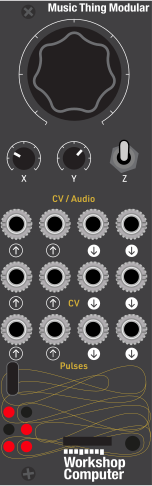 TI.PARAM 1TI.PARAM 2TI.PARAM 3TI.IN 1TI.IN 2TI.IN 3TI.IN 4trigger inputtrigger inputTO.OSC / TO.CV 1TO.OSC / TO.CV 2TO.OSC / TO.CV 3TO.OSC / TO.CV 4TO.TR 1TO.TR 2
Controls
TI.PARAM 1
Knob value can be read with TI.PARAM 1
TI.PARAM 2
Knob value can be read with TI.PARAM 2
TI.PARAM 3
Knob value can be read with TI.PARAM 3
->1: Switch maps to TI.PARAM 4 (value 1)
TI.PARAM 4 -> 0: Switch maps to TI.PARAM 4 (value 0)
->2: Switch maps to TI.PARAM 4 (value 2)
Inputs & Outputs
Inputs
Outputs
Inputs
TI.IN 1
maps to TI.IN 1 (calibrated)
TI.IN 2
maps to TI.IN 2 (calibrated)
TI.IN 3
maps to TI.IN 3 (calibrated)
TI.IN 4
maps to TI.IN 4 (calibrated)
trigger input
triggers envelope on TO 1
trigger input
triggers envelope on TO 2
Outputs
TO.OSC / TO.CV 1
Uncalibrated CV/oscillator output maps TO.CV 1 or TO.OSC 1
TO.OSC / TO.CV 2
Uncalibrated CV/oscillator output maps TO.CV 2 or TO.OSC 2
TO.OSC / TO.CV 3
Calibrated CV/oscillator output maps to TO.CV or TO.OSC 3. Note: this output is low pass filtered and best used for CV
TO.OSC / TO.CV 4
Calibrated CV/oscillator output maps to TO.CV or TO.OSC 4. Note: this output is low pass filtered and best used for CV
TO.TR 1
Digital pulse output maps to TO.TR 1
TO.TR 2
Digital pulse output maps to TO.TR 2
README
TelexIO
TelexIO is a port of the open-source TelexI and TelexO expander modules (for Teletype) to the Music Thing Modular Workshop Computer.
The TELEX are a family of eurorack expanders that were designed by bpcmusic to interface with the Monome Teletype to provide additional inputs and outputs. These modules can also be used with other i2c devices that can send the appropriate i2c commands over the i2c bus, e.g. Crow. The original Telex Expanders (hardware design files and source code) can be found here: https://github.com/bpcmusic/telex
This card emulates both TelexI and TelexO modules together on a single workshop computer and responds to the same TI and TO commands from an i2c-connected Teletype as the original modules do.
The Workshop Computer’s knobs, inputs, and outputs are mapped to corresponding TelexI and TelexO functionality, with a few differences due to different hardware.
For the compiled binary card (v0.2) see telexio.uf2 in this folder.
Input and output mapping
Mapping between Workshop Computer and TelexI/TelexO functionality:
- The three knobs (main, x, y) correspond to the first three TelexI knob inputs.
- The switch is mapped to the fourth TelexI input, generating values 0,1,2.
- Audio and CV inputs are mapped to the corresponding TelexI inputs. This makes use of the calibration data in the Workshop Computer's EEPROM, if available.
- Audio, CV and trigger outputs are mapped to the corresponding TelexO outputs. The Workshop Computer has two trigger outputs instead of TelexO’s four, so two are unavailable. The CV outputs make use of the EEPROM calibration data.
- There are two additional trigger inputs. These are internally normalised to trigger envelopes configured on the first two output channels of TelexIO.
- The maximum output range for the Workshop Computer's outputs is +/- 6V.
- Callibration can be done using the 01 Midi card.
Electrical notes
Please read
TelexIO needs an i2c connection. The Workshop Computer contains two (typically unpopulated) pins labeled UART DEBUG that can be used for i2c. Solder a header to the UART pads TX and RX:
- RX (bottom) -> SCL
- TX (top) -> SDA
Make sure Workshop Computer and Teletype share GND. A dedicated GND wire between the Workshop Computer and the Teletype i2c bus is recommended. Without it, I sometimes experienced data corruption during i2c communication.
By default the computercard.h framework seems to configure the UART pins as outputs during startup. Many other cards use this framework, though not many other cards actually make use of the UART pins. This default setup will affect the i2c bus when using those cards. Therefore, when using other cards based on computercard.h, disconnect the i2c connection, or recompile those cards with the appropriate UART configuration flag - ENABLE_UART_DEBUGGING - see my CMakeLists.txt file. While it may be electrically safe to leave the bus connected (I am not completely certain about this) it will definitively confuse the i2c devices on the bus.
Notes on implementation
On the RP2040, Core 1 handles the i2c interrupts and the TelexI code, while Core 0 runs most of the TelexO code with a sample rate of 48 kHz.
As the RP2040 has no FPU, some floating-point code from TelexO was rewritten to use integer arithmetic (particularly the polyblep code) and some float calculations are passed from Core 0 to Core 1 for less time critical processing.
LLM disclosure
AI was used for code review, safety checks and optimisation suggestions. No vibe coding or otherwise unreviewed code is used in this project.
License
TelexIO is MIT licensed, in line with the code it is derived from.
History
V0.2 add callibrated inputs and outputs, change app type copy_to_ram for speed
V0.1 first version
Future work:
- Further optimisation, if needed.