
67 Fragments
Six-slot sampler and sequencer with MIDI pitch control, configurable random CV outputs, saved kits, alternate variation mode, web editor, and included 24 kHz long-sample firmware.
Panel
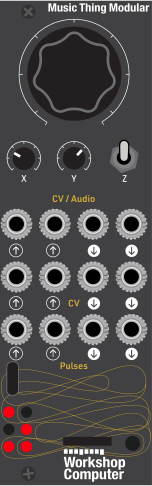 Pattern SelectPattern ShiftRepeat DivisionAudio In 1Audio In 2Pattern Shift CVReverse Probability CVClock InRecord GateAudio Out 1Audio Out 2Random CV 1Random CV 2Step PulsePattern Start Pulse
Controls
Pattern Select
Selects one of 21 patterns.
Pattern Shift
Shifts pattern slot numbers, wrapping around the six slots.
Repeat Division
Sets repeat division to x1, x2, x4, or x8.
Slot Settings: Select a slot with Main, set playback mode with X, and set reverse probability with Y.
Sequencer Settings: Select a pattern with Main, shift the pattern with X, and set repeat division with Y.
Reset, Clear, Save: Tap to reset. Hold until the LEDs flash, then tap once to clear or twice to save.
Inputs & Outputs
Inputs
Outputs
Inputs
Audio In 1
Audio input for channel 1
Audio In 2
Audio input for channel 2
Pattern Shift CV
Controls pattern shift. When patched, X attenuates the incoming CV.
Reverse Probability CV
Controls reverse probability. When patched, Y attenuates the incoming CV.
Clock In
Advances the sequencer.
Record Gate
Records into the selected slot while high.
Outputs
Audio Out 1
Audio output for channel 1
Audio Out 2
Audio output for channel 2
Random CV 1
Configurable random voltage, stepped by default.
Random CV 2
Configurable random voltage, slewed by default. Can be coupled to CV Out 1 from the web editor.
Step Pulse
Outputs a 10 ms pulse on each sequencer step.
Pattern Start Pulse
Outputs a 10 ms pulse on the first index of the current pattern.
README
Fragments
Fragments is a six-slot sampler and sequencer for the Music Thing Modular Workshop System Computer and Workshop Computer.
Record short sounds into the six slots, then play them back with patterns, shift, repeat division, reverse probability, playback modes, MIDI pitch, and random CV outputs.
Each slot can hold up to 400 ms of stereo audio at 48 kHz. Samples can be recorded from the module or imported with the included web editor.
Downloads
- fragments.uf2: standard 48 kHz firmware, up to 400 ms per slot.
- fragments_24k.uf2: alternate 24 kHz firmware, up to 800 ms per slot with a darker sound.
Use web/fragments_librarian.html for both firmware versions. Select the matching firmware profile in the editor before importing or sending samples.
Quick Start
- Patch audio into Audio In 1, Audio In 2, or both.
- Move Z up.
- Use Main to choose a slot.
- Send a gate to Pulse In 2 to record into that slot.
- Move Z to the middle.
- Send a clock to Pulse In 1.
- Use Main to choose a pattern, X to shift it, and Y to set repeat division.
LEDs show the selected slot while Z is up. In playback, they show the active slot or variation.
Controls
Z Up: Slots
| Control | Function |
|---|---|
| Main | Selects slot 0-5 |
| X | Sets playback mode |
| Y | Sets reverse probability |
| Pulse In 2 | Records while high |
Playback modes, from low to high on X:
| Mode | Behavior |
|---|---|
| Loop | Repeats until the next sequencer step |
| One Shot | Plays once, then rests |
| Interrupt | Plays once, then returns to live input |
| Passthrough | Plays live input instead of the recording |
New or cleared slots default to One Shot with 0% reverse probability.
Z Middle: Patterns
| Control | Function |
|---|---|
| Main | Selects one of 21 patterns |
| X | Shifts every slot number in the pattern, wrapping around |
| Y | Sets repeat division: x1, x2, x4, or x8 |
| Pulse In 1 | Advances the pattern |
Main, X, and Y use pickup behavior. Changing Z position will not immediately jump to the physical knob value; the setting changes after the knob moves.
Z Down: Reset, Clear, Save
| Gesture | Function |
|---|---|
| Tap Z down | Reset to the first pattern step |
| Hold Z down until all LEDs flash, release, tap once | Clear all samples |
| Hold Z down until all LEDs flash, release, tap twice | Save the current kit |
After the LEDs flash, the card waits one second for a tap. A single tap waits briefly before clearing so the card can tell it apart from a double tap.
Recording
- A standard slot records up to 400 ms.
- Variation mode records one longer sample up to 2.4 seconds.
- A recording must be at least 10 ms.
- Only patched audio inputs are recorded.
- If no audio input is patched, the slot is left unchanged.
- In standard mode, recording one channel preserves the other channel.
- Patched-but-silent audio can be recorded as silence.
- Recording does not stop the sequencer.
The monitor input setting controls when live input is mixed with playback:
| Mode | Behavior |
|---|---|
| Always | Live input is always mixed with the program output |
| When Armed | Live input is mixed while Z is up or while recording |
| When Recording | Live input is mixed only while recording |
The default monitor mode is When Armed.
CV And Pulse
| Jack | Function |
|---|---|
| CV In 1 | Pattern shift |
| CV In 2 | Reverse probability |
| Pulse Out 1 | 10 ms pulse on every sequencer step |
| Pulse Out 2 | 10 ms pulse on the first index of the pattern |
| CV Out 1 | Configurable random voltage, stepped by default |
| CV Out 2 | Configurable random voltage, slewed by default |
CV In 1 and CV In 2 keep these assignments in every Z switch position. When a CV input is patched, its matching knob becomes an attenuator: X for CV In 1 and Y for CV In 2.
The CV inputs automatically work with unipolar signals. If an input crosses below 0 V, it switches to bipolar behavior so a roughly +/-6 V signal can sweep the full control range.
The web editor can configure the CV outputs' voltage range, quantization, clock division, slew time, and CV Out 2 coupling.
USB MIDI
Fragments appears as a USB MIDI device over USB-C. Depending on the card and operating system, it may appear as Fragments, MTMComputer, or a Music Thing MIDI card name.
| MIDI | Function |
|---|---|
| Notes | Change playback speed for all slots together |
| C4 / note 60 | Normal speed |
| Pitch bend | +/-12 semitones |
| CC 16 | Main knob |
| CC 17 | X knob |
| CC 18 | Y knob |
Note Off has no assigned behavior. Moving a physical knob takes control back from its MIDI CC value.
Variation Mode
Hold Z down while rebooting the Computer with its boot/reset button to start in Variation mode for that session. Reboot normally to return to standard mode.
Variation mode uses the six slot buffers as one longer sample. Patterns then play that one sample six different ways:
| Pattern Value | Variation |
|---|---|
| 0 | Normal speed |
| 1 | 2x speed, one octave up |
| 2 | 3x speed, one octave and a fifth up |
| 3 | Reverse |
| 4 | Reverse at 2x speed |
| 5 | 0.5x speed, one octave down |
In Variation mode:
- Pulse In 2 records the long sample.
- Main with Z up controls pitch over +/-24 semitones, with sweet spots at useful intervals.
- X with Z up sets the global playback mode.
- Y with Z up sets reverse probability.
- CV In 1 still controls variation shift.
- CV In 2 still controls reverse probability.
Web Editor
Open web/fragments_librarian.html in Chrome or Edge.
- Select Connect MIDI and allow SysEx access.
- Choose the Fragments MIDI input and output.
- Select Ping Card to confirm the connection.
The web editor can:
- Load, trim, preview, normalize, copy, and paste samples.
- Send one slot or all loaded samples to the card.
- Save and load kits.
- Edit and send pattern banks from CSV.
- Control playback speed and the Main, X, and Y knobs over MIDI.
- Configure monitor input and CV output behavior.
Supported audio import depends on the browser, but WAV, AIFF/AIFC PCM, MP3, and M4A are supported in common browsers.
Pattern CSV
Each CSV row is one pattern. Each value is a slot number from 0 through 5. Rows may contain 1-16 steps. The row number determines the pattern number.
0
0,1
0,2,4,2
5,4,3,2,1,0
The web editor accepts up to 21 rows. Sending fewer rows replaces only those patterns. Save the kit afterward to keep the new pattern bank across power cycles.
The factory bank is available at web/fragments_factory_patterns.csv.
Saved Kits
A saved kit includes:
- Audio slots and channel assignments.
- Slot playback modes and reverse probability.
- The 21-pattern bank.
- CV output settings.
- Monitor input mode.
Pattern selection, shift, division, MIDI note, pitch bend, and current sequencer position are performance controls and are not saved.
Building
Requirements:
- Raspberry Pi Pico SDK
- CMake
- ARM embedded GCC toolchain
export PICO_SDK_PATH=/path/to/pico-sdk
cmake -S . -B build_local -DCMAKE_BUILD_TYPE=Release
cmake --build build_local -j4
The flashable file is build_local/fragments.uf2.
The included source builds the standard 48 kHz firmware. The 24 kHz source
variant is included as src/fragments_24k.cpp and
src/usb_descriptors_24k.c for reference.
To flash the card, hold BOOTSEL while connecting USB-C, then copy the UF2 file
to the mounted RPI-RP2 drive.
License
Fragments is licensed under the Creative Commons Attribution-NonCommercial-ShareAlike 4.0 International License. See LICENSE.md.