
77 Punk Confusion
Punk Confusion is a deliberately confused card built around two very different meanings of "punk". Switch Up is a voltage-controlled Atari Punk Console-inspired synth voice with two timing controls, hard gate input, and nasty stepped tones. Switch Middle is Broken Venue, a wrecked-room audio effect for external signals: slapback, grit, feedback, and collapsing PA energy inspired by the cramped, abrasive feel of rooms like CBGB, the 100 Club, the Marquee, and the Whisky a Go Go. Hitting Switch Down or Pulse In 2 throws the current venue's original recorded punk-inspired vocal call through the same Broken Venue processing chain.
Panel
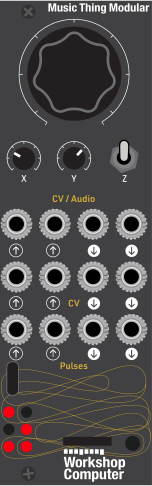 Input / Room GainRoomAudienceBroken Venue InputVocal Slice CVAPC CV 1APC CV 2APC GateVocal TriggerMain OutputStereo Room OutputUnusedUnusedUnusedUnused
Controls
Input / Room Gain
Soft-pickup input gain. Attenuates hot modular signals below noon, sits near unity at noon, and boosts quieter headphone/line sources clockwise; hot Eurorack-level signals may clip above about 2 o'clock.
Room
Selects snapped room zones in approximate length order: Marquee, CBGB, the 100 Club, then the Whisky a Go Go.
Audience
Simulates gentle audience absorption; clockwise damps the wet room path and lightly damps the dry side while preserving venue character.
Atari Punk Console: Free-running APC-inspired synth voice with CV over both timing controls.
Broken Venue: Fixed 50% dry/wet dirty room / PA treatment for external audio at Audio In 1.
Vocal Stab: Hold down to gate the current venue's vocal call through the Broken Venue chain and edit vocal-call trim with Main.
Inputs & Outputs
Inputs
Outputs
Inputs
Broken Venue Input
External audio source for the Broken Venue mode.
Vocal Slice CV
Beta input. When patched, positive voltage selects a later vocal start slice; negative voltage selects a slice and reverses playback.
APC CV 1
Voltage control for APC timing section 1, paired with Knob X.
APC CV 2
Voltage control for APC timing section 2, paired with Knob Y.
APC Gate
Hard gate for APC mode when patched. With no gate patched, the APC runs freely.
Vocal Trigger
Gates and retriggers the current venue's vocal call, matching the Switch Down gesture.
Outputs
Main Output
Main audio output for both APC and Broken Venue modes.
Stereo Room Output
Decorrelated room output for stereo patches; APC mode mirrors Audio Out 1.
Unused
Unused.
Unused
Unused.
Unused
Unused.
Unused
Unused.
LEDs
APC Mode / Room Zone / Vocal Trim
Indicates Switch Up APC mode; in room mode participates in venue-zone display; while Down is held, participates in the vocal-trim meter.
Broken Venue Mode
Indicates Broken Venue / vocal mode.
APC Clock / Room Zone / Vocal Trim
In APC mode, blinks from the divided astable trigger clock; in room mode participates in venue-zone display; while Down is held, participates in the vocal-trim meter.
Vocal Trigger
Flashes for Switch Down or Pulse In 2 vocal triggers.
APC Gate / Room Zone / Vocal Trim
In APC mode, indicates gate-open state; in room mode participates in venue-zone display; while Down is held, participates in the vocal-trim meter.
Clip / Chaos
Indicates aggressive signal level or internal overload.
README
Punk Confusion
A split-brain punk card for the Music Thing Modular Workshop Computer.
Switch Up is the word "punk" taken literally: a voltage-controlled
Atari Punk Console-inspired synth voice. Switch Middle is Broken Venue, a
dirty room and damaged PA treatment for external audio. Switch Down and
Pulse In 2 fire short venue-linked vocal calls through the same room engine.
Quick Start
- Flash
uf2/punk_confusion_2mb.uf2for a standard 2 MB card, oruf2/punk_confusion_16mb.uf2for a 16 MB card. - Patch
Audio Out 1to your mixer. PatchAudio Out 2as well for stereo room output in Broken Venue mode. - For APC mode, set the switch Up and turn
Mainup.Audio Out 1is the direct APC voice;Audio Out 2is the same voice through a fixed CBGB-style room/PA treatment. - For Broken Venue, patch audio to
Audio In 1, set the switch Middle, setMain,X, andYnear noon, then choose a room withX. - Hold the switch Down, or patch gates to
Pulse In 2, to inject the current venue's vocal call.
Modes
Switch Up: Atari Punk Console
This is a simple dual-555-style APC model rather than an audio effect.
Main: APC output volume.X: trigger oscillator rate, like APC pot 1. Clockwise is faster.Y: monostable one-shot time, like APC pot 2. The useful direction is matched to the tested hardware feel.CV In 1: adds toX.CV In 2: adds toY.Pulse In 1: hard gate when patched. Unpatched, the APC free-runs.Audio Out 1: dry APC output.Audio Out 2: APC through a fixed CBGB-style room/PA treatment, with the audience absorption set internally around 33% and a small gain trim.
X clocks the astable trigger oscillator. Y sets the one-shot length. When
the one-shot is still high, incoming triggers are ignored, giving the classic
skipped, stepped APC behaviour. Main controls the level feeding both APC
outputs together.
Switch Middle: Broken Venue
Broken Venue processes external audio from Audio In 1 through a fixed 50/50
dry/wet dirty-room engine.
Main: input/room gain with soft pickup. Below noon attenuates hot modular signals, noon is about unity, and clockwise boosts quieter headphone or line-level sources. Hot Eurorack-level signals may clip above roughly 2 o'clock.X: venue selection in room-length order.Y: audience absorption. Clockwise means more bodies in the room, reducing reflected energy and lightly damping the dry side so the 50/50 mix still reads as a room change.Audio Out 1: main processed output.Audio Out 2: decorrelated stereo room output.
The Y curve is inspired by Rummler/Green/Jurkiewicz/Kahle, "Forget About The
Seat Dip Effect" (Forum Acusticum / Euronoise 2025). The firmware uses a cheap
three-band approximation: small low-frequency loss, stronger attenuation around
400 Hz-3 kHz, and moderate high-frequency damping.
Venue Order
X selects snapped venue zones:
| X range | Venue | Character |
|---|---|---|
0-1023 |
Marquee |
tight, sharp, short, metallic comb bite |
1024-2047 |
CBGB |
cramped, abrasive, short slapback |
2048-3071 |
100 Club |
denser, darker, warmer low-mid room |
3072-4095 |
Whisky a Go Go |
larger, brighter, splashier stage PA with mild comb bite |
These are not acoustic models of the real rooms. They are four punk-venue personalities built from one compact delay, reflection, saturation, and filtering engine.
Switch Down: Vocal Calls
Switch Down is a momentary performance layer, not a separate full mode.
- Pressing or holding Down triggers the vocal call for the currently selected venue.
- Releasing Down stops playback, so you can stutter the call manually.
Pulse In 2mirrors this behaviour: high gates the call, rising edges retrigger it, and low stops it.- Driving
Pulse In 2at audio rate can chop the shout into a raw vocal texture. That is intentional. Audio In 2is a beta vocal slice/reverse CV input. When patched, positive voltage selects a later start slice for the next trigger; negative voltage selects a slice and plays it backwards. Unpatched, calls play normally from the start.- The vocal is routed through the same Broken Venue path and gets an extra send into the room delay so it sits inside the venue.
Audio In 2 is sampled only when the vocal is triggered. It does not scrub an
already-playing shout.
Audio In 2 voltage |
Slice behaviour |
|---|---|
| Unpatched | Normal forward playback from the start |
| Near 0 V | Forward slice 0, starts at 0% |
| Positive CV, low to high | Forward slices 0-7, starting at 0%, 12.5%, 25%, 37.5%, 50%, 62.5%, 75%, and 87.5% |
| Negative CV, low to high magnitude | Reverse slices 0-7, starting around 12.5%, 25%, 37.5%, 50%, 62.5%, 75%, 87.5%, and near the end |
The Computer audio inputs clip at about +/-6 V. Hotter control signals, such
as a full-range Workshop System Slopes output, are safe but do not give extra
slice range: high positive voltages hold the last forward slice, and high
negative voltages hold the last reverse slice.
While holding Down, Main edits the saved vocal-call trim rather than the main
room input gain. The trim has soft pickup and is multiplied by the saved room
gain, so later input-gain changes still scale the shout level. The default trim
is midpoint.
Vocal Samples
The embedded calls are original recordings by Adrian Vos, processed for Punk
Confusion as 24 kHz mono signed 16-bit PCM and kept around -6 dBFS peak to
avoid extra digital clipping after the Colourbox drive.
| Venue | Sample |
|---|---|
Marquee |
Oi |
CBGB |
Hey Ho |
100 Club |
No Future |
Whisky a Go Go |
Let's Go |
The source WAVs are kept in samples/, matching the organisation used by other
sample-based releases in this repo. The beta firmware includes those calls as
factory fallback samples, but the normal user workflow is now WebSerial loading:
flash the card once, then change the four vocal calls from a browser without
rebuilding or reflashing the UF2.
WebSerial Sample Loader
The WebSerial loader stores uploaded calls in a reserved flash sample bank. Uploaded samples persist across normal restarts and may also persist after reflashing, so the web page includes a simple factory-restore button.
Use it like this:
- Flash
uf2/punk_confusion_2mb.uf2for a standard 2 MB Workshop Computer card, oruf2/punk_confusion_16mb.uf2for a 16 MB card. - Open
web/index.htmlin Chrome, Edge, or another Chromium-based browser with WebSerial support. - Choose the matching card size in the page.
- Drop one audio file into each venue slot on the page. If you already have a
saved
punk_confusion_samples.pbankfile, drop it intoAlready have prepared sounds?instead to fill all four slots at once. You can also useBrowse a folder of WAVsto choose or drop any folder of.wavfiles, audition the detected files, and assign four of them to the sample slots. - Hold the card switch Down while powering or resetting the card.
- Wait for confirmation: all LEDs flash three times, then LEDs 1, 3, and 5 stay lit while the card waits for the browser.
- Press
Connect card, choose the Workshop Computer serial device, then pressSend sounds to card. - Restart the card and use it normally with the new shouts.
During upload the status panel shows four stages: asking whether the card is ready, sending the sounds, waiting while the card saves them, and upload complete. Larger banks can take a little while to write, so wait for the final complete message before restarting the card.
The uploaded samples are stored in flash, so they can persist even after you
reflash the firmware. To return to the embedded factory shouts, enter loader
mode again and press Use built-in sounds again in the web page. That erases
the uploaded sample-bank header, so the firmware falls back to VocalSamples.h.
The WebSerial builds use 24 kHz 8-bit µ-law samples in the flash sample bank.
This is deliberately more compact than the embedded 16-bit PCM header and lets
the firmware jump to slice points or play backwards without loading whole files
into RAM. The standard 2 MB build reserves about 1 MB for uploaded samples;
the 16 MB build reserves about 14 MB.
The web page converts source files to mono 24 kHz µ-law and shows how much of
the sample bank they will use before upload. If the sounds are too large, the
page will ask you to shorten them or use the 16 MB build. Save prepared sounds downloads the converted .pbank file, which can later be dropped back
onto the page without reloading the original WAV or AIFF files. Factory
fallback WAVs and VocalSamples.h are backed up in factory-samples/ for
maintainers.
The folder picker is intentionally general: it looks for visible .wav files
and ignores other files, including hidden macOS sidecar files such as
._Sample.wav. File names do not need to match the factory samples. Pick any
four detected WAVs, audition them in the browser, and assign them to the four
Punk Confusion slots. This can be useful for Squid Salmple, 1010music,
Elektron, or Ableton export folders, but the page still converts the chosen
WAVs into Punk Confusion's own .pbank format before sending them to the card.
Jack Map
| Jack | Role |
|---|---|
Audio In 1 |
Broken Venue input |
Audio In 2 |
Beta vocal slice/reverse CV |
CV In 1 |
APC timing CV for X |
CV In 2 |
APC timing CV for Y |
Pulse In 1 |
APC hard gate when patched |
Pulse In 2 |
Vocal trigger/gate, including audio-rate chopping |
Audio Out 1 |
Main output |
Audio Out 2 |
Stereo Broken Venue output; fixed CBGB-style APC character output in Switch Up |
CV Out 1 |
Unused |
CV Out 2 |
Unused |
Pulse Out 1 |
Unused |
Pulse Out 2 |
Unused |
LED Map
LED 1: APC mode indicator in Switch Up; venue-zone display in room mode.LED 2: Broken Venue / vocal mode indicator.LED 3: divided APC trigger-clock blink in Switch Up; venue-zone display in room mode.LED 4: vocal trigger / Switch Down flash.LED 5: APC gate-open indicator in Switch Up; venue-zone display in room mode.LED 6: clip / chaos indicator.
Middle-mode venue display on LED 1 / LED 3 / LED 5:
| Venue | LEDs |
|---|---|
Marquee |
LED 1 |
CBGB |
LED 3 |
100 Club |
LED 5 |
Whisky a Go Go |
LED 1 + LED 3 + LED 5 |
While Switch Down is held, LED 1 / LED 3 / LED 5 temporarily become a three-step
meter for the saved vocal-call trim.
Building
This release builds two beta firmware targets from the same source: one for standard 2 MB cards and one for 16 MB cards.
cmake -S . -B build
cmake --build build -j2
The generated UF2s are:
build/punk_confusion_2mb.uf2build/punk_confusion_16mb.uf2
The firmware uses set_sys_clock_khz(192000, true),
PICO_XOSC_STARTUP_DELAY_MULTIPLIER=64, and the default flash binary type. The
2 MB target reserves 1 MB at the top of flash for user samples; the 16 MB
target reserves 14 MB.
To run the WebSerial loader page locally:
make webui
Then open http://127.0.0.1:8765/ in a Chromium-based browser.
Credits
- Card concept, samples, hardware testing, and release direction: Adrian Vos.
- Firmware and documentation assistance: Codex.
ComputerCardlibrary: Chris Johnson, MIT licensed.- Workshop Computer platform: Music Thing Modular and Tom Whitwell.
This card intentionally builds against the local
ComputerCard.h copy in this release folder. The upstream
Demonstrations+HelloWorlds/PicoSDK/ComputerCard/ComputerCard.h copy is left
untouched.
License
Punk Confusion code, documentation, and included vocal samples are released
under the MIT License. See LICENSE.
Firmware distribution notices
See THIRD_PARTY_NOTICES.md for dependency
copyright and license texts. Keep the accompanying NOTICE.txt with
each UF2 when redistributing it.