
799 Mazerunner
Load the webapp and connect to the Workshop Computer - on load, a momentary press down of the switch or a trigger detected on CV In 2 generates a maze and two solutions for it, using user-selected algorithms. Internal or external clock steps through the solution paths (resettable with a trigger to Pulse In 2), with Path B having separate clock division/multiplication. Once the end of the maze is reached, the path ping-pongs back and forth, looping indefinitely - depending on your choices and settings the loops can be vastly different lengths to each other, which can make for some happy accidents as they phase against each other over time. The braid control removes walls from dead ends, causing loops that can be quite musical to the ear. There are three choices for ways to map the resulting paths to the 2 quantised pitch CV outputs (1 step per turn, length of straight run mapped to pitch leap, length of opposite path's last straight run mapped to pitch leap) and gates fire each time a corner is turned. There are also sum and difference outputs, with slew that can be activated in the webapp.
Panel
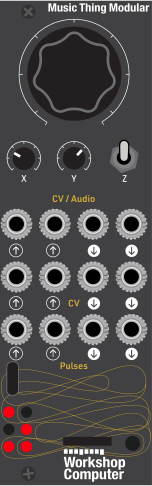 TempoQuantizer ScaleMapping ModePath B Clock Ratio OffsetMapping Mode OffsetScale OffsetRegenerate TriggerClockResetPitch SumPitch DifferencePath A PitchPath B PitchPath A GatePath B Gate
Controls
Tempo
40-400 BPM internal clock
Quantizer Scale
Shared by both paths; knob-only apart from CV In 1
Mapping Mode
Maze-to-CV mapping mode, shared by both paths; also offset by Audio In 2
Algorithm Select: Held - Main/X/Y select generation algorithm / Path A solve algorithm / Path B solve algorithm
Performance: Held (default) - Main/X/Y select tempo / quantizer scale / maze-to-CV mapping mode
Maze Settings: Held - Main/X/Y select maze size / braid amount / Path B clock ratio (pending, except clock ratio which is live)
Regenerate: Quick press and release of Down fires one regenerate using whatever is currently pending
Inputs & Outputs
Inputs
Outputs
Inputs
Path B Clock Ratio Offset
Live addition to Path B's clock multiply/divide, regardless of switch bank - see Y knob
Mapping Mode Offset
Live addition to the maze-to-CV mapping mode, regardless of switch bank - see Y knob
Scale Offset
Live addition to the shared quantizer scale, regardless of switch bank - see X knob
Regenerate Trigger
Regenerate + reset trigger (crosses ~1.2V) - fires exactly what a Down-tap fires; not a modulation input
Clock
Internal clock (tempo knob) drives playback whenever nothing is patched in here; patching a cable takes over unconditionally
Reset
Restarts both paths' playback from their entry cell; does not rebuild the maze
Outputs
Pitch Sum
Sum of Path A + Path B's pitch, uncalibrated - independent slew (Off/Fast/Medium/Slow), web-app-settable only
Pitch Difference
Absolute difference between Path A and Path B's pitch, uncalibrated, always >=0 - independent slew, web-app-settable only
Path A Pitch
Path A melody (calibrated MIDI note, shared quantizer scale)
Path B Pitch
Path B melody (calibrated MIDI note, shared quantizer scale) - independent of Path A, not a harmony
Path A Gate
Fires when Path A turns a corner (either direction)
Path B Gate
Fires when Path B turns a corner (either direction)
LEDs
Clock Tick
Blinks on every main clock tick (internal or external)
Path A Direction
Lit while Path A is travelling forward in its ping-pong
Held Bank
Off = Middle, about half = Up, full = Down
Bank Headline Value
Brightness shows generation algorithm / quantizer scale / braid amount for the current bank
Path A Turn
Flashes when Path A turns a corner
Path B Turn
Flashes when Path B turns a corner
README
Maze Runner
Generates a maze, then solves it twice with two independently chosen algorithms to drive two voices at once. Path A (CV/Pulse Out 1) and Path B (CV/Pulse Out 2) each turn their solved route into music:
- Every turn in the route fires a gate.
- The length of each straight run sets how many clock steps pass before the next turn.
- Each turn moves the pitch by some number of scale degrees, quantized to a scale.
- Reaching the exit reverses that path and plays it back (ping-pong), looping forever.
The two paths reach their ends on their own schedules, and Path B can also run at its own clock multiply/divide. Loops of different lengths phase against each other over time.
A maze is generated at power-on and whenever you regenerate (see below). Firmware is src/build/mazerunner.uf2.
Controls
The switch selects a bank. While it sits in a position, Main / X / Y control that bank's parameters.
| Knob | Switch Up | Switch Middle (default) | Switch Down |
|---|---|---|---|
| Main | Generation algorithm: Prim / Kruskal / Wilson / DFS | Tempo, 40-400 BPM (internal clock) | Maze size (pending) |
| X | Path A solve algorithm (5) | Quantizer scale (10), shared by both paths | Braid amount 0-100% (pending) |
| Y | Path B solve algorithm (5) | Maze-to-CV mapping mode (3), shared | Path B clock multiply/divide (21), live |
Regenerate: quickly press and release the switch Down (under about 300 ms), or send a trigger to CV In 2. This builds a new maze, re-solves both paths and restarts playback. Holding Down longer to adjust its bank does not regenerate.
Pending settings preview live (LEDs, web app) but only take effect on the next regenerate. Everything else takes effect immediately.
Knob pickup: each parameter locks to its current value when you enter a bank, and the knob does nothing until you turn it to that value. This is normal. Sweep the knob once and it catches.
Jacks
| Jack | Function |
|---|---|
| Pulse In 1 | Clock. When nothing is patched, the internal clock (tempo knob) runs. Patching any cable takes over, whether or not it carries pulses. |
| Pulse In 2 | Reset. Restarts both paths from their start; does not rebuild the maze. |
| CV In 1 | Live addition to the quantizer scale, in any bank. |
| CV In 2 | Regenerate + reset trigger (fires above ~1.2 V). Not a modulation input. |
| Audio In 1 | Live addition to Path B's clock multiply/divide, in any bank. |
| Audio In 2 | Live addition to the maze-to-CV mapping mode, in any bank. |
| Pulse Out 1 | Path A gate: fires on each turn. |
| Pulse Out 2 | Path B gate: fires on each turn. |
| CV Out 1 | Path A pitch (calibrated). |
| CV Out 2 | Path B pitch (calibrated). Independent of Path A, not a harmony. |
| Audio Out 1 | Sum of Path A + Path B pitch (uncalibrated). |
| Audio Out 2 | Absolute difference of Path A and Path B pitch (uncalibrated, never negative). |
Audio Out 1/2 each have their own slew: Off (default) / Fast (~30 ms) / Medium (~200 ms) / Slow (~1.4 s). Slew is set in the web app only.
LEDs
| LED | Meaning |
|---|---|
| 0 | Blinks on every main clock tick |
| 1 | Path A direction (lit = forward) |
| 2 | Held bank: off = Middle, half = Up, full = Down |
| 3 | Headline value for the held bank (generation algorithm / scale / braid) |
| 4 | Flashes when Path A turns |
| 5 | Flashes when Path B turns |
All six flash together briefly when a regenerate fires.
Parameters in detail
Generation algorithms: Prim, Kruskal, Wilson, DFS backtracker.
Braid: at 0% the maze has exactly one route, so both paths find the same route and play in unison. Higher braid opens dead ends into loops, giving multiple routes, which is what lets the paths diverge. Braid is also what makes the loop-based melodies.
Solve algorithms (per path):
- Direct: shortest path.
- Wall-follower: right-hand rule; explores dead ends, so usually much longer.
- Tremaux's: marks corridors as it goes; correct even with loops.
- Pledge: walks toward the exit and wall-follows when blocked; escapes loops that trap wall-following.
- Random walk: chaotic, with a light pull toward the exit.
If any solver fails to reach the exit within its step budget, that path silently falls back to Direct.
Mapping mode (both paths):
- Direct: each turn moves exactly 1 scale degree.
- Run-length-as-leap: a turn moves by the length of the run just finished, capped at 7 degrees.
- Cross-path leap: as above, but sized from the other path's most recently finished run.
Scales: Major, Natural minor, Dorian, Mixolydian, Harmonic minor, Major pentatonic, Minor pentatonic, Blues, Whole tone, Chromatic. The root is fixed at C3. Changes apply immediately, mid-sequence.
Path B clock ratio: ×16 ×13 ×11 ×8 ×7 ×6 ×5 ×4 ×3 ×2 ×1 ÷2 ÷3 ÷4 ÷5 ÷6 ÷7 ÷8 ÷11 ÷13 ÷16 (default ×1). Changing the ratio mid-play can cause one slightly off-timed step; a reset on Pulse In 2 re-syncs it. With an external clock, tempo changes reach Path B's multiplied steps after up to one beat.
Internal clock: tempo changes take effect from the next beat.
Web app
web/index.html is a live visualizer and settings page. It needs Chrome or Edge (Web MIDI), and a USB-C data cable to the card. Open it, pick the card and click Connect.
It shows the maze with both paths (Path A solid, Path B dashed) and a live cursor for each, plus a settings panel.
- Generator, Solver A/B, Maze size and Braid show current (what's playing now) and pending (what the next regenerate will apply, highlighted yellow when different).
- Tempo, Mapping mode and Path B ratio show live values.
- Scale is a dropdown. You can also set it with the knob or CV In 1, and the most recent change wins.
- Sum slew / Diff slew dropdowns set Audio Out 1/2 slew.
Notes
- Nothing is saved to flash: scale, slew and all other settings reset on power-up (scale to Major, slew to Off).
- Maze sizes go up to 16 × 16.
- Knob response curves and the CV In 2 trigger threshold are first guesses and may want tuning by ear.
Building
Source is in src/ (Pico SDK, ComputerCard v0.3.0 vendored as src/ComputerCard.h; USB-MIDI via TinyUSB). Build with the standard Pico SDK CMake flow using src/CMakeLists.txt. src/sysex_protocol.h documents the USB message format used by the web app.