
801 WaveSeq
Wave sequencing, as made famous by the Korg Wavestation: instead of one
waveform, the oscillator plays a sequence of them, each for its own time,
pitch and level, crossfading from one to the next.
There are up to 32 steps, and a bank of 64 single-cycle waves in eight
families - additive, saw to square, pulse width, hard sync, FM, vowels,
wavefolding and digital. A step's wave is a position in the bank rather
than a choice from a list, so it can sit between two waves.
The sequence is edited from a Music Thing 8mu. Its eight faders edit
one bank of eight steps at a time, and its four buttons choose what the
faders edit: A is WAVE, B is TIME, C is PITCH and D is LEVEL. A long
press of a button chooses the bank (A steps 1-8 to D steps 25-32), and
holding a button while moving a fader sets the last step, from 1 to 32;
it starts at 8. Pressing a button again flips to its second page: A gives per-step FM amount and B per-step wave scan amount,
each multiplying the panel's amount and crossfading between steps; C gives
per-step glide, sliding into the step's pitch from the last; and D gives a
per-step gate length on Pulse Out 1, from off through to a tie. After a
page change each fader picks
up its step only once it reaches the stored value, so changing page never
makes the sound jump. The 8mu's LEDs show the stored values, with the
playing step lit fully. Tilting the 8mu forward and back scans every
step's wave together; tilting it left and right widens the detune on
Audio Out 2.
Without an 8mu the card plays a default sequence, still under the panel's
pitch, speed and crossfade controls.
Panel
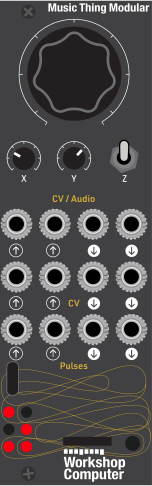 PitchFM amountScan amountFMWave scanPitchSpeedClockRestartOutDetunedStep pitchLevelGateStart
Controls
Pitch
C1 to C7.
FM amount
Depth of linear FM from Audio In 1, squared law. Each X/Y setting keeps its value; after the switch moves a knob picks up only once turned to its setting's value, so nothing jumps.
Scan amount
Depth of wave scan from Audio In 2, up to 32 waves either way.
Timing: X and Y set speed and crossfade.
Modulation: X and Y set FM amount and wave scan amount.
Direction: Momentary. Each tap steps the direction - forward, ping-pong, random - and the top LEDs show which for a second (one, two or three LEDs).
Inputs & Outputs
Inputs
Outputs
Inputs
FM
Linear FM of the oscillator, depth set by X with the switch in the middle.
Wave scan
Offsets every step's wave position, up to 32 waves either way, depth set by Y with the switch in the middle. Works at audio rate.
Pitch
1V/oct, added to the Main knob.
Speed
Sequence speed, 1V/oct - each volt doubles the speed. With a clock, moves the clock divider/multiplier two steps a volt.
Clock
While clocks are arriving, steps advance on beats instead of by time, each lasting the number of beats (1-8) set by its TIME fader, for clocks anything up to 20s apart. A beat is the clock divided or multiplied by the speed knob (X, switch up): /8 to x8. The card follows the clock from its second pulse, and returns to free running once four of the clock's periods (at least 2s) pass without one.
Restart
Restarts the sequence from its first step, with oscillator phases reset.
Outputs
Out
The wave sequence.
Detuned
The same sequence, detuned by 6 cents - more with the 8mu tilted left or right.
Step pitch
The current step's PITCH as 1V/oct, 0V for no offset, gliding with the GLIDE page.
Level
The current step's LEVEL, following the crossfade, 0-5V.
Gate
A gate for each step, its length set per step on the GATE page (D, second page): off, a fraction of the step (at least 5ms), or tied into the next step. Default half the step.
Start
Trigger when the sequence returns to its first step.
LEDs
Page A / step
With an 8mu or the web editor, LEDs 0-3 show the button whose page is selected (A-D), steady for its first page and blinking slowly for its second. Without one, they show the playing step - bright for steps 1-4 of each bank, dim for 5-8.
Page B / step
Page C / step
Page D / step
Gate
Follows Pulse Out 1, the per-step gate.
8mu / editor
Lit while an 8mu, or the web editor, is connected. Blinks fast while the X or Y knob is waiting to pick up its setting.
README
Wave Sequencer
Wavestation-style wave sequencing for the Workshop Computer, edited from a Music Thing 8mu over USB MIDI host.
A sequence of up to 32 steps, where every step plays a wave from a bank of 64 single-cycle waves for a set time, at a set pitch and level, crossfading into the next step.
Three ways to use it
The card works on its own; the 8mu and the web editor are both optional.
| Plugged into the Computer's USB socket | The card is | The faders are |
|---|---|---|
| an 8mu | USB host | the 8mu's, read directly. No computer needed |
| a computer | a USB MIDI device called Wave Sequencer | the web editor's, and an 8mu plugged into the computer is passed on by the editor |
| nothing | USB host, waiting | (plug an 8mu in any time) |
The card picks its mode once, at power-up, so after plugging a computer in, power-cycle the module. Telling the two apart needs Computer Rev 1.1 hardware; older boards are always a USB device.
The 8mu
There are 32 steps, in four banks of eight, and the eight faders edit one bank at a time. The sequence starts 8 steps long (bank A), and its length can be anything from 1 to 32.
The four buttons are acted on when you let go, so how long you held one decides what it does:
| Do this | To |
|---|---|
| Short press A-D | Choose the page, which is what the faders edit (below). Press the same button again for its second page (and again to flip back); another button always starts on its first page |
| Long press A-D (half a second) | Choose the bank the faders edit: A = steps 1-8, B = 9-16, C = 17-24, D = 25-32. The LED of fader 1-4 for that bank flashes three times |
| Hold A-D and move a fader | Set the last step: the button is the bank, the fader the step within it. Hold D and move fader 8 for 32 steps; hold A and move fader 4 for 4 steps. The fader has to move a good way (about a sixth of its travel) to count. The faders up to the last step light briefly. The fader movement doesn't edit anything |
Steps past the end of the sequence are skipped, as a step with TIME fully down is, and keep their settings, so shortening and lengthening the sequence loses nothing. On power-up, steps 9-32 start as copies of steps 1-8.
| Button | First page | Fader sets | Second page | Fader sets |
|---|---|---|---|---|
| A | WAVE | Wave position, scanning through the 64-wave bank | FM | Per-step FM amount, default 100% |
| B | TIME | Step duration, 20 ms to 4 s. Fully down skips the step. In clocked mode, 1-8 clocks | SCAN | Per-step wave scan amount, default 100% |
| C | PITCH | -12 to +12 semitones, centre is no offset | GLIDE | Per-step glide time, default 0 (jump) |
| D | LEVEL | Step loudness | GATE | Per-step gate length on Pulse Out 1, default half the step |
Per-step FM and SCAN multiply the panel's FM amount (X, switch middle) and wave scan amount (Y, switch middle) for each step. They crossfade from step to step along with the wave, pitch and level, so a long crossfade glides between them. A step at 0% gets no FM (or scan) at all, whatever the knob says.
GLIDE. Fully down, a step jumps straight to its pitch. Above that, its pitch slides from wherever the previous step's pitch was, starting as the step begins to be heard (the start of the crossfade into it), and taking up to the whole length of the step at the top. CV Out 1 glides with it.
GATE. Sets how long Pulse Out 1 stays high for each step, as a fraction of the step (never shorter than 5 ms, so short settings make triggers). Fully down gives no pulse at all for that step, so the page doubles as a rhythm pattern. At the top the gate stays high into the next step, a tie. The default is half the step.
Pickup. After a page change the faders don't do anything until they reach the value already stored for their step (or pass it), then take it over. So switching page never makes the sound jump.
LEDs. The 8mu's LEDs show the stored values on the current page, the playing step is lit fully, and steps past the end of the sequence are dark. On the Computer, LEDs 1-4 show which button's page is selected: lit steadily for its first page, blinking slowly for its second.
Motion. Tilting the 8mu forward and back scans every step's wave together, up to 16 waves either way. Tilting it left and right detunes Audio Out 2 by up to 50 cents. Lying flat, neither does anything. Both are gently smoothed (a lag of about 40 ms), as the 8mu sends its tilt in coarse steps that would otherwise make the scan and detune zipper.
Without an 8mu the card plays a default sequence, still under the panel controls.
Web editor
Open web/index.html in Chrome or Edge. It's a single file
and needs no network. Safari and iOS can't do WebMIDI with SysEx.
Plug the computer into the Computer's USB socket with a data cable, power-cycle the module, and press Connect card & 8mu. The page reads the sequence from the card (the card is the source of truth), then sends every edit as it's made.
From the top (each section has a − button by its heading that folds it away, and + to bring it back; the browser remembers which are folded):
- Readouts. Step, pitch (as a note name), speed, crossfade, direction and whether the card is clocked, live from the card's knobs, CV and switch. While the X or Y knob on the module is waiting to pick up its setting, that setting's box has a dotted orange outline; it goes once the knob reaches the value.
- Bank, length and shift. Bank buttons, −/+ for the length, and −/+ to shift every step in the sequence one place left or right (all its settings with it, the end step wrapping round). Just above the sequence, so they stay put as the length changes.
- Sequence. All 32 steps, eight to a row. In a row with steps in the sequence, each step's width is its duration, its trace is its wave at its level, and the shaded end is its crossfade into the next; steps past the end shrink to small grey boxes, so on load there's one row of eight and three rows of boxes. The bank the faders edit has an orange box round its row. A playhead follows the card. Click a step to select it (and its row's bank).
- Copy, paste & randomise. Select steps on the sequence: click one, Shift+click a range, Ctrl/⌘+click to add or remove single steps, double-click for a whole row, Alt+click for a whole column (the same fader in every bank), or use the buttons. Copy (Ctrl/⌘+C) takes every setting of the selected steps; Paste (Ctrl/⌘+V) puts them back: one copied step fills every selected step, several fill the same number of selected steps in order, or else keep their pattern from the first selected step. Shift+paste pastes only the page the faders show. Randomise changes the wave; the wave, pitch and level; or everything (time, FM, scan, glide and gate too), of the selected steps, a row, a column or the whole sequence. Pitch stays within the spread chosen (±2, ±7 or ±12 semitones), level stays audible, and a randomised step is never skipped. Undo (Ctrl/⌘+Z) takes back pastes, randomising and shifts. The keys are listed on the page.
- Now playing. The wave being heard, including part-way through a crossfade.
- Faders. Eight pages, like the 8mu's two pages per button: tabs A, A2, B, B2... choose the page. They show the selected bank's eight steps. Drag, use the arrow keys, or double-click to reset.
- Wave bank. All 64 waves. Click one to give it to the selected step, or to every selected step.
- 8mu on the computer. Its faders, buttons and tilt drive the page, with the same pickup, banks and last-step setting as the card (the 8mu card on the right lists them). The page lights the 8mu's LEDs as the card would. A dashed line on a fader shows where the 8mu's fader is while it waits to pick up.
- Both editors at once. With the CVSeq editor open too (each Computer plugged into the computer), one 8mu drives whichever editor you last clicked in, or opened. The header shows 8mu: here or 8mu: elsewhere; clicking it, or anywhere on the page, takes the 8mu. The other page ignores the 8mu and leaves its LEDs alone, but follows where the faders are, so they pick up as usual when it comes back. Use two windows side by side rather than tabs: Chrome slows a tab that's been in the background for a few minutes.
- Inputs & outputs and 8mu. Cards on the right: every jack and what it does, and the 8mu's buttons (page, bank, last step), pickup, LEDs and tilt.
- Presets. Seven built in, plus your own, kept in the browser
(
localStorage), with their length. Save, update, rename, delete, and export or import as a JSON file. Loading a preset sends it to the card. Presets from before 32 steps still load, playing 8 steps with steps 9-32 as copies of 1-8. - Direction buttons (forward, ping-pong, random) set the card's direction, and follow it when the switch is tapped. The page also shows what the X and Y knobs are doing and whether one is waiting to pick up.
- Restart and Reset (to the default sequence) act on the card too.
Without a card the page still edits, previews and keeps presets, with a simulated playhead at 1x speed.
The card and page talk SysEx; the protocol is documented in
sysex.h. The card and the editor must be the same version: this
one (protocol 4, 32 steps) won't talk to older firmware.
Panel
| Control | Function |
|---|---|
| Main knob | Pitch, C1 to C7 |
| Switch down | Tap to step the direction: forward, ping-pong, random |
The switch's up and middle positions choose what the X and Y knobs do:
| Switch | X knob | Y knob |
|---|---|---|
| Up | Speed, 1/8x to 8x. With a clock: clock divider or multiplier (below) | Crossfade, from a hard cut to fading over the whole step |
| Middle | FM amount (Audio In 1) | Wave scan amount (Audio In 2) |
All knobs have a small dead zone at each end, so the full range is reached even if a knob doesn't quite read its very ends, and speed has one in the middle, so exactly 1x is easy to find.
Each of the four settings keeps its value. After the switch moves, a knob does nothing until it's turned to (or past) its new setting's value, then takes over, so nothing jumps. LED 6 (bottom right) blinks fast while a knob is waiting. At power-up the knobs take over straight away for the position the switch is in; the others start at speed 1x, crossfade 25%, and FM and wave scan off (so Audio In 1 and 2 do nothing until turned up).
Directions. Forward loops 1 to 8. Ping-pong plays forwards then backwards, without repeating the end steps. Random picks any other step that isn't skipped, never the same step twice in a row. After a tap, the top LEDs show the new direction for a second: one LED for forward, two for ping-pong, three for random. The web editor can set it too.
| Jack | Function |
|---|---|
| Audio In 1 | Linear FM, depth set by X (switch middle) |
| Audio In 2 | Wave scan, up to +/-32 waves, audio rate, depth set by Y (switch middle) |
| CV In 1 | Pitch, 1V/oct |
| CV In 2 | Speed, 1V/oct. With a clock, moves the clock ratio two steps a volt |
| Pulse In 1 | Clock. Steps advance on beats while clocks keep arriving: a beat is a clock divided or multiplied by the speed knob, and a step lasts its TIME fader's 1-8 beats. Clocks up to 20 s apart. Followed from the second pulse; the speed knob takes over again after four of the clock's periods (at least 2 s) without one |
| Pulse In 2 | Restart from the first step |
| Audio Out 1 | Wave sequence |
| Audio Out 2 | Wave sequence, detuned |
| CV Out 1 | Current step's pitch offset, 1V/oct, including glide |
| CV Out 2 | Current step's level, crossfaded, 0-5V |
| Pulse Out 1 | Gate for each step, length set on the GATE page (D, second page) |
| Pulse Out 2 | Trigger at the start of the sequence |
Clock divide and multiply. While a clock is plugged into Pulse In 1, the speed knob (X, switch up) stops scaling time and picks a ratio instead, in eleven equal zones round the knob: ÷8, ÷6, ÷4, ÷3, ÷2, ×1 (the middle), ×2, ×3, ×4, ×6, ×8. Dividing, a beat waits for that many clocks; multiplying, each clock is split into that many evenly spaced beats, measured from the clock and started again by every clock, so they never drift from it (and never run on past a clock that slows). CV In 2 moves the ratio two steps a volt, about an octave. The web editor shows the ratio in the Speed readout and step times in beats and clocks.
The waves
Eight families of eight, ordered so that neighbouring waves morph smoothly:
- Additive build, sine to saw
- Saw to square
- Pulse width, 50% to 4%
- Hard-sync saw
- FM, ratio 1 then ratio 3, rising index
- Vowel formants
- Wavefolded sine
- Stepped sines, then random spectra
They are generated at power-up and band-limited at three levels, chosen by pitch, to keep aliasing down on high notes.
Building
mkdir build && cd build
cmake .. && make
Needs the Pico SDK. EightMU.h and ComputerCard.h are copied from
Demonstrations+HelloWorlds/PicoSDK/ComputerCard.
Not yet
- Sequences aren't saved on the card, so they're lost at power-off. Keep them as presets in the web editor and send them again after power-up.