
818 Bibesque
A hardware-tested Workshop Computer adaptation of Plinky Synth's Bib: shaped drive and wavefold, clock-quantised stereo tape delay, rhythmic multi-tap repeats, modulated reverb, shimmer and dub freeze.
Panel
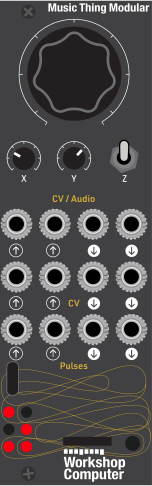 PageXYAudio In 1Audio In 2X ModY ModDelay ClockLeft OutRight Out
Controls
Page
Selects Drive, Delay, Reverb or Mix.
X
Active-page X parameter; modulated by CV In 1.
Y
Active-page Y parameter; modulated by CV In 2.
Detail Page: Delay tape transport/wobble or persistent reverb shimmer.
Main Controls: Normal page controls.
Action: Tap/toggle in Drive and Delay; hold for Mix freeze.
Inputs & Outputs
Inputs
Outputs
Inputs
Audio In 1
Primary audio input; normalised to both channels when Audio In 2 is unpatched.
Audio In 2
Right audio input for stereo processing.
X Mod
Bipolar modulation of active-page X after pot pickup.
Y Mod
Bipolar modulation of active-page Y after pot pickup.
Delay Clock
External clock for Bib-style delay-time quantisation.
Outputs
Left Out
Left processed audio output.
Right Out
Right processed audio output.
LEDs
Page Bit 0
Binary Main-page indicator.
Page Bit 1
Binary Main-page indicator.
X Value
Effective active-page X value.
Y Value
Effective active-page Y value.
Page State A
Page-specific state such as wavefold, clock lock, shimmer or freeze.
Page State B
Page-specific state such as ping-pong, tap count, wet mix or limiter reduction.
README
Bibesque
Bibesque is a Workshop Computer adaptation of the Bib stereo dub processor by Plinky Synth. It recreates Bib-inspired drive, wavefold, stereo tape delay, clock quantisation, rhythmic multi-tap delay, modulated reverb, shimmer and dub freeze using the Workshop's three pots, switch, CV inputs and six LEDs.
Install
Flash uf2/Bibesque_1.0.0_rc1.uf2 to a Workshop Computer program card, then
reset the module. This is a hardware-tested release candidate.
Firmware verification
Bibesque_1.0.0_rc1.uf2 SHA-256:
b5a17ea961525608482eb7649a371fd8593a5a6879cbdf0d73d777516156d1d9
Controls
Main selects Drive, Delay, Reverb or Mix in four regions. LEDs 0–1 show that page as binary: off/off, on/off, off/on, on/on.
- Drive: X = drive; Y = bipolar delay send. Clockwise Y is normal stereo delay; anticlockwise is asymmetric ping-pong. Tap Z to toggle overdrive and wavefold.
- Delay: X = delay time; Y = feedback. Tap Z once to begin a multi-tap phrase, then tap up to eight relative repeat heads. Move X substantially to clear the phrase and return to one even repeat. Pulse In 1 clock-quantises X to Bib-style 3/4, straight and dotted divisions across octaves.
- Reverb: X = reverb send; Y = decay. With Z Up, X sets persistent shimmer.
- Mix: X = wet/dry mix; Y = output level. Hold Z Down for dub freeze.
With Z Up on the Delay page, X controls tape speed (stop through 2x) and Y controls wobble. Long delays and long multi-tap phrases use automatic tape slowdown, extending the 32k-sample tape to roughly two seconds.
CV In 1 and CV In 2 are bipolar modulation inputs for the active page's X and Y parameters. CV is added after physical-pot pickup.
LEDs
LEDs 2–5 change with the active page. LEDs 2 and 3 show effective X/Y values, including CV. LEDs 4–5 show relevant state: wavefold/ping-pong, clock-lock/ multi-tap count, shimmer/wet mix, or freeze/limiter reduction.
Attribution and licence
This is an independent adaptation, not original Bib hardware or panel artwork.
It directly adapts MIT-licensed Bib DSP ideas and reverb code from the
Buddies public source repository,
and includes the MIT-licensed ComputerCard
framework by Chris Johnson. Bibesque adaptation and integration by Adrian Vos.
The included LICENSE contains the MIT licence text.