
833 BuzzyBee
A Workshop Computer adaptation of the Buddies Buzzrito stereo swarm oscillator. BuzzyBee combines a virtual XY pad, recordable motion, original-style comb, glide, BOC, wobble, pink noise, calibrated pitch CV, and musical note-memory chord modes.
Panel
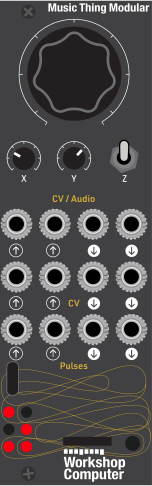 TuneVirtual Pad XVirtual Pad YPitch CVX CVY CVGate InLive XYStereo LeftStereo RightPitch MonitorUnusedGate MonitorUnused
Controls
Tune
Overall pitch; Audio/CV In 1 adds calibrated 1 V/oct pitch.
Virtual Pad X
Horizontal virtual-pad position and recorded-motion axis.
Virtual Pad Y
Vertical virtual-pad position and recorded-motion axis.
Record XY Motion: After a normal boot, latch Up to record X/Y; return to Middle to play the new path.
Performance / Motion Playback: Plays the saved path or provides live X/Y when no path is playing.
Gate Override: Hold to force the gate open with Pulse In 1 patched, or mute the unpatched drone.
Chord Mode: Briefly press and release Down to cycle the 1-4 note-memory chord modes.
Inputs & Outputs
Inputs
Outputs
Inputs
Pitch CV
Calibrated 1 V/oct pitch input added to Main tune.
X CV
Modulates virtual-pad X and overrides saved X motion while patched.
Y CV
Modulates virtual-pad Y and overrides saved Y motion while patched.
Gate In
Gates the oscillator; leave unpatched for drone operation.
Live XY
A rising edge stops motion playback and restores live X/Y.
Outputs
Stereo Left
Left saw/sub swarm output.
Stereo Right
Right saw/sub swarm output.
Pitch Monitor
Approximate pitch control-voltage monitor.
Unused
Unused in this firmware.
Gate Monitor
High while the audio gate is open.
Unused
Unused in this firmware.
LEDs
Virtual Pad Top Left
Top-left virtual-pad weight.
Virtual Pad Top Right
Top-right virtual-pad weight.
Virtual Pad Bottom Left
Bottom-left virtual-pad weight.
Virtual Pad Bottom Right
Bottom-right virtual-pad weight.
Gate Level
Audio gate level.
Chord Mode / Record
Chord-mode brightness, or full brightness while recording.
README
BuzzyBee
BuzzyBee is a hardware-tested Workshop Computer adaptation of the Buddies Buzzrito stereo saw and sub swarm oscillator. It keeps the original seven-point XY preset interpolation, comb character, glide, BOC, seeded wobble, pink noise, note-memory chord behavior, and recordable XY movement while adapting the instrument to Workshop Computer controls and I/O.
Install
Flash uf2/BuzzyBee-1.0.0.uf2 to a Workshop Computer card. Boot with the
switch Middle for normal performance.
Controls
| Control | Function |
|---|---|
| Main | Overall tune. The original Buzzrito base pitch is near noon. |
| X / Y | Virtual XY-pad position. Y is inverted so clockwise follows the intended sound direction. |
| Audio/CV In 1 | Calibrated 1 V/oct pitch input, added to Main. |
| CV In 1 / 2 | X / Y virtual-pad CV. A patched axis overrides that saved-motion axis. |
| Pulse In 1 | Gate input. Leave unpatched for drone operation. |
| Pulse In 2 | Rising edge stops motion playback and restores live X/Y. |
| Switch Up | Latches XY recording after a normal performance boot. Return to Middle to play it. |
| Switch Middle | Plays the saved path, or gives live X/Y when no path is playing. |
| Switch Down tap | Cycles chord modes 1-4. |
| Switch Down hold | With Pulse In 1 patched, forces the gate open; otherwise mutes the drone. |
Switch Up records a new path. A closed gesture loops and an open gesture ping-pongs. Leaving X/Y stationary records a parked point. Motion is stored in RAM, lasts about 2.05 seconds at full length, and clears on power cycling.
Chord modes use original Buzzrito note memory, not fixed chord shapes. In modes 2-4, hold successive pitches briefly using Main or pitch CV. BuzzyBee retains the most recent 2, 3, or 4 stable notes and distributes its saws across them. Mode 1 immediately returns to a single live pitch.
LEDs And Outputs
LEDs 0-3 show the virtual pad's top-left, top-right, bottom-left, and bottom-right weights. LED 4 follows gate level. LED 5 shows chord mode and is full brightness while recording.
Audio Outs 1 and 2 are the stereo swarm. CV Out 1 is an approximate pitch monitor and Pulse Out 1 follows the audio gate. CV Out 2 and Pulse Out 2 are unused.
WebUSB Editor
Boot or reset with the latched switch Up to enter the muted Workshop Buzzrito WebUSB editor mode. The Buzzrito manual and web editor
can read and edit the seven presets. To save edited presets, move the switch Down and hold it for one
second; the card writes a CRC-checked record to flash and reboots. Power-cycle
with the switch Middle for normal performance.
The editor is separated from performance so USB traffic and flash writes cannot disturb audio or motion playback.
Build
export PICO_SDK_PATH=/path/to/pico-sdk
cmake -S releases/833_BuzzyBee -B /private/tmp/buzzybee -DCMAKE_BUILD_TYPE=Release
cmake --build /private/tmp/buzzybee -j2
Attribution And Licence
BuzzyBee is released under the MIT License.
It adapts MIT-licensed software from the public Buddies Buzzrito source, including Buzzrito preset definitions and XY interpolation, pink-noise and interpolation-noise algorithms, wavetable support, and the original swarm, comb, wobble, and chord-note behavior. The Workshop per-sample renderer, knob/CV mapping, motion controls, WebUSB boot separation, pitch-CV conversion, and release integration were written for BuzzyBee.
No upstream logos, front-panel artwork, documentation graphics, or hardware
design are included. See the
third-party notices
for the full provenance record. ComputerCard.h is the MIT-licensed ComputerCard
framework by Chris Johnson, distributed by Music Thing Modular.