
85 PlantHolder
Originally a companion for the Instruo Pocket Scion, now a generally fun stereo reverb that's also a USB MIDI host. Plug in the Scion or any USB MIDI device — the Computer will power it — and break MIDI channels 1 and 2 out as v/Oct + gate (route voices in the Scion companion app, or your device's MIDI Settings). The reverb is modelled on the Fairfield Circuitry Placeholder (EB) — three cross-coupled delay lines with a tone-tilted feedback path. DECAY self-oscillates around 2–3 o'clock, highly interactive with Size, Tone, LPF, and Mix. The name nods to the Scion's plant-biosonification heritage and to the Householder reflection matrix at the heart of the Placeholder's feedback delay network. Requires a Rev1_1 board (Q2 2025 or later) for USB host mode.
Panel
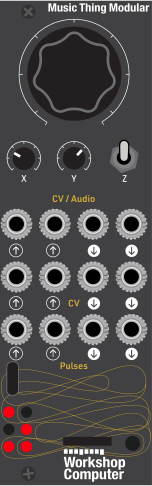 MixDecayToneAudio LeftAudio RightDecay CVSize CVReverb LeftReverb RightPitch Ch 1Pitch Ch 2Gate Ch 1Gate Ch 2
Controls
Mix
Dry/wet balance. Held at its stored value while the MOD page is latched
Decay
Feedback amount, from a single reflection up into self-oscillation around 2–3 o'clock. Highly interactive with Size, Tone, LPF, and Mix
Tone
Shelving tilt around 500 Hz, with a detent at noon. CW cuts lows and lifts highs. Sits inside the feedback path as well as on the wet output, so it doubles as a damping control
Size / Ratio: X and Y set reverb SIZE and the length ratio between delay lines
Decay / Tone: X and Y set reverb DECAY and the TONE tilt
Mod Page: Hold Down for 1 s to latch the MOD page (LED 5). Main becomes the wet hi-cut and X/Y become MOD depth and type, until you hold Down again. While Down is held unlatched, the knobs keep their Middle meanings.
Inputs & Outputs
Inputs
Outputs
Inputs
Audio Left
Left channel audio input
Audio Right
Right channel audio input
Decay CV
Bipolar trim added to the DECAY knob; full scale covers the whole range
Size CV
Bipolar trim added to the SIZE knob; full scale covers the whole 12–160 ms range
Outputs
Reverb Left
Left channel reverb output
Reverb Right
Right channel reverb output
Pitch Ch 1
v/Oct for MIDI channel 1, A4 = 0 V, with ±2-semitone pitch bend
Pitch Ch 2
v/Oct for MIDI channel 2, A4 = 0 V, with ±2-semitone pitch bend
Gate Ch 1
Gate for MIDI channel 1, last-note priority
Gate Ch 2
Gate for MIDI channel 2, last-note priority
LEDs
Host Status
Solid when a USB MIDI device is mounted. Blinks when the board is older than Rev1_1 and cannot run USB host mode
MIDI Activity
Flashes on incoming note and pitch-bend messages
Gate Ch 1
Gate Ch 2
Mod Latched
Lit while the MOD page is latched
README
PlantHolder — Computer Card
PlantHolder is a Workshop Computer card originally intended as a companion for the Instruo Pocket Scion. The name is a nod to two ideas: the Scion’s origins in plant biosonification, and the Householder-reflection feedback matrix at the heart of the Fairfield Circuitry Placeholder reverb this card emulates.
While it was originally designed for the Scion, it's just a generally fun reverb that's also a MIDI host. Use it with any USB MIDI device you like!
The reverb will self-oscillate at around 2–3 o'clock on the decay knob. This is highly interactive with Size, Tone, LPF, and overall Mix.
Features
- USB MIDI host — plug the Pocket Scion or any USB MIDI device into the Computer’s USB port. The Computer's USB port will power the Scion, which is a nice bonus!
- 2-channel CV/Gate — MIDI channels 1 and 2 (route voices in the Scion companion app, or your device's MIDI Settings); v/Oct + gate with ±2-semitone pitch bend.
- Reverb — three cross-coupled delay lines with a tone-tilted feedback path (Placeholder EB, 12–160 ms). DECAY runs from a single reflection up into self-oscillation.
- CV — CV In 1 → DECAY, CV In 2 → SIZE.
Board requirement
USB host mode requires Rev1_1 or newer (Q2 2025+). On an older board the USB host is not started and LED 0 blinks slowly; on a Rev1_1 board LED 0 is off until the USB device is mounted.
Hardware connections
| Computer jack | Role |
|---|---|
| Audio In 1/2 | L/R audio input |
| Audio Out 1/2 | L/R reverb output |
| CV Out 1 / Pulse Out 1 | v/Oct + gate — MIDI ch 1 |
| CV Out 2 / Pulse Out 2 | v/Oct + gate — MIDI ch 2 |
| CV In 1 | DECAY (bipolar trim) — controls the reverb's decay time |
| CV In 2 | SIZE (bipolar trim) — controls the reverb's size |
Controls
Switch Up — SIZE / RATIO
| Knob | Function |
|---|---|
| Main | MIX |
| X | SIZE (12–160 ms) |
| Y | RATIO |
Switch Middle — DECAY / TONE
| Knob | Function |
|---|---|
| Main | MIX |
| X | DECAY |
| Y | TONE |
Switch Down (hold > 1 s) — MOD (LED 5)
Toggle with a 1 s hold on Down.
| Knob | Function |
|---|---|
| Main | Wet hi-cut (1 kHz → open) |
| X | MOD depth |
| Y | MOD type — none / cyclical / random / both |
Reverb topology
Per the EB Specifications:
mono in ──[HPF]──► 3 delay lines (SIZE / RATIO)
                     ├─ nested self-feedback, out of phase
                     └─ 4th path: Σ ──[TONE tilt]──► in phase
                    both scaled by DECAY, so self cancels
                              └──► Σ/3 ──[TONE]──[HI-CUT]──► stereo wet
All four feedback paths share the DECAY gain, so each line's own contribution cancels and what remains is pure cross-feedback — "every delay line feeds back only to every other delay line". The in-phase mode therefore has a gain of 2 × DECAY, which crosses unity around three quarters up the knob: that is the pedal's documented onset of self-oscillation at 2–3 o'clock. Past it the card sings, bounded by a soft limiter rather than running away.
TONE sits inside that fourth path as well as on the wet output, so it acts as a damping control — which is why oscillation is easier to provoke at either extreme of TONE than at noon.
Implementation: placeholder_reverb.h (PlaceholderReverb).
Known limitation: delay-line length is slewed one sample per sample with no fractional interpolation, so large SIZE sweeps pitch-shift audibly and deep MOD is grainy. Fine for slow moves; not a smooth-scrub delay.
LEDs
| LED | Indication |
|---|---|
| 0 | Solid: Scion mounted. Blinking: board older than Rev1_1 |
| 1 | MIDI activity |
| 2 | Gate ch 1 |
| 3 | Gate ch 2 |
| 4 | Unused |
| 5 | MOD page latched |
Building
cd releases/85_plant_holder
cmake -S . -B build -DPICO_SDK_PATH=/path/to/pico-sdk
cmake --build build
Or, from inside the repo's dev container (.devcontainer/), just make —
the harness stages the firmware into UF2/.
Flash UF2/plant_holder.uf2.
License
MIT — see LICENSE.
Credits
- Fairfield Circuitry Placeholder (EB) — reverb topology.
- rppicomidi/usb_midi_host.
- ComputerCard — Chris Johnson.