
873 Blueberry Smoothie
The third card in the Workshop Buddies trilogy, Blueberry Smoothie is a hardware-tested monophonic CV and gate recorder conceptually inspired by Blueberry, not a direct firmware port or an exact recreation of its hardware interface. Any compatible pitch CV into CV In 1 is snapped to the nearest note in Blueberry's fixed C, D, F, G, A pentatonic set, repeated across octaves; Pulse In 2 supplies an independent gate. The suggested 4 Voltages patch can span several octaves and is not required. Main transposes the quantised result. Down toggles recording, LED 2 shows an active take, and Up plays the saved phrase with recorded timing or one event per Pulse In 1 clock edge. Loops are held in RAM and clear on reset; the card produces pitch and gate, not audio.
Panel
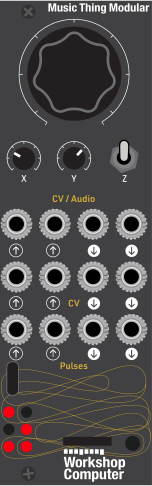 Transpose NotchesPitch CVClockGate InQuantised PitchGateLoop Start
Controls
Transpose Notches
Cross 3 o'clock for one upward notch or 9 o'clock for one downward notch; return through centre to rearm. Alternating fifth/fourth steps transpose the quantised result, reaching an octave after two upward notches.
Play Loop: Finishes an active recording and plays the captured phrase.
Free Play: Plays live CV pitch and gate; recording continues here until stopped.
Record Toggle: One Down press starts a new take; release, then press again to stop. Holding does not retrigger.
Inputs & Outputs
Inputs
Outputs
Inputs
Pitch CV
Any compatible pitch CV, quantised at 1 V/oct to the nearest C, D, F, G or A across octaves before Main transposition. The suggested 4 Voltages source can span several octaves.
Clock
Advances one recorded event per rising edge during loop playback.
Gate In
Independent live and recorded gate from Slopes or an external gate/trigger source.
Outputs
Quantised Pitch
Calibrated 1 V/oct pitch from the live quantiser or recorded loop, including Main transposition.
Gate
High for an active live or recorded note.
Loop Start
Short pulse at loop restart.
LEDs
Input Calibration
Reports input calibration data only, not CV output calibration. Off does not prevent use.
Loop Playback
Lit while a recorded loop is playing in Switch Up.
Recording
Stays lit while recording, including after the switch returns to Middle.
Clock Patched
Lit when Pulse In 1 is connected.
Gate
Lit while the live or recorded note gate is high.
Pitch
Brightness represents current quantised pitch.
README
Blueberry Smoothie
Card 873, version 0.3.0, Beta. Hardware test protocol passed on 2026-10-10. The last in the workshop computer buddies trilogy. Blueberry smoothie is an attempt to match the warkshop system hardware to the quirks of the Blueberry module. By the nature of the different hardware UI it is a conceptual version rather than being acurate in any way!
Blueberry Smoothie is a Blueberry-inspired, monophonic quantised keyboard recorder for the Workshop Computer. Patch one output from the Workshop System's 4 Voltages module to CV In 1. The card quantises its voltage to pitch. Pulse In 2 supplies an independent gate from Slopes or an external gate/trigger. No resting-voltage learning is needed.
This is a new Workshop implementation inspired by the original Blueberry, not a direct firmware port.
Install
Flash Blueberry-Smoothie-0.3.0.uf2 to a Workshop Computer program card, then reset with the switch in Middle. This is the unchanged, hardware-tested Workshop Blueberry 0.3.0 binary, published under the Blueberry Smoothie card name. No sound is generated by the card itself: patch its pitch and gate outputs to your oscillator/envelope.
Behaviour
| Control | Function |
|---|---|
| CV In 1 | Pitch voltage from any suitable CV source, quantised to Blueberry's C major pentatonic scale at 1 V/oct. |
| Pulse In 2 | Explicit live gate. Pitch changes do not create gates; no gate cable means gate off. |
| Main | Blueberry-style persistent transposition. Turn past 3 o'clock for one upward notch, return through centre, then repeat. Turn past 9 o'clock for one downward notch. A notch alternates fifth/octave movement exactly like Blueberry's buttons. |
| Switch Middle | Free play: live keyboard voltage is quantised to C major pentatonic. An active recording continues after releasing Down. |
| Switch Down | Record toggle: press once to start a new take, release to Middle and play, then press again to stop. |
| Switch Up | Play the recorded loop. If recording, finish the take and start playback. |
| Pulse In 1 | Clock. While patched in Up, each rising edge advances one recorded note event, following original Blueberry clock behaviour. Without a clock, playback uses the captured timing. |
| CV Out 1 | Quantised pitch, using Workshop output calibration. |
| Pulse Out 1 | Live Pulse In 2 gate, or the recorded gate during playback. |
| Pulse Out 2 | Brief pulse at each loop restart. |
Audio In 1/2, CV In 2, Audio Outs, and CV Out 2 are unused.
4 Voltages single-button selections latch. They can hold a pitch while a separate gate source articulates notes. In Up, live CV In 1 and Pulse In 2 do not override saved playback. Return Middle for live control. Recorded pitches include the Main transposition used during recording.
Workshop System Patch
4 Voltages is a suggested source, not a requirement. Its output voltages can span several octaves when interpreted as 1 V/oct pitch, so the buttons and their combinations need not produce notes close together or within one octave. Any CV-plus-gate source compatible with the Workshop inputs can be used: patch pitch CV to CV In 1 and its gate to Pulse In 2. The pitch is quantised to Blueberry's C major pentatonic scale (C, D, F, G, A), repeating across octaves. Pitch and gate may also come from separate modules.
Quantised Scale
The fixed scale is Blueberry's five-note pentatonic set: C, D, F, G, A. Relative to C, these are 0, 2, 5, 7, and 9 semitones, repeated in every octave. Incoming pitch CV snaps to the nearest of these notes rather than passing through continuously. E, B, and the sharp/flat notes are not selected. This is Blueberry's original note set, not the conventional C major pentatonic set C, D, E, G, A. Main transposes the quantised result, so its note names change after a transposition notch; the five-note pattern remains the same.
| From | To |
|---|---|
| 4 Voltages output | Computer CV In 1 |
| Computer CV Out 1 | Top oscillator pitch input |
| Top oscillator sine | Ring Mod upper input |
| Computer Pulse Out 1 | Top Slopes input |
| Top Slopes output | Ring Mod lower input |
| Ring Mod output | Mix input |
| Bottom Slopes output | Computer Pulse In 2 |
Set top Slopes to Falling, Loop off, for an audible envelope. Set bottom Slopes to Loop/Falling for gates, or substitute an external gate source. Turn oscillator FM down. Pulse In 1 remains an independent playback clock.
LEDs
| LED | Meaning |
|---|---|
| 0 | Input calibration coefficients were loaded from EEPROM. |
| 1 | Loop playback is active in Switch Up. |
| 2 | Recording in progress; stays lit after Down is released until recording stops. |
| 3 | Pulse In 1 is patched. |
| 4 | Gate is high. |
| 5 | Current quantised pitch brightness. |
LED 0 reports input calibration only, not CV output calibration. It can remain off on a Computer with calibrated outputs; no user calibration step is needed.
Important Limits
- Loop data is held in RAM and clears at reset/power-off.
- The first pass stores up to 512 changes of pitch or gate. Steady held notes use one event regardless of their duration, so typical phrases can be long.
- The scale is fixed to Blueberry's default major pentatonic for now.
- Recorded timing has 1 ms resolution. Gate triggers sampled by the audio runtime are retained for at least one control tick. Pulses shorter than one 48 kHz audio sample may still be missed.
- Input calibration is available in ComputerCard 0.4.0. When no calibration record is present, the card still works with the framework's approximate voltage conversion but LED 0 remains off.
- CV inputs are less precise than audio inputs. A local
CVIn1Millivolts()accessor uses the framework's existing CV1 calibration coefficients. Calibrated CV output remains enabled.
Build
Install CMake, an Arm GNU embedded toolchain (arm-none-eabi-gcc), and the
Raspberry Pi Pico SDK with its required submodules. Run from the Workshop
Computer repository root. This release was verified with Pico SDK 2.3.0 and
Arm GCC 15.2.1; build outputs stay outside the repository.
export PICO_SDK_PATH=/path/to/pico-sdk
cmake -S releases/873_Blueberry_Smoothie -B /private/tmp/blueberry-smoothie -G "Unix Makefiles"
cmake --build /private/tmp/blueberry-smoothie -j2
The build creates workshop_blueberry.uf2. Flash
Blueberry-Smoothie-0.3.0.uf2.
See TEST_PROTOCOL.md.
The 0.3.0 protocol passed on Workshop hardware on 2026-10-10, including toggle recording, the recording LED, live control, saved playback, and clock/gate inputs. Catalogue status remains Beta while more users test it.
The source target keeps its original workshop_blueberry name to preserve
the tested firmware. A clean release-folder build produced a byte-identical
UF2 to the packaged binary; its SHA-256 is recorded in uf2/SHA256SUMS.txt.
Native control tests replace hardware I/O while executing the card code:
c++ -std=c++17 -Wall -Wextra -Ireleases/873_Blueberry_Smoothie/tests releases/873_Blueberry_Smoothie/tests/control_test.cpp -o /tmp/blueberry-control-test
/tmp/blueberry-control-test
Earlier source and UF2s are preserved in the Workshop Buddies Blueberry archive. Version 0.3.0 debounces Down presses for 10 ms and requires a settled release between toggles. Holding Down only toggles once. Booting with Down held does not start recording; release it before the first press. Starting a new take replaces the old loop; stopping leaves it saved in RAM while Middle stays live. Version 0.2.0 also corrects the first pass's pitch scaling to standard 1 V/oct and captures playback-clock edges at audio rate so they are not lost between control ticks. Workshop-specific changes were AI-assisted.
Attribution And Licence
Blueberry Smoothie's card code is MIT licensed, copyright 2026 Adrian Vos.
It includes the MIT-licensed
ComputerCard.h 0.4.0 framework by Chris Johnson. Its interaction model is
inspired by the MIT-licensed Blueberry software in the
Buddies public repository.
No original Blueberry source, graphic design, or hardware files are included.
The original software's MIT licence, the graphic design's CC BY-SA 4.0 licence,
and the hardware's CERN-OHL-P v2 licence are distinguished in the
upstream licence file.
The Pico SDK dependency and import helper use BSD-3-Clause; its notice is
included in licenses/PICO_SDK_LICENSE.txt.
The card's sequencer, quantiser, transposition, gate capture, recording toggle,
LED mapping, and tests were written for the Workshop, with AI assistance.
Source development is maintained in
Workshop Buddies.
See THIRD_PARTY_NOTICES.md.