
89 Lockstep
Two CV outputs wander together through a scale (parallel motion): you tune two oscillators by hand to set the interval and the card moves them in lockstep, clocked and quantized. X sets how often it moves (clock division when clocked, internal rate when free), Y sets how far (frozen single note up to +/- one octave). Switch DOWN (momentary) selects the scale via the Main knob; UP freezes the current pitches; MIDDLE runs. Main knob is a resonant low-pass filter processing the two oscillators returned through Audio In 1/2, out Audio Out 1/2. Pulse In 1 clocks it, Pulse In 2 re-seeds. The walk is centered high and floored so the pitch CV never goes negative.
Panel
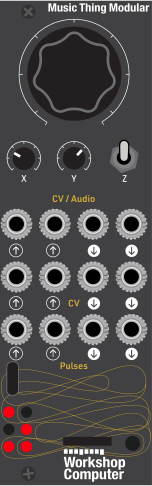 Filter Cutoff / Scale SelectMovement RateMovement RangeOscillator A ReturnOscillator B ReturnUnusedUnusedClockRe-seedVoice A FilteredVoice B FilteredVoice A PitchVoice B PitchVoice A GateVoice B Gate
Controls
Filter Cutoff / Scale Select
Resonant low-pass cutoff for the returned oscillators; selects the scale while switch is held DOWN
Movement Rate
Clock division when clocked, internal rate when free-running
Movement Range
How far the walk wanders, from a single held note to plus/minus one octave
Inputs & Outputs
Inputs
Outputs
Inputs
Oscillator A Return
Oscillator A fed back in for filtering
Oscillator B Return
Oscillator B fed back in for filtering
Unused
Not used in this version
Unused
Not used in this version
Clock
Rising edge advances the walk (divided by X); internal clock when unpatched
Re-seed
Rising edge jumps the walk to a fresh pattern
Outputs
Voice A Filtered
Oscillator A through the resonant low-pass
Voice B Filtered
Oscillator B through the resonant low-pass
Voice A Pitch
Quantized V/Oct pitch CV for oscillator A
Voice B Pitch
Quantized V/Oct pitch CV for oscillator B (parallel, identical walk)
Voice A Gate
10 ms gate on each note change for voice A
Voice B Gate
10 ms gate on each note change for voice B
LEDs
Position / Scale bit 0
Walk position bar in Run; scale-index bit while selecting
Position / Scale bit 1
Walk position bar in Run; scale-index bit while selecting
Position / Scale bit 2
Walk position bar in Run; scale-index bit while selecting
Position / Scale bit 3
Walk position bar in Run; scale-index bit while selecting
Position / Scale bit 4
Walk position bar in Run; scale-index bit while selecting
Position / Scale bit 5
Walk position bar in Run; scale-index bit while selecting
README
Lockstep
Dual quantized pitch-mover for the Music Thing Modular Workshop Computer.
Two CV outputs wander together through a scale. You tune two oscillators by hand to set the interval; Lockstep walks them in parallel, so the harmony you dialled in moves as one — clocked, quantized, and always in key. One knob sets how often it moves, another how far. The Main knob is a resonant low-pass filter that processes the two oscillators returned through the audio inputs, so the card is a complete generative two-voice instrument on its own.
Why this card exists
It came out of a long dead-end: driving oscillators from another card's bassline that output pitch CV in negative territory, which some oscillator inputs (a SineSquare's Pitch jack, for one) simply won't track. Lockstep is built the opposite way — its walk is centered high (around MIDI 72) and floored so the CV never drops below ~0 V. It drives positive-only pitch inputs cleanly, and you tune the oscillators down to taste.
I/O
| Jack | Direction | Function |
|---|---|---|
| Pulse In 1 | Input | Clock. Each rising edge can advance the walk (see X knob for division). Disconnected → internal free-running clock. |
| Pulse In 2 | Input | Re-seed. A rising edge jumps the walk to a fresh pattern (and recenters it). |
| CV Out 1 | Output | Voice 1 pitch CV. V/Oct, hardware-calibrated, quantized to the scale. |
| CV Out 2 | Output | Voice 2 pitch CV. Follows CV Out 1 (parallel motion), except when it takes a mid-beat passing move (see Doubling below). |
| Pulse Out 1 | Output | Gate (~10 ms) on every step where voice 1's quantized note changes. Drive an external envelope for voice 1. |
| Pulse Out 2 | Output | Same gate for voice 2 — fires on the main step and on any mid-beat double. |
| Audio In 1 / 2 | Input | The two oscillators, patched back in for processing. |
| Audio Out 1 / 2 | Output | The oscillators through the resonant low-pass filter. |
| CV In 1 | Input | Doubling probability (bipolar). Unpatched → the ~25% default. Patched: full negative = never, 0 V ≈ 50%, full positive = nearly every interval. Patch a slow LFO or random CV to make the ornamentation itself drift. |
| CV In 2 | Input | Scale offset (bipolar). Shifts the knob-selected scale up or down the 12-scale table; a full swing reaches any scale. 0 V = no shift. Sweep it slowly to morph dark→bright, or step it to change key/mode per phrase. |
Controls
X — Movement rate
How often the pitch moves.
- Clocked (Pulse In 1 patched): X is a clock divider — fully CW = move on every clock pulse, fully CCW = hold for up to 60 pulses.
- Free (Pulse In 1 unpatched): X is the internal rate — fully CW ≈ fast (many moves/sec), fully CCW ≈ slow (~2 sec per move).
Y — Movement range
How far it wanders from the center.
- Fully CCW = frozen on a single note (no movement).
- Fully CW = up to ±1 octave of quantized wander.
Everything in between scales the span; small settings drift gently around the center, large settings roam.
Doubling — voice B passing tones
Both voices normally step together on every beat. But sometimes voice B (CV Out 2) takes one extra step at the midpoint of the interval — a passing tone of ±1–2 scale steps — then re-locks with voice A on the next beat. Voice A holds the pulse; B adds a little melodic flourish over it.
- Probability is set by CV In 1 (unpatched ≈ 25% of intervals). See the I/O table.
- It only happens when there's room: the interval must be at least 2 clocks long (so not at X fully CW / every-clock) and Y must be above zero.
- Pulse Out 2 gates on the double too, so an external envelope re-articulates the passing note.
Main knob — Filter cutoff (switch-dependent)
- Switch UP or MIDDLE: resonant low-pass cutoff for the two oscillators returned on Audio In 1/2. Left = dark, right = bright and open. Resonance is fixed and moderately singing.
- Switch DOWN (held): selects the scale instead (see below). The cutoff is held at its last value while you do this.
Switch
| Position | Function |
|---|---|
| MIDDLE | Run — normal generative movement. |
| UP | Freeze — hold the current pitches. The walk stops; CV outs stay put. Flip back to MIDDLE to resume. |
| DOWN (momentary) | Scale select — while held, the Main knob picks the scale. LEDs show the scale index in 6-bit binary. Release to return to Run/Freeze. |
LEDs
| State | Display |
|---|---|
| Run | A single bright LED shows the walk's current position within its range (a bouncing bar). Dim flashes mark note changes. |
| Freeze | All six LEDs dim and static. |
| Scale select (switch DOWN) | Scale index (0–11) in 6-bit binary at half brightness. |
Scales
Twelve scales, arranged CCW (dark/minor) → CW (bright/ambiguous), reused from the Markov card: Phrygian, Hirajōshi, Harmonic Minor, Natural Minor (default), Minor Pentatonic, m7 Arpeggio, Dorian, Major Pentatonic, Ionian (Major), Maj7 Arpeggio, Whole Tone, Chromatic. All scales are rooted at C — you set the actual key by tuning the oscillators.
Hold switch DOWN and turn the Main knob to pick the base scale. CV In 2 then offsets that choice up or down the table (see I/O), so you can modulate the scale under CV while the knob sets home. Scale changes re-quantize the current notes immediately — a slowly swept LFO on CV In 2 makes the held voices drift through modes and reharmonize.
How to patch it
- CV Out 1 → Oscillator A Pitch (1V/Oct). CV Out 2 → Oscillator B Pitch.
- Tune the two oscillators by ear to the interval you want (a fifth, an octave, a third — whatever). Both now move in parallel, preserving that interval.
- Optional articulation: Pulse Out 1 → envelope A, Pulse Out 2 → envelope B, so the notes re-trigger on each change instead of gliding continuously.
- Optional processing: Osc A → Audio In 1, Osc B → Audio In 2, then Audio Out 1/2 → your mixer. The Main knob now filters both voices.
- Clock: patch your system clock to Pulse In 1, or leave it unpatched to free-run at the rate set by X.
- Set Y for how much the line should move, X for how fast, hold switch DOWN and sweep Main to pick a scale.
Freeze a phrase: let it run until a nice shape appears, flip the switch UP to lock the pitches, then keep playing over it. Flip back to MIDDLE to set it moving again.
Technical notes
- Sample rate 48 kHz, system clock 192 MHz. Integer-only DSP in the audio callback.
- Movement: a reflected random walk in semitones, bounded by Y, quantized to the selected scale. The output is octave-folded to stay ≥ MIDI 60 (~0 V) so it drives positive-only pitch inputs.
- Parallel motion: CV Out 1 and CV Out 2 carry the same walk, so the interval between your two voices is whatever you tuned into the oscillators. The exception is doubling — voice B occasionally departs for a mid-beat passing tone, then re-locks (see above).
- Filter: a Chamberlin state-variable low-pass per channel, fixed-point Q12, with a fixed moderate resonance.
- The pure movement engine (
src/lockstep_engine.h) is unit-tested on the host — seesim/test_engine.cpp(./sim/build.sh), which checks that every output note is a scale tone, stays positive-CV, and respects the range.
Build
Requires the Pico SDK at PICO_SDK_PATH.
cd src
cmake -S . -B build
cmake --build build -j$(sysctl -n hw.logicalcpu)
# Output: build/lockstep.uf2
Flash by holding BOOTSEL while connecting USB, then copy the .uf2 to the mounted drive.
Status
Built and validated in offline simulation; not yet tested on hardware.