
102 NIBBLE-KO
NIBBLE-KO is the percussion half of NIBBLE (uglifruit/WorkshopNibble),
expanded into a dedicated twelve-voice drum machine: every voice
independently synthesised or sample-based, chosen and uploaded from a
browser WebUI.
Patch one output of the FOUR VOLTAGES module into CV In 1. The card learns
which voltage each button combination produces, the same ten-level
detector and SHIFT technique as NIBBLE's Percussion half: hold one button
as a bank select, tap another to play it repeatedly - twelve ordered
gestures from four buttons and six pairs.
CALIBRATION IS THE WHOLE GAME. Use output 1 of Four Voltages with its knob
near twelve o'clock, and give the card ten well-separated voltages. Levels
that sit close together do not fail cleanly - a pad plays the wrong drum,
fires twice or does nothing, differently each time. The card blinks LEDs 4
and 5 when two captures are too close; move the knob and run it again
rather than playing around it.
The momentary switch is a MODE SELECTOR rather than a trigger. Hold it and
press a button to choose - drums, mute groups, or twelve performance
effects - then Middle plays that mode and Up records it. Because the mode
latches, everything is recorded through one mechanism.
THE EFFECTS are four banks of three, the shift picking the family: filters,
destruction (crush, decimate, wavefold), rhythmic (stutter, flam, gate) and
transport (reverse, tape-stop, silence). Up to four layer at once, in
series. The transport bank means different things to different voices - a
sample plays backwards where a synthesised voice runs its ENVELOPE
backwards, a swell instead of a decay - so one press gives backwards kick
and hats over swelling toms at the same time. Each shift records two lanes,
the effect and its own parameter curve, so a sweep can be drawn once and
effects punched in and out over the top of it.
THREE PATTERN SLOTS sit on the fourth mode, where the SWITCH is the verb:
hold D and tap A, B or C to recall a slot instantly, or do the same with
the switch UP to store the live loop into it instead. That reuses what Up
already means everywhere else - commit this to the loop - so there is no
new gesture to learn. Recall does not move the playhead, so switching
mid-bar reads as the band changing part rather than a stop and start, and
it discards whatever you were playing, which is what makes it possible to
try something over a pattern and abandon it.
PATCHABLE. CV In 2 takes over the Main knob, Pulse In 2 fires a random
effect for as long as it is high, and Audio In 1 and 2 set that effect's
depth and a global CHAOS level. Chaos drives two glitch generators on the
CV outputs - one sparse and beat-anchored, one dense and syncopated, both
following the live quantise grid. Patch either back into Pulse In 2 and the
card glitches itself.
1.2.1. Drums, the looper, mute groups, the twelve effects, pattern slots,
sample playback, the browser sample manager, flash-saved calibration and the
CV expansion above are all played and working on hardware. Patterns can be
SAVED TO YOUR COMPUTER and loaded back from the browser tool, as plain JSON
files - the card keeps its three slots in RAM, so the file on disk is the
permanent copy. A pattern stores voice numbers rather than sounds, so one
saved against any kit plays against any other. New in this release: the LOOP
LENGTH is settable from 4 to 16 beats, so odd time signatures are playable -
the click is unstressed and nothing marks beat one, so fourteen beats is 7/4
twice, or 5/4 + 2/4 + 3/4 + 4/4, or whatever you hear in it. Shortening is
non-destructive: the card always records the full sixteen beats, so putting
the length back brings the hidden hits with it. The loop also keeps playing
while the browser tool is connected, so a voice can be re-pointed at a new
sound and judged by ear against the pattern it has to sit in. 1.2.1 fixes
the browser tool failing to find the card when the computer shows it under
another Workshop card's cached MIDI name - it now identifies the card by
asking rather than by matching the port name. That is a change to the web
page only: THE FIRMWARE IS UNCHANGED FROM 1.2.0 AND NEEDS NO REFLASHING -
the UF2 below is the same binary, so if you are already running 1.2.0 just
take the new browser page. See the repository's README for the fuller
detail.
Panel
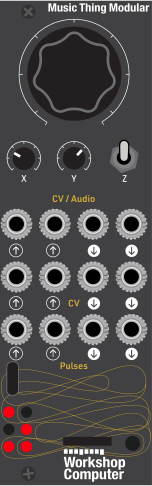 DJ Filter / FX depthTempoKit characterFX depthChaosFour VoltagesMain overrideClkInRandom FXDrumsDrumsGlitch (sparse)Glitch (dense)GateClick
Controls
DJ Filter / FX depth
Overridden by CV In 2 while something is patched there. In DRUMS and MUTE it is a DJ filter - low-pass to the left, high-pass to the right, generous bypass at centre. In FX mode it becomes the held effect's depth instead, and the filter latches where it was, picking up again only when the knob is turned back through that value so leaving the mode never jumps it. Movements are recorded into the loop; in FX mode each shift has its own parameter curve, so holding a shift alone and turning Main dra…
Tempo
40 to 240 BPM, ignored while an external clock is running on Pulse In 1.
Kit character
Reshapes the whole kit at once when a voice is struck - anticlockwise lower and longer, clockwise higher and shorter. On a synthesised voice that is pitch and decay; on a sampled one it is playback rate, which couples the two the way tape does. Applied at the moment of striking, so sweeping it never warps a sound already ringing.
Record: Play the current mode AND record it. Drum hits, effects and knob movements are captured the same way. Mute toggles are deliberately NOT recorded - a mute is a mixer move rather than part of the music, so it stays live state and persists across pattern recalls, making it an arrangement layer above the patterns. The loop stores events rather than audio, so overdubbing never degrades what is already there.
Play: Play the current mode without recording.
Mode select: Hold DOWN and press a button to choose a mode; the choice lands when you RELEASE, and then LATCHES, so Down and Up never need to be held at once. A: drums. B: mute groups. C: twelve performance effects. D: three pattern slots, hold D and tap A/B/C to recall - or do the same with the switch UP to store. With a PAIR held it fires a one-shot instead - A+B undo (which covers RECORDING - hits, effects and knob curves - and deliberately not the pattern slots), A+C quantise (which cycles…
Capture (during calibration): While calibrating, tap to capture the combination you are holding. Outside calibration a tap is just a short mode-select gesture and does nothing on its own.
Inputs & Outputs
Inputs
Outputs
Inputs
FX depth
Sets the depth of the random effect fired by Pulse In 2. A control voltage is the intended use; feeding it actual audio makes the depth judder at signal rate, which is either a mistake or exactly what you wanted. With nothing patched the effect uses that slot's own parameter curve instead.
Chaos
How busy the two glitch outputs are, and how fine. Turning it up raises the odds of any division firing AND widens the pool - at the bottom only beats are candidates, at the top every half-division is, so more chaos is finer as well as denser. Above about two thirds the dense output starts producing ratchets, short bursts instead of single gates. Never reaches certainty: a stream that fires on every candidate is a pulse train, not a random one. With nothing patched it sits at about 5%, one beat…
Four Voltages
Patch one output of the Four Voltages module here - output 1 with its knob near twelve o'clock is the reliable setting. The card learns which voltage each button combination produces, so it works at any knob position; re-learn whenever you move it. WELL-SEPARATED VOLTAGES MATTER MORE THAN ANYTHING ELSE: the knob moves all four outputs at once, and towards either extreme several combinations collapse onto nearly the same voltage. Two levels sitting close together do not fail cleanly - a pad play…
Main override
Takes over the Main knob while patched, so whatever Main does in the current mode is under CV instead - the DJ filter in DRUMS and MUTE, the held effect's depth in FX. Overrides rather than offsets, the same way Pulse In 1 overrides the tempo knob: a cable wins. Bipolar, and full swing covers the knob's whole travel.
ClkIn
An external clock at one pulse per beat. Overrides the tempo knob for as long as pulses keep arriving and hands the tempo back a few seconds after they stop.
Random FX
While HIGH, a randomly chosen effect is applied - one of the same twelve the buttons play. Level-sensitive rather than edge-triggered, so the incoming gate's WIDTH is how long the effect lasts; the effect is rolled once when the gate opens and held until it closes. It sits BELOW the hand and below anything recorded, so it colours the slots you are not using rather than fighting you for one. Patch CV Out 1 or 2 back into here and the card glitches itself.
Outputs
Drums
The mono drum bus, after the DJ filter. Audio Out 2 carries the same bus, not a stereo partner - patch either socket and you get the whole kit.
Drums
The same mono drum bus as Audio Out 1.
Glitch (sparse)
Gates on random beat divisions, weighted hard toward the downbeat and with longer gates - musical enough to use as an accent track on its own. Divisions follow the live quantise grid (switch+A+C), so this always agrees with what the card is recording to. Density is set by chaos on Audio In 2; with nothing patched there it fires about one beat in twenty.
Glitch (dense)
The same idea as CV Out 1 turned up: off-beats and finer subdivisions, short gates, and at high chaos occasional ratchets - short bursts rather than single hits. Deliberately skips the beat itself, which CV Out 1 already owns. This is the one to patch into Pulse In 2 when you want the card to fall apart.
Gate
Fires on every drum hit, live or looped.
Click
Fires once per beat.
LEDs
Buttons A B / C D
Laid out in the same 2x2 as the Four Voltages buttons - shows which combination is currently held, flashes on each hit, and during calibration shows which combination to press next.
Beat
Pulses on the beat. During calibration marks the four single-button steps.
Record
Lit while recording. During calibration marks the six two-button steps.
README
NIBBLE-KO
A twelve-voice synth/sample percussion looper for the Music Thing Modular Workshop System Computer, played by shift-and-tap on the Four Voltages module — with a browser sample manager.
Four buttons. Ten voltages. Twelve drums, yours to fill.
Status: 1.2.1, released. Drums, the looper, mute groups, twelve performance effects, three pattern slots, sample playback, the browser sample manager, flash-saved calibration and the CV expansion all work on hardware. Patterns save to and load from your computer as JSON, and the loop keeps playing while the browser tool is connected. The loop length is settable from 4 to 16 beats, so odd time signatures are playable. New in 1.2.1: the browser tool finds the card by asking it, not by matching its MIDI port name — so it connects even when your computer shows the card under another Workshop card's cached name. Browser page only; the firmware is unchanged and needs no reflashing. See CLAUDE.md for exactly what's here and what isn't.
A program card for the Music Thing Modular Workshop System Computer that expands the Percussion half of NIBBLE into a dedicated drum machine: twelve voices, each independently synthesised or sample-based, freely assigned and uploaded from a web interface — no toolchain, no reflashing.
Lineage
NIBBLE-KO combines two existing cards rather than starting from nothing:
- The playing technique and looper come from NIBBLE's Percussion half: Four Voltages' four non-latching buttons read as ten learned voltage levels, with a shift trick that recovers press-order from a signal that otherwise throws it away — hold one button as a bank select, tap another to play it, turning six two-button combinations into twelve distinguishable gestures. A four-bar event looper with lossless overdub sits behind it.
- The sample management comes from BioMimicry's USB-MIDI SysEx upload pipeline: drop a WAV in the browser, it's converted, uploaded, and written into a reserved flash region that survives reflashing the firmware.
Playing it
The momentary switch is a mode selector, not a trigger. Its three positions:
| Switch | |
|---|---|
| Down | choose a mode — hold it, press a button, and the choice lands when you release |
| Middle | play the chosen mode |
| Up | play it and record into the loop |
The mode latches, so Down and Up never need to be held at once — which is what lets every mode be recorded through one mechanism.
| Hold switch, press | Mode |
|---|---|
| A | Drums — the kit (where you start) |
| B | Mute — three mute groups |
| C | FX — twelve performance effects |
| D | Pattern — three stored loops |
And with a pair held, one-shot actions:
| Hold switch, press | |
|---|---|
| A + B | Undo — revert the last recording pass (not pattern stores; see below) |
| A + C | Quantise — cycle the record grid: 16th → 12th → 8th |
| C + D | Play / Stop |
| B + D | WebUI — hand the card over to USB for the browser setup tool |
The adjacent pairs carry what you reach for mid-take. The WebUI takes the awkward diagonal, since it is a setup activity done with both hands free.
Why singles commit on release but pairs fire instantly. Four Voltages holds its last voltage, so the CV may already be sitting on the single you are trying to pick — pressing it produces no change at all, and a press-driven select would never fire. Reading the state on release is immune to that. A pair cannot get stuck the same way, because letting go of one falls back onto a single, so a pair press is always a real transition.
Drums
Singles are shifts, not sounds. Hold one and tap another to play: twelve ordered gestures from four buttons, because hold-C-tap-A and hold-A-tap-C are different gestures on an identical voltage.
Main is a DJ filter (low-pass left, high-pass right, bypass at centre), X is tempo, Y is kit character. All three are recorded when the switch is Up.
Mute
Hold B, tap A, C or D to toggle one of three mute groups. The pads show each group's hits going past — full brightness when it sounds, half when it is muted, so you can see the pattern you have silenced and time bringing it back.
Mutes are not recorded, and they persist across pattern recalls. A mute is a mixer move rather than part of the music: it says "not this group, right now". Recording it would bake a live judgement into the loop and make you fight the recording to change your mind. Keeping it as live state instead makes mutes an arrangement layer above the patterns — drop the hats, swap patterns, and the hats stay dropped.
Pattern
Three slots, and the switch is the verb:
| Middle + hold D, tap A/B/C | recall that slot, instantly |
| Up + hold D, tap A/B/C | store the live loop into it |
That reuses what Up already means everywhere else — commit this to the loop — so there is no new gesture to learn.
Recall keeps the playhead where it is, so switching mid-bar reads as the band changing part rather than a stop and start. It discards whatever you were playing, which is what lets you try something over a pattern and abandon it.
Undo does not reach the slots. It is about recording — the hits, effects and knob curves a pass with the switch Up put into the live loop. Storing a pattern is a separate deliberate act on separate state, and a gesture that sometimes meant "undo my playing" and sometimes "un-store that slot" would be two features sharing one name. What protects a slot instead is that storing refuses an empty loop, so the destructive case cannot happen by accident.
The pads show three states: full is the pattern playing, half is a slot with something in it, dark is empty — so what you can jump to is readable at a glance.
Patterns live in RAM only — they do not survive a power cycle. Getting them in and out over the web app is the next natural step, and a pattern is a good candidate for it: a bare event list under 2KB, carrying no audio.
A hold-to-store gesture would not work on this hardware. Four Voltages latches: a held button is a level that sits there indefinitely, so any "held for a second" test passes eventually and every recall would become a store.
Quantise
switch + A+C cycles the grid new hits snap to: 16th → 12th (triplet) → 8th, and round again. The two status LEDs show which, as a pattern you read at a glance rather than a count:
| LEDs | Grid |
|---|---|
| 4 alone | 16th |
| 4 and 5 | 12th (triplet) |
| 5 alone | 8th |
The middle setting sits visually between the outer two, which is also where it sits musically.
It only affects hits recorded from that point on. A hit is snapped once, at the moment you play it, and never moves again. That is what lets a straight part recorded under 16ths and a triplet fill recorded under 12ths live in the same loop, each on the grid it was played against — which a single live "playback grid" setting could not do, since one divisor would apply to every hit at once and switching to triplets would drag the straight part along with it.
The trade is that a hit's original unquantised timing is gone the moment it is recorded, so a future "loosen the grid" control could not recover it.
FX — twelve effects, four banks
Hold any single as a shift, press another for its effect. The shift picks the family, which is what makes twelve gestures learnable as four groups:
| Hold | Tap | Effect | Main knob |
|---|---|---|---|
| A filters | B | Low-pass | cutoff |
| C | High-pass | cutoff | |
| D | Band sweep | centre | |
| B destruction | A | Bit-crush | bits discarded |
| C | Decimate | sample-rate reduction | |
| D | Wavefold | drive | |
| C rhythmic | A | Stutter | repeat rate |
| B | Flam | gap, 5–35 ms | |
| D | Gate | chop rate | |
| D transport | A | Reverse | — |
| B | Tape-stop | fall time, 50 ms–2.4 s | |
| C | Silence | — |
Effects are momentary — held, not toggled — and one per bank, so up to four layer at once, processed in series.
The transport bank means different things to different voices, which is the point of grouping it: the gesture is "play it wrong on purpose", and what that means depends on what the voice is made of.
| Sampled voice | Synthesised voice | |
|---|---|---|
| Reverse | plays backwards | envelope backwards — a swell |
| Tape-stop | rate winds to nothing | pitch winds to nothing |
Since five voices are sampled and seven synthesised, one reverse press gives you backwards kick and hats over swelling toms and cymbals at the same time.
Both are armed at trigger time, so they catch hits that start while the effect is held and leave anything already sounding alone.
Recording effects
Each shift owns two recorded lanes — which effect is running, and that lane's parameter curve — performed separately:
- shift + tap, switch Up: records the effect popping in and out
- shift alone + Main, switch Up: draws that lane's parameter curve
So you can sweep a filter curve once, then punch the effect in and out over the top of it on later passes without re-recording the sweep. Turning Main with no shift held does nothing, deliberately: with four curves and no button down, which one you meant is ambiguous.
There are four parameter curves, one per shift — not one per effect. The
three effects under a shift share it: B+A, B+C and B+D all read and
write the same curve. That is what makes the shift a coherent layer rather
than three unrelated things, but it has a consequence worth knowing before
it surprises you — recording a depth twiddle under B+C overwrites a curve
you recorded earlier under B+A, wherever the two overlap in the bar.
To play over a recorded curve without disturbing it, jam with the switch at Middle. Your hand takes the depth live while you hold the gesture, the recorded curve is left alone, and it picks up again the moment you let go. Only the switch at Up writes. That is the difference between trying something and committing it, and it is the same distinction everywhere else on the card.
Calibration is the whole game
Patch output 1 of Four Voltages into CV In 1, with its knob at about twelve o'clock. A normal power-up loads the last saved calibration from flash and is playable immediately. Holding the switch Down through the first moment of boot forces a fresh calibration instead: the LEDs show a combination, you hold it and tap the switch to capture, ten times over. A successful run is saved, and stays saved across power cycles until the next alt-boot learn replaces it — so recalibrate only when the Four Voltages knob has actually moved. Aborting a re-calibration (hold the switch 2s) keeps whatever was saved before, rather than losing it.
Give it well-separated voltages, or nothing else will work properly.
That knob moves all four outputs at once, and towards either extreme several combinations collapse onto nearly the same voltage. When two learned levels sit close together the symptom is not a clean failure but an intermittent one: a pad that plays the wrong drum, fires twice, or does nothing — and does it differently each time, because a few millivolts of drift moves the reading across the boundary. It reads as a flaky card rather than a mis-set knob.
The card tells you when this has happened. LEDs 4 and 5 blinking during calibration means that capture was too close to an earlier one. A run that finishes with no warnings will behave predictably; one that warns will not — so move the Four Voltages knob and calibrate again rather than trying to play around it.
Twelve voices, your choice of source
Every voice slot can be either a synthesised drum voice (phase-accumulator body, noise mix, pitch sweep, the same DSP as NIBBLE's kit) or a sample. Five are currently sampled from the Cheetah SpecDrum's original kit — kick, snare, closed hat, open hat, clap — and seven stay synthesised. A mix, not a wholesale swap: the synthesised voices are the ones whose Y-knob reshaping earns its keep, and a bit-crushed synth tom next to a sampled clap is the point of the card.
The Y knob is playback rate on a sampled voice and pitch-plus-decay on a synthesised one — the same gesture either way, making the whole kit higher-and-shorter or lower-and-longer.
Which sample a voice plays is a mapping of indices, not baked audio, so the browser will be able to re-point it at runtime. See samples/README.md.
Panel
| CV In 1 | one output of Four Voltages — the instrument |
| CV In 2 | takes over the Main knob while patched |
| Pulse In 1 | external clock, one edge per beat |
| Pulse In 2 | while high, a random effect is applied |
| Audio In 1 | depth of that random effect |
| Audio In 2 | chaos — how busy the glitch outputs are |
| Main | DJ filter, or FX depth while in FX mode |
| X | tempo, 40–240 BPM (ignored while clocked) |
| Y | kit character — pitch and decay on synth voices, playback rate on samples |
| Audio Out 1 / 2 | the drum bus, mono, both the same |
| CV Out 1 | glitch gates, sparse and beat-anchored |
| CV Out 2 | glitch gates, dense and syncopated |
| Pulse Out 1 | gate on every hit |
| Pulse Out 2 | click, one per beat |
| LED 4 / 5 | recording / beat |
Patching it
Everything above works unpatched — the card is played from its own panel and nothing here is required. But six sockets turn it into something you can drive from the rest of the rack.
CV In 2 takes the Main knob. Whatever Main does in the current mode is then under voltage: the DJ filter in DRUMS and MUTE, the held effect's depth in FX. It overrides rather than offsets, the same way an external clock overrides the tempo knob — a cable wins.
Pulse In 2 fires a random effect for exactly as long as it is high. It is level-sensitive, not edge-triggered, so the gate's width is the effect's duration. The effect is rolled once when the gate opens and held until it closes, and it sits below both your hands and anything recorded — so it colours the slots you are not using rather than fighting you for one. Audio In 1 sets its depth.
Audio In 2 is chaos, and it drives the two glitch outputs. Turning it up raises the odds of any division firing and widens the pool: at the bottom only beats are candidates, at the top every half-division is, so more chaos is finer as well as busier. Past about two thirds the dense output starts producing ratchets. It never reaches certainty — a stream that fires on every candidate is a pulse train, not a random one.
CV Out 1 and 2 are the glitch gates. Both follow the live quantise grid, so they always agree with what the card is recording to. CV Out 1 is sparse, weighted hard toward the downbeat, with longer gates — usable as an accent track on its own. CV Out 2 is dense, syncopated, deliberately skipping the beat that CV Out 1 already owns.
These are gates, not triggers: each one lasts most of the division it fired on, so it scales with the tempo and is long enough to be a musical effect rather than a click. That matters because the gate's width is exactly how long Pulse In 2 applies its random effect for.
The patch worth trying first: CV Out 2 into Pulse In 2. The card's own glitch generator now fires its own random effects, and Audio In 2 is the single knob that takes it from occasional to falling apart.
Patterns are sound-agnostic
Worth stating because it shapes what everything else can be: a recorded pattern holds voice indices, never sounds. "Slot 4 fired at tick 96" — not which sample slot 4 happens to play. The chain to audio is
pattern event → voice index → voice/sample map → bank index → audio
and only the last two links know anything about sound.
So re-pointing a voice at a different sample, or uploading a new one, changes what every existing pattern plays without altering a byte of the pattern. The same four bars can be a Cheetah kit or your own recordings.
That falls out of NIBBLE's decision to record the voice rather than the gesture, which it made for an unrelated reason: so re-arranging the gesture map couldn't silently change an old loop.
Saving patterns (new in 1.1.0)
The card's three pattern slots live in RAM and are lost at power-off. The browser tool is where they persist: open the Patterns tab, and each slot has Save… and Load….
Save writes a plain JSON file to your computer — that file is the permanent copy. Load pushes one back onto a slot, ready to play immediately with hold D, tap A/B/C. Neither touches flash, so neither reboots the card.
Because patterns are sound-agnostic (above), the file holds voice numbers and no audio at all — a few KB of readable JSON:
{
  "card": "nibble-ko", "kind": "pattern", "slot": 0,
  "knobCount": 4,
  "events": [ { "tick": 12, "what": 3, "value": 100 } ]
}
So a pattern saved against one kit plays against a completely different one, and patterns can be shared, versioned or hand-edited like any other text file. Events are validated on the way in, and the card re-sorts and range-checks whatever arrives, so a hand-edited file cannot corrupt playback.
The loop keeps playing while the browser tool is connected, so a voice can be re-pointed at a new sound and judged by ear against the pattern it has to sit in. Only recording stops; an upload still silences the card, because writing flash stops everything.
Loop length (new in 1.2.0)
The Patterns tab sets how many beats the loop plays before repeating, anywhere from 4 to 16. Sixteen — four bars of 4/4 — is the default and what every earlier version did.
This is what makes odd metres playable. The click on Pulse Out 2 is unstressed and nothing on the card marks beat one, so the length is a count rather than a time signature: fourteen beats is 7/4 twice, or 5/4 + 2/4 + 3/4 + 4/4, or an eleven and a three. The card does not decide, and neither does the click — you do, by what you play against it.
Shortening is non-destructive. The card always records against the full sixteen beats and the setting only moves where the playhead wraps, so hits past the new end are hidden rather than erased and restoring the length brings them back exactly as they were. Pattern slots always hold the full sixteen.
The caveat is inherent rather than a bug, and worth knowing before you reach for it mid-take: since nothing marks beat one, changing the length moves the join to an arbitrary point in what you played. The part that vanishes — or the gap a longer setting exposes — can land anywhere in the phrase.
The browser setup tool
Hold the switch Down and press B + D: all four pads glow and the card
appears over USB as a MIDI device. Open web/index.html
in Chrome or Edge and click Connect. The loop carries on playing, so you
can hear each change against it; only recording stops.
Uploaded samples form a library, not a per-pad slot: one recording can be played by several voices at once and costs the space of one. Every gesture can be pointed at anything the card holds — its own synth voice, a built-in sample, or one of yours — and you hear the change immediately, with Save Kit making it survive a power cycle.
WAVs are converted in the browser to the same 8-bit 48kHz format the built-in
samples use. See web/README.md.
What isn't done
Patterns live in RAM, and that is now a choice rather than a gap. They still do not survive a power cycle on the card — but since 1.1.0 the browser tool saves a slot to a JSON file on your computer and loads it back, so the file is the permanent copy. An on-card flash store was considered and rejected: it would duplicate persistence the file already provides, at the cost of a flash region and a write path. See Saving patterns above.
Two smaller things, unrelated to the roadmap above:
- Only the Kit and Samples are configurable from the browser. Mute groups and loop settings need SysEx messages that do not exist yet, so those tabs are reference displays.
- Deleting a sample frees the slot, not the space. Uploads append and nothing compacts the region; only Erase All reclaims bytes. The Samples tab shows both numbers.
- Mute groups are hardcoded three ways by voice index.
Changelog
1.2.1
The browser tool finds the card by asking it, not by its name. It sends the
MSG_HELLO SysEx to each plausible MIDI port and takes whatever answers — so
the card is found under any name at all.
It used to match the MIDI port name against /nibble|workshop|pico/i, and that
does not hold up. Every card in the Workshop System family ships the same
USB VID/PID, and macOS CoreMIDI caches a MIDI Studio name against that
identity — so a card plugged in after a sibling inherits the sibling's name.
One was reported in the field appearing as MTMComputer, with the page stuck
on "Waiting…" while the card sat there enumerated, in WebUI mode, and answering
perfectly. (Windows truncates port names or reports a generic USB Audio Device; Linux truncates too and matched only by luck.)
The retry watcher tested the same name the search did, so it could not recover either, and the page never said what ports it had seen — which is why this cost its reporter two sessions, weeks apart, before they diagnosed it themselves. When nothing answers, the page now lists the ports it found and explains the cached-name trap, so the next person gets a message that diagnoses itself.
This is a change to web/index.html only. The firmware is unchanged from
1.2.0 and there is nothing to reflash — grab the new page and you are set.
Found and diagnosed by a user who hit it twice. Thank you.
1.2.0
Loop length is settable, 4 to 16 beats, on the Patterns tab of the browser tool. This is what makes odd time signatures playable: the click is unstressed and nothing marks beat one, so fourteen beats is 7/4 twice, or 5/4 + 2/4 + 3/4 + 4/4, or whatever you hear in it. See Loop length.
It is a playback setting, so shortening is non-destructive: the card always records against the full sixteen beats, and putting the length back brings the hidden hits with it, unchanged. The caveat is inherent rather than a bug — since nothing marks beat one, changing the length moves the join to an arbitrary point in what you played.
Fixed: Undo put the filter and tone knobs in arbitrary places. Undo drops the automation it deleted, but it did that by handing the lane back to the PHYSICAL KNOB — whose resting position may be minutes old and unrelated to the music, so the tone jumped. It now holds the last replayed value instead: an undo is silent in the tone, and the next hand movement or recorded event takes over as usual.
Fixed: saving a pattern failed on busy patterns. The dump sent one chunk per USB service pass, and on a dense patch core 0 is busy enough that core 1 gets very few passes — so the transfer could not finish before the browser gave up, and the failure appeared on exactly the patterns most worth saving. The dump now drains in one pass.
Minor optimisations to the control path: software division removed from the per-tick code (the Cortex-M0+ has no divide instruction, so each one was a function call), the control-rate functions moved into RAM, and the automation replace-scan bounded to its window rather than walking the whole event array.
1.1.0
Patterns save to and load from your computer. The Patterns tab in the browser tool gains Save… and Load… per slot, writing plain JSON. The card still keeps its three slots in RAM, so the file on disk is the permanent copy. See Saving patterns.
The loop keeps playing while the browser tool is connected. Entering the WebUI used to stop it, which made every audition a stop/reassign/restart — wrong for the thing the tool is mostly used for, since choosing a sound is a judgement made by ear against the pattern it sits in. Only recording stops now; an upload still silences the card, because writing flash stops everything.
Fixed: Undo could silence the loop until the start of the next pass. Undo replaces the event array and rebuilds the playback cursor from the playhead. If the undone pass had added its hits behind the playhead, the shortened array ran out and the cursor was left past the end — and since it is only rewound when the loop wraps, nothing sounded for the rest of the bar. It presented as intermittent, because it only bit when the undone hits were behind the playhead. Recalling a sparser pattern mid-bar dropped out the same way and is fixed by the same change.
Fixed: the browser could read a reply meant for an earlier request. Replies share one queue, and a burst reply (the sample library, a pattern dump) is drained only as far as its terminator — so anything queued behind it was handed to the next request instead. It showed up as saving a pattern before any slot had been stored failing with an unexpected-reply error.
Firmware now advertises its capabilities. An unknown SysEx message is
answered with silence, which a browser cannot tell apart from a card that
failed to reply — so a page talking to older firmware reported "the card did
not respond" and looked like a bug in working code. MSG_INFO now carries a
feature-bits byte, and the Patterns tab says "this card's firmware predates
pattern transfer" instead of timing out.
1.0.1
A latched voltage was overriding recorded FX depth.
1.0.0
First release.
Credits
The baked drum samples are Cheetah SpecDrum ROMs (1986), from https://samples.kb6.de/. See samples/README.md.
The browser setup tool's look — dark theme, EB Garamond, the whole visual
language, and a fair amount of the actual CSS — follows
Johan Eklund's Resonator web UI for his
own Workshop System card. Its connection handling, ack queueing and upload
sequence are ported from WorkshopBio/web/index.html (Andy Jenkinson), whose
hard-won comments this card's docs/LESSONS.md leans on throughout — see
that file for the fuller lineage from NIBBLE and BioMimicry.
Repo
https://github.com/uglifruit/Nibble-KO (public).
License
CC BY 4.0 — see LICENSE — except web/, which is GPLv3
because its CSS is a derivative of Resonator's own GPLv3-licensed source
rather than an independent design. See web/LICENSE and
web/README.md.