
800 Graphic Osc
Graphic Osc is an oscillator whose waveform you draw by hand: eight faders are the eight stages of one wave cycle. Use a Music Thing 8mu plugged straight into the Computer's USB-C socket (the Computer acts as USB host), or a laptop running the bundled web editor (the Computer acts as a USB MIDI device; an 8mu can be plugged into the laptop instead). The card picks the role at power-up. Page buttons A-D switch the faders between stage levels, stage times, stage curves and a performance page (fine tune, level, symmetry, fold, brightness, odd/even harmonics, formant). Pitch comes from the Main knob plus CV In 1 at 1 V/oct; the oscillator is on Audio Out 1. Symmetry (page 4) is smooth, and CV In 2 controls it too, by a depth set with Knob Y (switch in the middle) - zero depth is no effect, full depth is CV In 2's old always-on range. Whatever you draw is played through band-limited wavetables that are rebuilt on the fly, so even hard steps and folded shapes do not alias at any pitch (measured on a PC harness, see README). FM (Audio In 1 modulates the oscillator's pitch) and sync (Audio In 2, soft or hard, stepped by a quick press of the Z switch) are also built in; they are less clean than the plain oscillator (see README for measurements). The Z switch chooses what the X and Y knobs do, and every knob-controlled setting uses soft takeover so nothing jumps. A small Turing Machine sequencer runs alongside: Pulse In 1 clocks a 16-bit shift register, CV Out 1 is the quantised note (1 V/oct, 2 octaves), Pulse Out 2 is the register's least significant bit; with the Z switch up, Knob X locks the loop (clockwise = repeat, 12 o'clock = random, counter-clockwise = repeat inverted) and Knob Y picks one of eight scales.
Panel
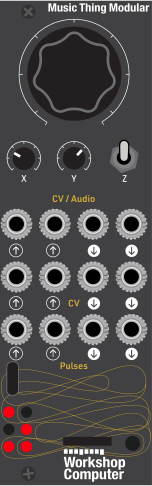 PitchLock / FM amountScale / Symmetry mod depthFMSync sourcePitch CVSymmetry CVSequencer clockOscillatorSequencer noteCycle gateSequencer LSB
Controls
Pitch
Oscillator pitch in every switch position. 5 octaves, C1 (32.7 Hz) at full counter-clockwise to C6 (1047 Hz) at full clockwise. CV In 1 adds to this.
Lock / FM amount
Switch up - Turing Machine loop lock. Clockwise = the 16-step loop repeats exactly. 12 o'clock = fully random. Counter-clockwise = the loop repeats inverted each pass (32 steps). Switch middle - FM amount. Soft takeover, so a knob does nothing until it meets the value that setting already holds.
Scale / Symmetry mod depth
Switch up - quantiser scale, eight zones left to right (chromatic, major, natural minor, major pentatonic, minor pentatonic, dorian, whole tone, root and fifth). Switch middle - symmetry modulation depth (how much CV In 2 moves symmetry; zero is no effect). Soft takeover. (Sync type, off / soft / hard, has no knob - see the Z switch, Down.)
Turing mode: Knob X = Turing Machine lock, Knob Y = quantiser scale.
Modulation mode: Knob X = FM amount (modulator on Audio In 1), Knob Y = symmetry modulation depth (how much CV In 2 moves symmetry).
Sync step / factory defaults: Momentary; X and Y do nothing while it is down. A quick press steps the sync type (off / soft / hard, source Audio In 2). Held for a full second instead, it restores the default drawing and settings on every page.
Inputs & Outputs
Inputs
Outputs
Inputs
FM
FM modulator. Moves the oscillator's pitch in proportion to itself; amount is Knob X with the Z switch in the middle. Reduced or off at high pitch or for very fast modulators.
Sync source
Sync source. Each rising zero-crossing soft-syncs (reverses) or hard-syncs (resets) the oscillator; type is stepped by a quick press of the Z switch (held a full second instead, it is factory defaults).
Pitch CV
Oscillator pitch, 1 V/oct, added to the Main knob. Reads as 0 V when nothing is patched.
Symmetry CV
Oscillator symmetry (the wave's midpoint), added to the page-4 symmetry fader by a depth set with Knob Y and the Z switch in the middle. At full depth +-5 V sweeps the full range; at zero depth this input does nothing. Reads as 0 V when nothing is patched.
Sequencer clock
Each rising edge steps the Turing Machine.
Outputs
Oscillator
The drawn wave, band-limited. About +-4.8 V for a drawn +-1.0 at full output level; cannot clip.
Sequencer note
Turing Machine note, quantised to the scale chosen with Knob Y, 1 V/oct, C = 0 V, 2 octaves (0 to 1.917 V). Patch to CV In 1 to play the oscillator.
Cycle gate
High during the first half of each oscillator cycle (useful as a clock or sync at LFO rates).
Sequencer LSB
The Turing Machine shift register's least significant bit, held between clocks.
LEDs
Page 1 (levels)
Lit while page 1 is showing. For a second after Knob Y changes scale, the top three LEDs show the scale number in binary (LED0 = 1, LED1 = 2, LED2 = 4).
Page 2 (times)
Lit while page 2 is showing.
Page 3 (curves)
Lit while page 3 is showing.
Page 4 (perform)
Lit while page 4 is showing.
USB / pick-up status
Slow blink = nothing connected yet. Steady dim = an 8mu or a laptop is connected. Fast blink = a fader on this page, or an X / Y knob, still needs to be moved through its stored value ("picked up").
Waveform
The output wave as brightness. Visible at LFO speeds.
README
Graphic Osc
Draw one cycle of a wave with eight faders (an 8mu, the web editor, or both) and play it as an oscillator.
Pages (8mu buttons A-D): 1 stage levels, 2 stage times, 3 stage curves, 4 performance. A fader on a page you have just switched to does nothing until you move it through the value that page has stored (the status LED blinks while any are waiting), so nothing ever jumps.
Symmetry bends the wave's midpoint smoothly; CV In 2 adds to the page-4 fader, by a depth set with Knob Y (switch middle).
The Turing Machine is clocked by Pulse In 1; CV Out 1 is the quantised note, Pulse Out 2 the register's LSB. With the Z switch up Knob X is the lock and Knob Y the scale; in the middle X is FM amount (Audio In 1 is the modulator) and Y is symmetry modulation depth (how much CV In 2 moves symmetry). Sync type has no knob: a quick press of the Z switch steps it (off / soft / hard, source Audio In 2); held a full second, it is factory defaults instead.
Full instructions, recipes for saw / square / triangle, and the anti-aliasing measurements are in the README.